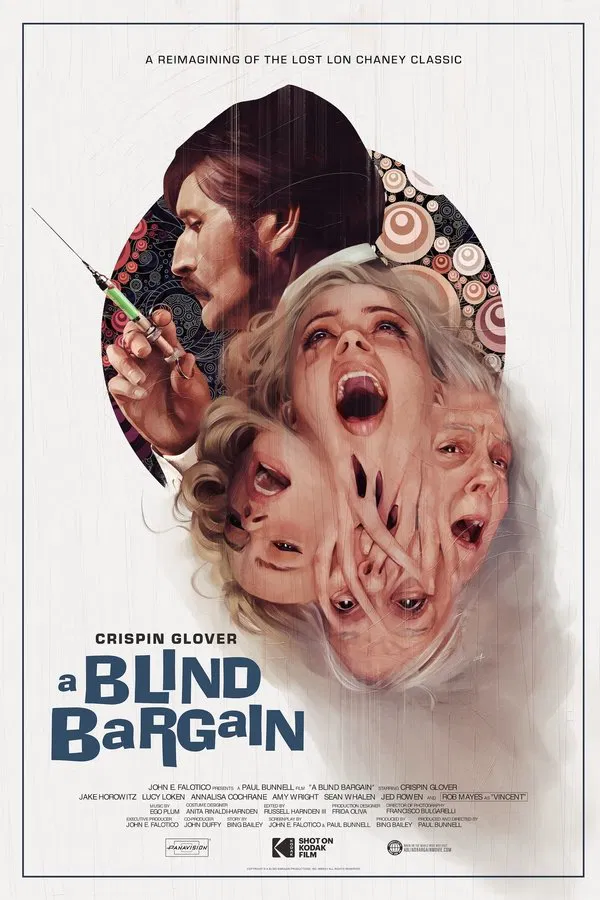
In 1922, acclaimed silent filmmaker Wallace Worsley would release one of his most famous directorial efforts, A Blind Bargain – a tale of mad science and medical malpractice which starred horror legend Lon Chaney as both the sinister Doctor Lamb and his creation, “The Ape Man”. Worsley drove the censors wild with his tale of man playing god an entire decade before the shock and sensation of Universal’s Frankenstein (1931) and Paramount’s Island of Lost Souls (1932). Tragically, A Blind Bargain would become lost to time when the only known surviving print of the film was destroyed in the 1965 MGM vault fire – but now, in 2025, audiences will finally get to experience this missing masterpiece of horror on the big screen at London’s FrightFest! Except this time, it stars Crispin Glover – who between this, the 2003 Willard, and The Wizard of Gore (2007), has made himself quite comfortable in the world of obscure cult horror remakes.
Let it be known that A Blind Bargain (2025) is by no means an attempt to faithfully reconstruct Worsley’s silent shocker as it would have been experienced by ‘20s audiences; director Paul Bunnell, best known for his ‘50s sci-fi parody / homage The Ghastly Love of Johnny X (2012), re-imagines the lost Chaney classic as a candy-coloured 1970s-set faux-sploitation flick, complete with trippy pop-art visuals and a curious meta-angle concerning the fading glory of Hollywood’s golden age. Bunnell’s Blind Bargain follows Dominic (Jake Horowitz), a recently-discharged Vietnam vet struggling with heroin addiction and criminal debts whilst attempting to care for his elderly mother, the silent screen star Joy Fontaine (Amy Wright). Following a visit to a rehabilitation clinic at his mother’s behest, Dominic is offered a solution to all his financial and medical woes by the mysterious Dr. Gruber (Crispin Glover) – but the offer comes with a price, one which would cost Dominic his morals… and his mother.
A Blind Bargain is an interesting and welcome attempt to re-envision a piece of lost media that cinema fans have eagerly wanted to experience for over half a century, but as with Dr. Gruber’s experiments, the results might not be exactly the ones you were looking for.
For a “re-imagining” of a film which modern viewers can only imagine in the first place, given how few remnants of it exist in the present day, it’s a little surprising to see just how much of A Blind Bargain’s source material was changed or reworked for Bunnell’s remake. Beyond the fact that none of the characters retain their names from J.G. Hawks’ script for the 1922 original, this remake also eschews said film’s central gimmick of having Glover play a dual role as both the doctor and the “Ape Man” – the latter role, bizarrely, being entirely absent from the 2025 version. Even the titular “blind bargain” is different, changing from a deal made with unforeseen consequences into a fairly directly unethical decision that just happens to go in some strange additional directions. Seemingly all that remains of the original A Blind Bargain in this new version is a handful of character archetypes and the same vague plot structure, so viewers excited to see the shocking images and moments that had the censors clutching their pearls back in 1922 will likely be disappointed outside of the film’s climactic sequence.
However, the re-imagined A Blind Bargain does also feature some interesting and curious additions. Joy Fontaine’s past as a silver-screen vamp gives Bunnell’s film an interesting meta touch, and her odd one-sided relationship with Gruber’s hulking manservant, Logos (Jed Rowen) – who fell in love with her through watching her classic screen performances on late-night horror host shows – is one of the picture’s most charming and compelling elements; it’s also through this element that the film manages to sneak in a couple of fun references and nods to the original’s star, Lon Chaney, as well as the silent era of filmmaking as a whole. Also of note are the snippets of stylish animation which pop up during a few of the film’s more hallucinatory sequences, as well as the convincing ‘70s-style production design and set décor which helps to sell A Blind Bargain as a period piece.
The intent behind Bunnell’s remake is a very honourable one, and it’s clear that a lot of effort was made by the cast and crew of this film in bringing it together, but for all that I wish to praise the various strengths of its production, the final result is a bit of a messy affair. A Blind Bargain is a film with an identity crisis, compiled of several different disparate parts stitched together in a way which leaves the otherwise well-crafted film feeling at odds with itself. Its origins as a resurrected version of a piece of lost ‘20s horror media feel disconnected from the tongue-in-cheek ‘70s exploitation homage (with occasional ‘50s and ‘60s genre parody elements thrown in) that the film stylistically and tonally wants to be. Straying further from either of these tones and approaches, the latter half of the film takes some odd detours into the realms of Lynchian “Hollyweird” surrealist fantasy and age-related body horror a’ la’ The Substance (2024), a large amount of which end up having very little impact on the film’s direction or overall narrative (if they aren’t practically forgotten altogether). Even the film’s lead, Dominic – whose moral dilemma kickstarts and is the central focus of the film’s plot – disappears for large stretches of time, and it never really takes the time to grapple with the consequences of his “blind bargain” and the effect it has upon him.
A Blind Bargain is an interesting and welcome attempt to re-envision a piece of lost media that cinema fans have eagerly wanted to experience for over half a century, but as with Dr. Gruber’s experiments, the results might not be exactly the ones you were looking for. Its throwback aesthetic and classic horror references will likely engage and entertain the festival crowd at FrightFest, but I can’t help but feel like A Blind Bargain could have delivered more on the promises it made.