The famous quote about movies is that they are an “empathy machine”, and personally I believe that is at it truest within the genre space – whether it be marginalised voices or something from an otherwise culturally “uncharted” part of the world – horror has it all. Whenever I see a movie from somewhere for the first time, 9 times out of 10 it’s going to be horror that is responsible – whether this is because the horror crowd is more open minded or maybe it is because every culture has their own folklore and myth ripe for interpretation? I’ll leave that up to you, reader. However, thanks to Fantasia, it has happened again, I have never seen anything from Kyrgyzstan before and here we are, with Burning (Ot), charting the cinema from this China neighbouring nation for the first time.
Using the formula made famous by Akira Kurosawa’s Rashomon, Radik Eshimov’s Burning sees a family home engulfed in a gas explosion, an explosion which threatens to consume the nearby buildings, a dramatic lashing that summons a narratively appropriate storm. Some locals take refuge in a neighbourhood shop where three onlookers regale a group of locals about events as they saw them; each is subtlety different, but each takes on the guise of a different sub-genre. The first is a religious horror that takes on board the psychotic mother-in-law concept, the second is a demonic possession piece and the final is much more domestic and upsetting. All three pieces revolve around the husband (Omurbek Izrailov), his wife (Aisanat Edigeeva) and the husband’s mother (Kalicha Seydalieva), a family grieving after the accidental death of a child.
Let’s hit on some universal truths, shall we. The performances of the main players are stellar, with each actor taking turns to be victim, middle man and the instigator. Across every genre reset there isn’t a single weak link, the emotions hit hard and beautifully. With each cast of the die, each antagonist becomes genuinely unsettling through their physicality – Seydalieva has a deadpan, lifeless detach, Edigeeva has a maniacal viciousness that wouldn’t be out of place as a Evil Dead deadites, and Izrailov – he does real-world evil about as convincingly as I have ever seen.
On a technical level, Burning impresses too. The cinematography amplifies the horror and makes a small bungalow-like home feel vast enough to never feel overly familiar or repetitive. With so much of the storytelling being dictated by lines of sight, the selective framing too presents some visually satisfying revelations. If that weren’t enough of a tell of quality, every repeated visitation almost entirely changes the visual language up. The mark of a great cinematographer is being able to achieve a lot through minimal means, and Kerim Kasymaliev does that with aplomb. Similarly, lighting in the open woods is a technical nightmare for low-budget productions, and not only are many of the typical pitfalls evaded it appears to be shot using natural light too. It’s very hard to either imitate the impression of natural light or make it look as clean as it does here, so kudos has to go to the lighting team too.
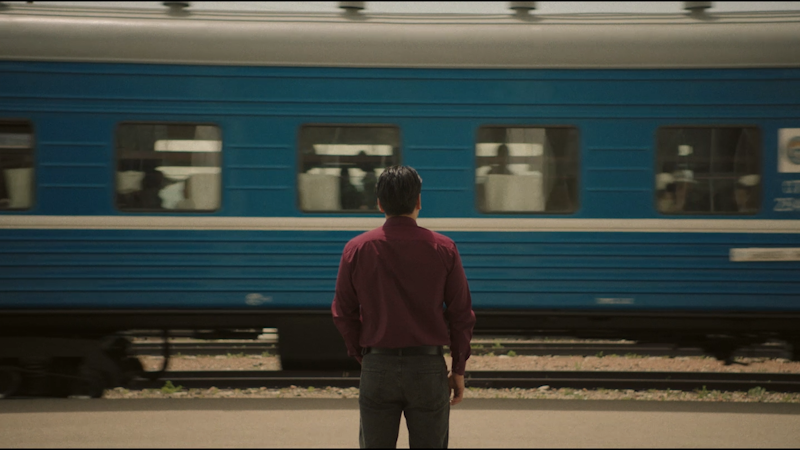

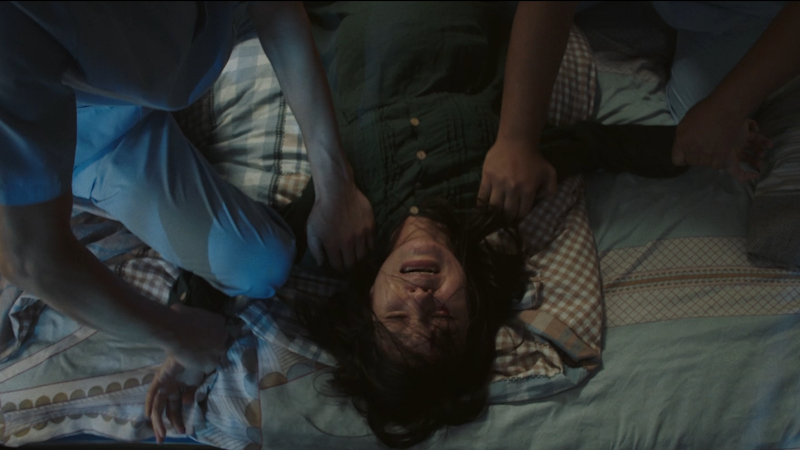
Let’s jump back and take a look at those individual interpretations recalled by the villagers. While they question any suspension of disbelief at times, given how intimate the moments they often recall are, but to pick on Burning for that oversight would be an incredibly mean-spirited take.
Events repeat whereby the mother-in-law arrives, she is driven to the home where her husband is, the wife forgets to put her headdress on, there’s a first meal, a night incident in which the wife observes someone watching her, the husband leaves for a few days, the ailments of the wife get worse, there’s a second meal prepared by the mother-in-law which comes to an unceremonious end by projectile vomiting, events escalate a little more with the husband absent, the husband returns and tells that the local exorcist is on his way (they use a different title), the husband shows the mother-in-law a room in their house kept behind lock and key, there’s a failed exorcism, the wife runs away into the woods, she’s captured, returns, wakes after a short nap, runs to the kitchen, and then boom. You’d think that would get repetitive, especially contained space, but credit to the genre deviations, the incredible acting prowess and cinematography to keep things fresh. When it does feel like another run through would be too much, Eshimov offers the third retelling as a speed run. The more fantastical presentations need their space, the last go around is just upsetting – so, the brevity is appreciated to prevent this from being a real “day-ruiner”.
I feel like I skimmed over a point a little brief in that plot DNA there: there’s quite a bit of vomiting in Burning – an anatomical reality that makes some people feel very queasy, as such, it needs to be flagged for the sensitive.
Ultimately, it’s no great surprise that Burning received so many positive reviews (especially from the audiences) from its run at Fantasia, as its a haunting, unforgettable movie that does so much with so very little that its hard to not come away impressed. And, it’s not often you get to say something like this without it reading like wafer thin hyperbole, but both it and Radik Eshimov have put Kyrgyzstan on the global stage, and I for one can’t wait to see more.