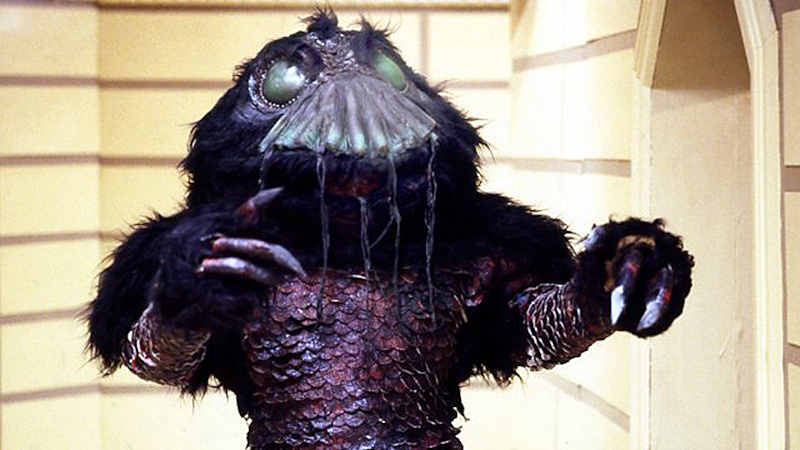
The Creature from the Pit is the kind of story title that points so clearly towards a particular tone, a series as iconoclastic as Doctor Who is duty-bound to undermine it. Much as the revival series’ Mummy on the Orient Express turned out rather more grave than its tongue-in-cheek moniker, so David Fisher’s third script for the show has an EC comics title but is actually Season Seventeen’s second overt comedy after City of Death.
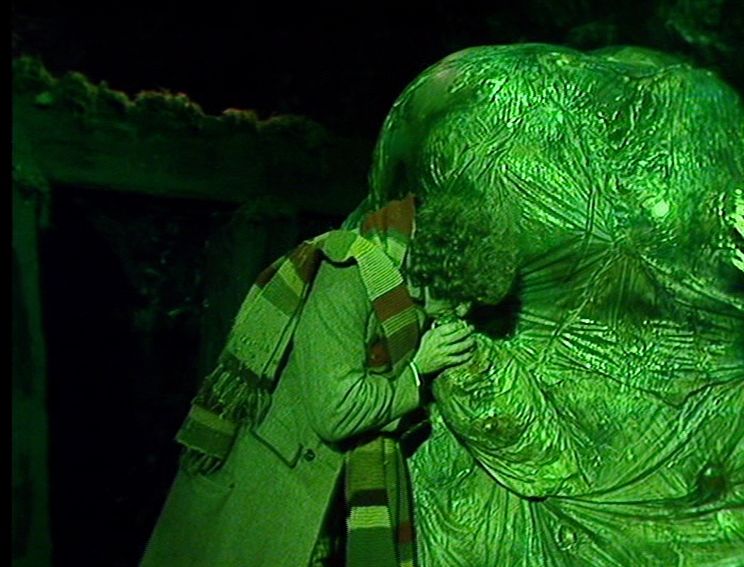
The reason why City of Death is remembered – justly – as one of Doctor Who‘s all-time masterpieces and The Creature from the Pit isn’t might come from an inability to make it clear to the audience that the humour is intentional. Certainly the serial’s most celebrated belly-laugh is something the production team didn’t foresee – the design of the titular monster, Erato. Fisher’s script specified that the appendage coming from Erato’s body was not a tentacle, perhaps looking to avoid a horror cliche. In the end, the combination of the stubby limb and Erato’s blobby form makes the creature look unmistakably like a huge green penis and scrotum. The moment where the Doctor blows into the end of the limb – a reference to the then-famous TV dog trainer Barbara Woodhouse – is justly notorious, while Erato’s apparent attack on the Doctor in the cliffhanger to episode two looks like Tom Baker is being teabagged by the Incredible Hulk.
It’s not the best final story for Christopher Barry, a director whose involvement with the show dates all the way back to 1963’s The Daleks. He rather ungallantly blamed Fisher for the design of Erato, and he clashed with Baker and Lalla Ward over their performances too. Two seasons ago, an internal BBC Drama Department memo had complained Baker’s humour was increasingly coming at the expense of any sense of reality or suspense in the narratives. Here, we are introduced to the Doctor as he reads Peter Rabbit with K9 (voiced with irritating over-emphasis by David Brierly rather than John Leeson) and riffs off a huge ball of string which he claims he helped Theseus escape the Labyrinth with. It would be fair to say that memo was not heeded.
it is worth noting that even before the big green wang makes its first bow there is an awful lot of kink in here.
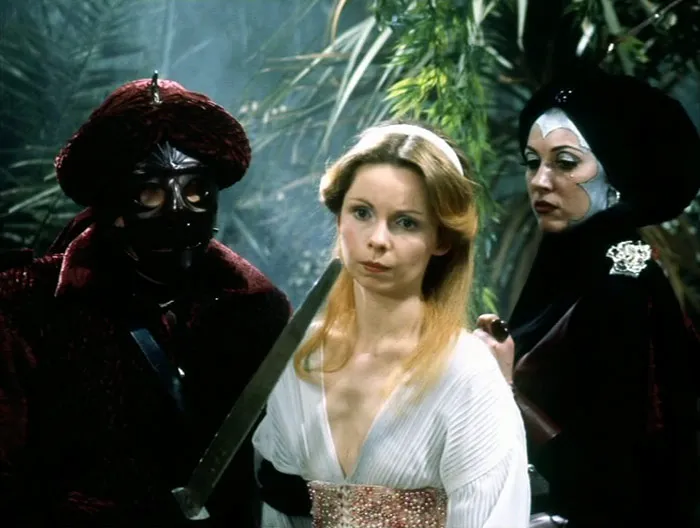
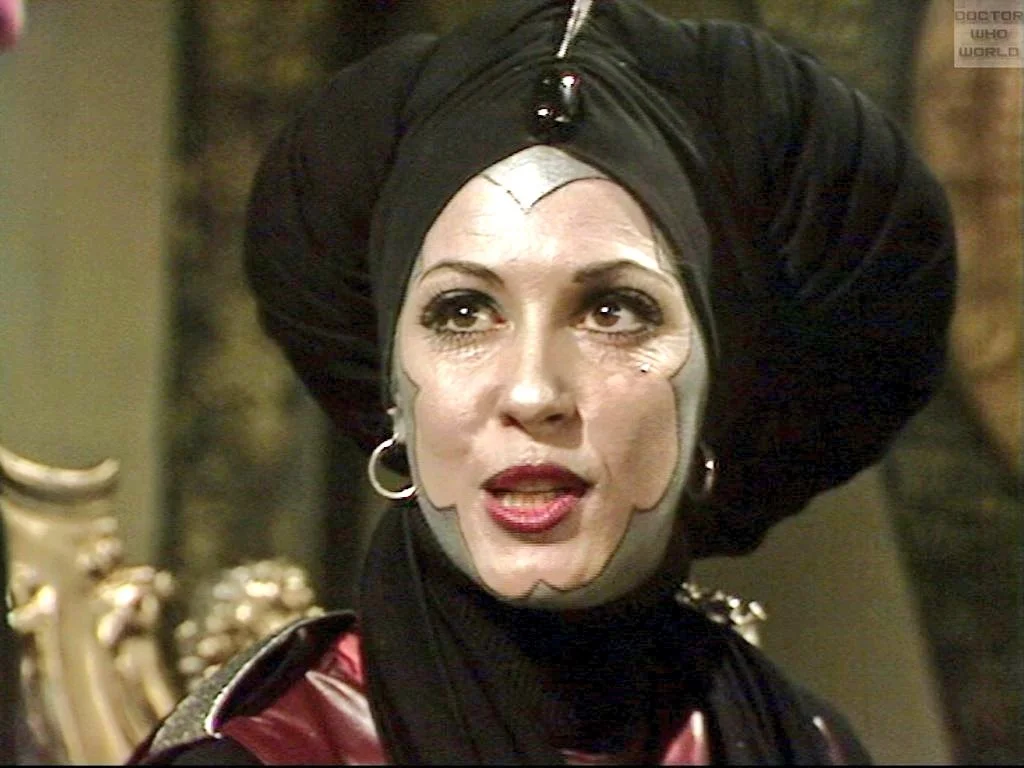
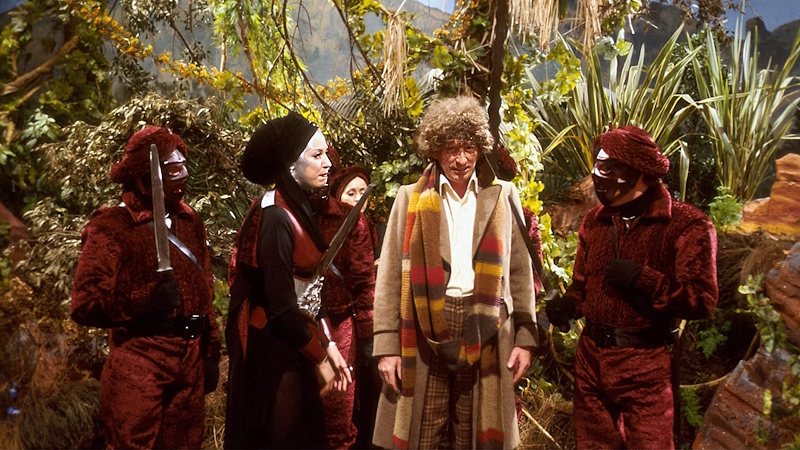
Instead, producer Graham Williams and script editor Douglas Adams seem to have decided that if Baker can’t be reined in, the show might at least follow him out into the wilds. For all Baker and Barry’s vision for the serial couldn’t be reconciled, both men successfully stamp their personality on the show. The monsters might be risible but Barry makes the jungle planet of Chloris look surprisingly atmospheric, worthy of comparison to the alien jungles that have appeared in Tom Baker’s era in stories like Planet of Evil and The Face of Evil. Barry must also have been pleased with the costume design by the superb June Hudson, creating outfits that evoke feudal power and medieval serfdom while using the bare minimum of metal.
The reason for this absence is tied to the biggest twist in Fisher’s script. Erato, it emerges, is an ambassador from a planet of plant creatures who photosynthesise metal instead of carbon dioxide. He hopes this biological quirk will make him welcome on the metal-starved planet of Chloris but the planet’s ruler, Lady Adrasta, thinks otherwise. Her power is based on controlling Chloris’s metal reserves with a fist made of… something nobody on Chloris can afford, I guess, and Erato is a clear threat to that. The political subtext of The Creature from the Pit is best addressed by Elizabeth Sandifer, whose post on the story reminds us that, underneath the cuddly surface of the Williams era, the Fourth Doctor is becoming a more and more overtly revolutionary figure. She notes that, while it’s true that The Creature from the Pit resembles the Star Trek episode Devil in the Dark, the conclusions to both stories reveal the differences in these shows’ world-views. In Star Trek‘s liberal future, the happy ending involves mining conglomerates learning to be more considerate of other life-forms. Doctor Who argues the whole system should be burned down.
For many, the idea of considering the political subtext of The Creature from the Pit will be absurd, yet for most of the run-time Fisher and Adams keep a surprisingly tight grip on the script. If this story was as bad as its reputation, it wouldn’t have birthed such a remarkable number of memorable quotes; the Doctor’s claim that he can achieve anything with “a teaspoon and an open mind” was borrowed for the title of Michael White’s well-loved book about the series’ science, while the exiled astrologer Organon – played by Catweazle himself, Geoffrey Bayldon! – wonderfully describes his business as “the future foretold, the present explained, the past apologised for”.
I couldn’t help but notice Organon’s name is one letter shy of Orgonon, the ranch where the eccentric sexologist Wilhelm Reich spent the later years of his life (and which is name-checked in the first line of ‘Cloudbusting’ by Season Nineteen writer Kate Bush). Erato, too, is named after the Greek muse of erotic verse; while “erotic” in ancient Greek could mean anything that was pursued for its own enjoyment rather than simply sexual pleasure, it is worth noting that even before the big green wang makes its first bow there is an awful lot of kink in here. The leather-clad Adrasta rules with the assistance of a whip-cracking henchmen, and her hench, er, plants the Wolfweeds seem to nuzzle their victims rather than attack them. Might this, too, be part of the deceptively purposeful subtext of The Creature from the Pit? Or am I overly distracted by the scene where a never-more-glamorous Lalla Ward as Romana subdues her captors simply by ordering them to sit down, as though they were disobedient dogs? It can be so hard to read these things.
Next: Nightmare of Eden (1979)