We’re at the penultimate serial of Jon Pertwee’s Third Doctor, so it’s probably time to tackle the burning issue of his tenure head-on: is he a toff? The Third Doctor, his detractors say, is the establishment Doctor, “The Pompous Tory” in the words of seminal fan blog Adventures With the Wife in Space. For all he was my childhood favourite, it’s hard not to see where the critics are coming from. There are plenty of Doctors who have an aristocratic air, but the Third Doctor is the only one who seems to revel in it, to take pleasure in how his bearing and accent allow him to steamroller through human society. Those last two words, though, hint at why I have a more forgiving view of Pertwee’s era. The fact that the Third Doctor spent the majority of his tenure on Earth means his opportunities to enact revolutionary change are stymied, firstly by our knowledge of human history and secondly by what level of political radicalism the BBC will accept in a teatime family adventure serial. Even if the writers wanted the Doctor to intervene in apartheid South Africa or Britain’s entry into the EEC, those scripts would never have got past the Head of Drama Serials’ desk.
I chose those examples deliberately, because the Pertwee era actually includes two explicit outer-space allegories for apartheid and the EEC – The Mutants and The Curse of Peladon, the latter of which The Monster of Peladon is a direct sequel to. So the stories set on alien planets become the political conscience of the Pertwee era, a test which The Monster of Peladon unfortunately flunks very hard. Since this is a sequel, the Doctor enters the action looking to meet up with the royals and diplomats he met before, rather than the suffering proletariat his successor would gravitate towards. Towards the end of episode one, there’s an astonishing moment where the Doctor warns Peladon’s Queen Thalira there’s going to be a rebellion if she’s not careful. It’s not a full-on dismissal of the underclass’s concerns, but even so it’s hard to imagine the Fourth Doctor bothering with the warning.
The Curse of Peladon was at least set entirely among the elite, with the ordinary people of Peladon reduced to noises off. It might have left something to be desired politically, but it made for more satisfying drama. Making The Monster of Peladon into an allegory for the 1974 miner’s strike means we have to see a full panorama of Peladonian society here, which writer Brian Hayles isn’t up to. For a start, it’s hard to buy Peladon as a society of deep division and inequality when there are roughly three castes and they all seem to live a short walk away from each other. That’s a production limitation, though. Hayles’s earlier The Ice Warriors had even fewer locations, but came up with a decent range of characters who felt plausibly alienated from each other when they needed to be.
The Monster of Peladon keeps failing this test, not least when it depicts the miners. The miners in The Monster of Peladon are one of the great guest-cast failures of classic Who. It is almost impossible to remember which miner is which, partly because of their flat performances but also because they’re all wearing fuzzy badger-striped wigs that tend to draw your attention away from… well, from literally anything else in the scene. Even Pertwee’s uncharacteristically horrible snot-green shirt can’t distract you from the memory of Harry Hill’s Badger Parade. Given that, as the story rolls through its overlong six episodes, it becomes increasingly invested in power struggles and hidden agendas among the miners, this is a huge problem.
Of the other guest stars, only Donald Gee’s Eckersley manages some form of complexity. Nina Thomas’s Queen Thalira is a terrible drip who needs to be given a pep talk about female empowerment by Sarah Jane Smith, despite the fact that she’s, y’know, the Queen. Ysanne Churchman’s Alpha Centauri remains committed to puncturing any kind of gravitas a scene may contain. Then, halfway through, Hayles throws the Ice Warriors into the mix, returning them to the villainous characterisation he’d subverted in The Curse of Peladon. This might have worked if it was a double-bluff – if they were there from the start and we didn’t suspect them because of the twist in the last Peladon story. Instead they just turn up at the end of episode three and immediately start shooting people and hissing “ambassaDOOOOORRR”, in the way classic series Doctor Who monsters do.
Really, whatever the shortcomings of the production – and there are many, including an infamously obvious stunt double for Pertwee and tatty-looking Ice Warriors that are thrown around like rag dolls – the curse of The Monster of Peladon is Hayles’s script. It’s one of those Doctor Who scripts where people are captured, escape, are recaptured, switch sides, betray their friends, have swordfights, etc. not for any plot or character reason but because there’s six episodes of this to fill and they have to get to the 150-minute mark somehow.
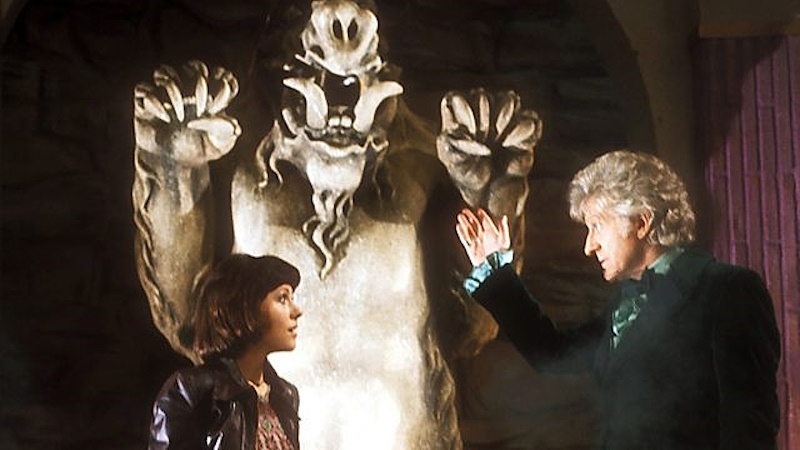
The laziness of the script can be measured by its treatment of Aggedor, the monster of the title. We’ve seen Aggedor before in The Curse of Peladon; here, the very first scene establishes that the miners worship it, and someone is using a hologram of the creature to assert control over them. Having firmly, unambiguously set up that power over Aggedor leads to power over Peladon’s underclass, the Doctor and Sarah Jane then meet and subdue the real Aggedor… and this is never mentioned again until the very end of the story. At no point during his long, dull negotiations with the badger-haired burrowers does the Doctor think to mention this, presumably because it would bring the story to an end two episodes earlier. Maybe this is the worst instance of the Third Doctor’s complacency; we could have got two more episodes of The Time Warrior if he’d been a bit more proactive.
Next: Planet of the Spiders (1974).