Part of the fascination I have with things that run as long as Doctor Who has is that it repeats; to you, it might be mere repetition, to me it’s an endlessly fascinating series of variations that shapes the story. There may be, for instance, a parallel universe where only the nerdiest comic book collector can remember a one-off Batman villain from the 1940s who dressed up as a clown. In our universe, the Joker is Batman’s principal nemesis, and we can all say why: he represents the chaos to Batman’s order, just as the Daleks represent the totalitarianism and intolerance that the Doctor, the ultimate wanderer, rejects. True enough, but Batman has a lot of chaotic villains, and Doctor Who has a lot of fascist ones. The Joker and the Daleks must return because they’re popular, and it is the process of bringing them back that transforms them from an example of an ideology the hero rejects into the embodiment of it.
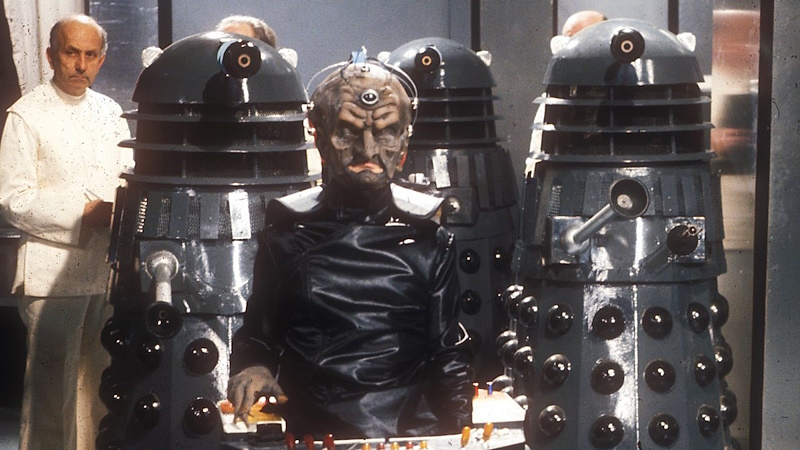
The Daleks were coded as fascists ever since their first story, where they raised their plunger arms in Nazi-style salutes and hailed the glory of atomic war. Even so, once they became pop culture icons the show might have shied away from that, in the same way that Freddy Krueger slowly changed from a child killer (and possible child molester) into an impish pun machine. Instead, we find ourselves here in Tom Baker’s first season, exploring their origin in a brutal nuclear war as genetic experiments performed by their Strangelovian creator Davros. Davros has a right-hand man called Nyder, played with real, brusque menace by Peter Miles. Nyder wears Himmler-style glasses and an Iron Cross, or at least he does for the first two episodes. Once BBC Standards and Practices spotted the Iron Cross, he did not wear it any more.
This would be bracing enough from a hot young writer looking to reinvent one of the series’ sacred cows, but this is written by the Daleks’ creator Terry Nation. It is one of the most staggering glow-ups in Doctor Who‘s history when you remember that his last script was Death to the Daleks, a drab, sluggish remix of decade-old ideas. The jump in quality here is so vast that some fans have theorised the incoming script editor Robert Holmes was responsible for this script. It’s true that Holmes performed a lot of extensive, uncredited rewrites during his time as script editor, but watching Death and Genesis back-to-back reveals how the latter is as much a quintessential Nation story as the former. It’s still set in isolated bunkers, full of war-movie tropes and characters called things like Ronson and Tarrant; anyone with a Terry Nation bingo card will have filled it out by episode four. This time, though, all these familiar ingredients are animated by storytelling discipline and genuine purpose.
The difference between Death to the Daleks and Genesis of the Daleks can best be illustrated by their treatment of killer viruses. Death has an actual, planet-wide plague, while Genesis has a scene where Davros idly fantasises about creating a virus that could wipe out all life in the universe. The former should be scarier, but it’s the latter that chills. Much of the credit there has to go to Michael Wisher, whose performance as Davros is extraordinary. Later scripts would characterise Davros as a ranting megalomaniac, but Wisher’s quietness is as menacing as any other actor’s screaming. When he does raise his voice the sound crew treat his voice with a very slight, subtle dose of the same metallic effects used to create the Daleks’ voices: a wonderful touch.
Indeed, the most frightening thing about Genesis of the Daleks is the sense that the Daleks are inevitable. Not just because this is a prequel, although that does give Davros’s confrontations with other Kaleds a hideous, deathly quality; since we know he succeeds in creating the Daleks, it’s safe to assume that anyone trying to stop him is about to come to a terrible end. They are also inevitable because the mindset that created them has already taken root. Davros might look like a deconstructed Dalek, in his mobile life-support system, but even the more human-looking of his fellow Kaleds are already barking Dalek-style statements about genociding the Thals. The Thals, too, are portrayed in an unprecedentedly cynical fashion. The first Dalek story’s critique of fascism is blunted somewhat by the Thals being Aryan beauties while the Daleks are ugly robots. Here, they not only look the same, they frequently act the same. There’s a subplot where Davros pretends to seek a truce with the Thals, which in any other story would make them look idiotically naive. It works here, because the usual moral chasm between Davros and the Thals has been downgraded to more of a moral crack in the pavement.
Everything is working here: the cast is great, the script is great, David Maloney’s direction imbues the Daleks with a kind of heaviness and menacing presence they haven’t had since The Dalek Invasion of Earth. There’s also Tom Baker in the performance that might just have cemented his legend. In his first story, Robot, he’s anarchic and charismatic, which he’s always been good at. Then for the next two stories he’s brooding and distant, which he’s also always good at. Genesis of the Daleks, though, is the one where he successfully blends these into a full character. It’s one of the least funny Doctor Who stories, and rightfully so – it’s hard to think of a previous serial with as many on-screen murders as this. But there are two moments where Baker smiles, and that’s all it takes to persuade you this mission to prevent the Daleks’ creation is going to work out fine. Even if we know that, in the long run, it doesn’t.
Next: Revenge of the Cybermen (1975).