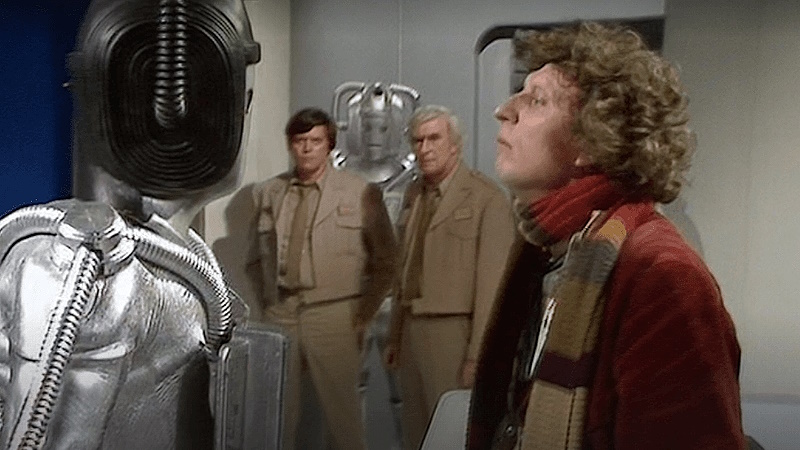
Revenge of the Cybermen is a real oddity. It’s not an oddity because it’s the only Tom Baker Cyberman story, or even because it’s the only 1970s Cyberman story, though these are the clearest symptoms of its true underlying strangeness. And it’s not odd simply because it’s a Patrick Troughton base-under-siege story plonked down at the end of Tom Baker’s first season. If anything, this is the part that makes the most sense. The new script editor and producer, Robert Holmes and Philip Hinchcliffe, are looking to re-route the show back towards the claustrophobic, paranoid horror territory it last occupied during Troughton’s tenure. It’s easy to understand why they’d get a writer associated with that period of the show back to write a new story with Troughton’s emblematic monsters, the Cybermen.
Revenge of the Cybermen isn’t a straight retread of Gerry Davis’s earlier Cybermen scripts, in the way that Terry Nation’s Dalek scripts for Jon Pertwee were. There is lip service paid to the show’s increasing sophistication: if this story was actually made in the late ’60s it would spend all four episodes on the situation on Nerva Beacon, whereas Revenge of the Cybermen at least introduces a third faction in the shape of the Vogans, a race living on a golden planet who believe themselves to have vanquished the Cybermen in a prior war.
One of the most visible issues here is that the Vogans are rubbish, generic sci-fi aliens from the name down. (Douglas Adams seems to have used a variant spelling of the same name in The Hitch-Hiker’s Guide to the Galaxy without realising it had been used in Doctor Who, which kind of illustrates the problem) The first scene involving them ends on a staggeringly hammy reaction shot that director Michael E Briant lingers on for far too long, and they don’t improve from there, despite the presence of Who stalwarts like Kevin Stoney and Michael Wisher among the cast. The Vogans are aloof, dome-headed humanoids whose leader speaks in a voice weirdly similar to Tony Benn; even in the context of 1950s science fiction they wouldn’t stand out as a fresh take on the sophisticated alien archetype. It is also slightly unfortunate that Wisher’s character is called Magrik, and every time his fellow Vogans refer to him by name you have to take a second to realise they’re not saying “Margaret”.
This is pretty funny, but it’s hardly the core problem with the story. After all, nobody is watching a story called Revenge of the Cybermen for the Vogans. The thing is, even with the aforementioned flaws, when the Cybermen actually enter the story halfway through they make everything worse. Up until this point, Revenge of the Cybermen chugs along quite pleasantly. It wouldn’t have been a classic if it had continued in this vein – it would still probably have been the worst story of Season Twelve by a comfortable distance – but it wouldn’t have been a stain on Hinchcliffe and Holmes’s otherwise flawless record. But the introduction of the Cybermen is meant to kick the threat level up a notch, and instead it makes the situation actually less fraught.
This is, infamously, the story where we discover the Cybermen’s allergy to gold, a weakness which followed them around for the rest of the classic series but no 21st-century writer has yet seen fit to bring back. Despite resting the whole story on this weakness, Davis still has Cybermen teleport down to the gold-covered surface of Voga without any protective gear whatsoever, making them embarrassingly easy to pick off. (As a side note, this is one of those stories where, judging by how many humans punch or kick the Cybermen, the director just forgets they’re meant to be made of metal) Their plan is to blow Voga up, scattering its fatal gold across the galaxy in billions of fragments, which is sort of like trying to get rid of anthrax using a hairdryer. They are prone to doing things like tying the Doctor and Sarah up using thin electrical cable, then acting surprised when they manage to escape – and the operative word here is acting, with Christopher Robbie’s Cyberleader strutting around with his hands on his hips tossing out Bond-villain one-liners. It’s no wonder that the Doctor – and it should be noted that Tom is on good form here, despite everything – can’t take them seriously. He takes an unwholesome glee in threatening the traitor Kellman with a badly-redesigned Cybermat (it looks like a big silver kipper) and mocks the Cybermen as “a pathetic collection of tin soldiers skulking around the galaxy in a worn-out spaceship!”
And this is where we get to the truly odd thing about Revenge of the Cybermen – it is a Robert Holmes-era story that’s made worse by Robert Holmes’s script editing. Some people would argue that The Android Invasion is as bad as this, but the script issues there are usually blamed on Holmes not paying enough attention, rather than too much. Davis complained that the Cybermen in Holmes’s drafts were too emotional, and he was right. The impassive rationality of the Cybermen just isn’t in Holmes’s wheelhouse; he prefers villains with a theatrical flair, a flamboyant psychosis, even when they’re completely non-corporeal like the Mandragora Helix. Even the title betrays the problem: Holmes would prefer to be writing a villain who is interested in revenge, rather than a villain who’s interested in nothing.
This isn’t to say that Davis’s script would be a masterpiece without Holmes’s involvement. A Cyberman story that is slavishly faithful to their 1960s persona would probably be pointless by 1975, and you could make a case that Davis’s vision for the Cybermen has already ran its course. The Daleks, the monsters whose shadow they’re fated to live in, represent fears that are sadly still current: of fascism, of eugenics, of nuclear war. The Cybermen were dreamed up by Davis and Kit Pedler as a reaction to “spare part surgery”, meaning as soon as artificial hips and heart valves stopped being regarded as a Promethean example of man’s hubris and started being regarded as life-savers this concept became useless. In the current series, this lack of a raison d’etre has freed up writers to deliver some surprising new takes on the Cybermen, using them to satirise consumerism (Rise of the Cybermen), explore ideas of death and afterlife (Dark Water), reflect a fear of capitalism without morality (The Next Doctor) or of progress itself (The Doctor Falls). But Gerry Davis is not the man you turn to if you want to reinvent a monster he co-created.
Arguably by the time of The Invasion, the Cybermen have already moved on from the horror of their initial, zombie-like appearance and become standard evil invading robots of the kind every science fiction franchise must have. The remaining years of the classic series would push this even further, and you can see this process beginning in Revenge of the Cybermen, where Robbie gets the odd stray “Excellent!” If we’re being charitable, Holmes is trying to drag them away from action-movie territory into the more Gothic areas he favours; you can imagine the Doctor making some variant of his “skulking around the galaxy” remark to Morbius, or Sutekh, or The Deadly Assassin‘s version of the Master, all of whom are villains who have seen better days. In those stories, though, there is a present and escalating threat that the villains won’t be powerless or trapped for long. With the Cybermen, it feels symptomatic of a bigger issue with these monsters, one which won’t be resolved until the 21st century.
Next up for all patrons: The Power of the Daleks (1966)