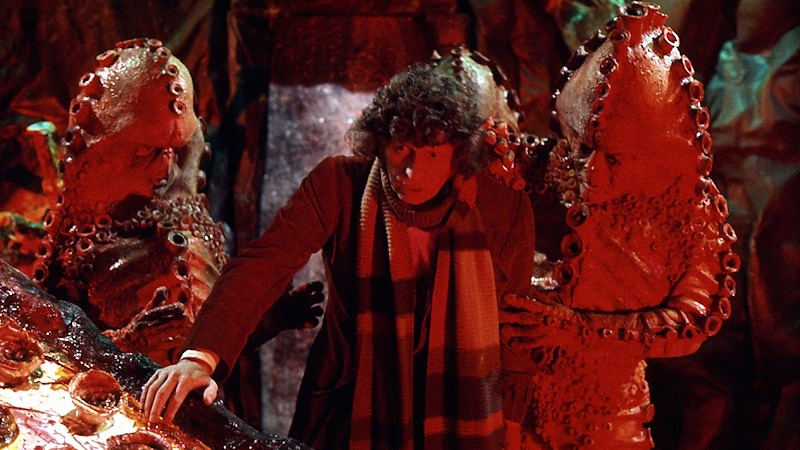
Terror of the Zygons is a rarity among classic Who stories, in that its masterpiece status is most often defended by pointing to its visuals. Classic-era Doctor Who fans, who normally find themselves in the position of declaring a haughty disinterest in special effects, have been known to go into raptures over how astonishingly convincing the Zygons look, how their costume barely needed updating when they came back for the 50th anniversary special, how everything from their whispery voice to their slimy, organic technology are so perfectly conceived (shame about their giant pet, the Skarasen, but you can’t have everything).
Just because a story looks cheap doesn’t mean it’s badly-written, but equally looking good doesn’t automatically equal style over substance. The question is not “does Terror of the Zygons look good?” – it does – but “does it have the ideas to back up its effects?”. On a strictly conceptual level, the answer is no. Terror of the Zygons is a souped-up Invasion of the Body Snatchers riff with a bit of Hammer Studios fog and the first of the series’ many (completely incompatible) explanations for the Loch Ness Monster. Even without the knowledge that the show is about to do a lot more stories like this, this isn’t an unprecedented list of inspirations for a Doctor Who story.
Except… This story was originally intended to close Season Twelve, but was pushed back to be the Season Thirteen opener when there was a change of planned air date. Season Thirteen therefore ended up bookended by Robert Banks Stewart stories with intriguingly skew-whiff takes on the Doctor’s role in human society, but that wasn’t the original idea. The original idea – and it’s strikingly obvious once you know where this story was supposed to fit – was to phase out the UNIT formula of the Pertwee years. Tom Baker’s debut season begins with an absolutely by-the-book UNIT story, where the organisation even provides the Doctor with his new companion, Harry. Then the Doctor would go off, have adventures all over the universe, and come back for both UNIT and Harry to be written out of the show in the season finale.
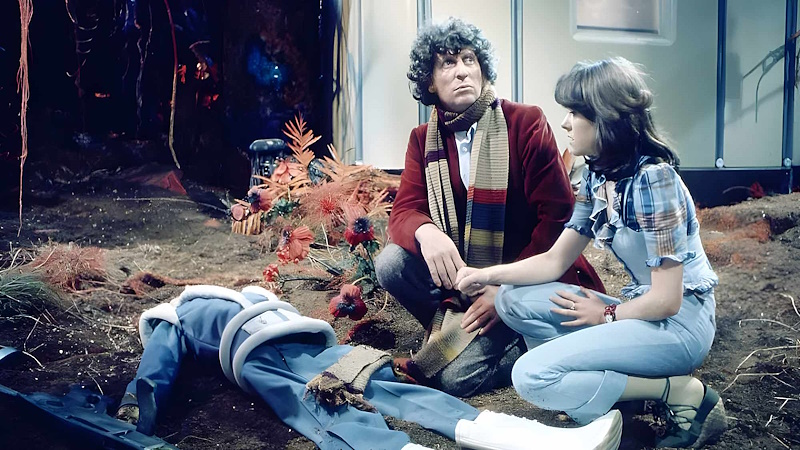
The late Ian Marter, who played Harry Sullivan, was by all accounts a lovely man, so presumably neither Banks Stewart nor script editor Robert Holmes are getting revenge on him by treating poor Harry like a pitbull treats a chew toy. Rather, it seems to be a product of Holmes’s own disdain for the UNIT set-up. There’s a scene where Harry is shot which goes a shade beyond the usual peril a Doctor Who companion is subjected to; for a moment, you wonder if the show is going to kill a companion for the first time since the Hartnell era. He survives, but he’s unconscious for long enough for the Zygons to produce a duplicate of him, leading to a genuinely unsettling scene of one of the Doctor’s companions stalking the other one around a shadowy barn, pitchfork in hand. It’s worth asking if a companion can really come back from having the actor playing them used – without make-up or any other visually distancing effect – as a source of fear.
That said, it’s not Harry’s fault that his Zygon duplicate is such a nasty piece of work. Rather, it’s because the Zygons themselves are astonishingly evil – the moral ambiguity that later stories such as The Day of the Doctor and The Zygon Inversion found in them is nowhere to be seen in their first appearance. Their leader, Broton, introduces himself to Harry with a rasped-out monologue about how they will easily conquer Earth, so there’s very little room for John Rawls-inspired negotiation or anti-war speeches here. Once the Doctor confronts them, though, he begins making snide jokes at their expense (“wave a tentacle”, “three of you”, etc.). Part of this is just the Doctor’s standard role in a story, to carefully deflate the threat before it all gets a bit too scary for the kiddies. But it’s also true that the Zygon’s plan isn’t that great. Their eventual tactic involves setting the Skarasen loose on an energy conference in central London, which, while it would doubtless cause a bit of a mess, is a serious step down from wanting to conquer the planet.
This all happens without any reduction in their threat level, partly because their aforementioned design continues to be effectively creepy. But it’s also because of Broton’s attitude; like Magnus Greel, Light or Madame Kovarian after him, he knows his plan has effectively failed, so he’s going to kill as many people as he can on the way out. It’s a petty, peevish kind of villainy, and it explains why this story was originally planned as UNIT’s final bow. Once, the Doctor and UNIT were heroes fighting monsters. Now there’s a new Doctor, whose values – which will be unforgettably demonstrated in Pyramids of Mars – are less human-centric, more alien. Called back to Earth against his will, he finds himself stuck in the middle of a conflict between small-minded, jumped-up humans and small-minded, jumped-up aliens. It’s no wonder that, as the Fourth Doctor’s tenure goes on, he finds less and less cause to return to our planet.
Yet, for all there is a strong element of critique here, the serial never stops functioning as a fine example of the kind of story it’s critiquing. The Zygons might ultimately be screw-ups, but they’re scary in both monster and human form. The effects team deserve their praise, but so does director Douglas Camfield, whose work here is as tight and ferocious as his previous zenith The Web of Fear. The end of episode one, which cuts before you’ve had the chance to gasp in shock, is a brilliant piece of work, but it’s the episode two cliffhanger that shows he’s a genius.
This involves the Doctor being pursued by a giant reptile monster across a real outdoor location in broad daylight, a short sentence which nevertheless contains at least fifty-three things that ’70s Doctor Who continually fails at. If this scene isn’t one of Terror of the Zygons‘s greatest set-pieces, it’s worth comparing to the comparable, infamously terrible model work in Invasion of the Dinosaurs, just one year earlier. Camfield keeps this chase – a chase between a healthy adult male and a basically immobile puppet – moving at a breathless pace, using swift, mobile cutaways to give the impression of the Skarasen bearing down on the Doctor, and even using what seems like a bit of stop-motion to animate the creature’s twitching tail.
It’s just visual spectacle, of course. We’re Doctor Who fans. We prefer more sophisticated pleasures. Except sometimes it’s worth stepping back and admitting that making a wildly overambitious low-budget TV show look this good isn’t a confidence trick, it’s an art form, and one the show has rarely pulled off as successfully as this.
Next: Planet of Evil (1975)