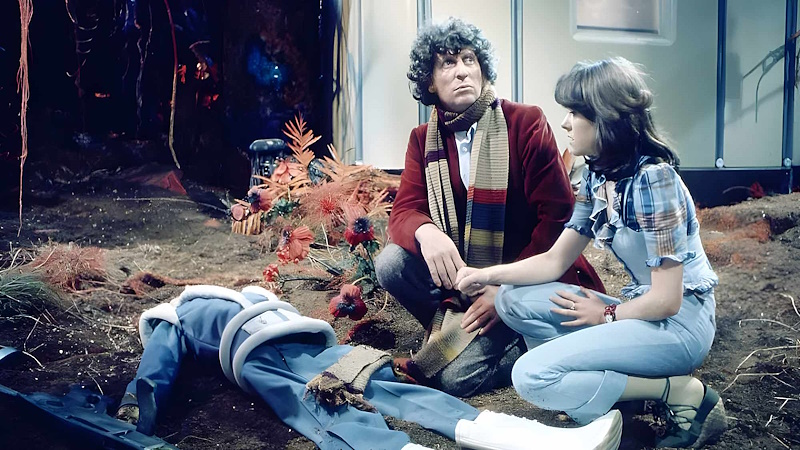
Season Thirteen is the first of two consecutive seasons where Louis Marks will turn in a very good script that nevertheless gets ignored because of all the consensus classics around it. Perhaps this is why he’ll leave the show next year, twelve years after his first story was broadcast. That story – Planet of Giants – looked like a one-off until he came back some eight years later with Day of the Daleks, and even if I didn’t enjoy Marks’s writing he would deserve credit for returning to the show after a long absence and effortlessly grasping the ways in which the show’s pace, tone and storytelling methods have changed. That has tripped up plenty of Hartnell-era scriptwriters before, but it doesn’t seem to bother Marks at all. There is a scene in Planet of Evil where Sarah asks the Doctor why they don’t just retreat to the TARDIS and leave the colonists on Zeta Minor to screw up by themselves. It’s the one moment where you remember that, when Marks started writing for this show, the Doctor would have been the one asking that question.
Sarah and the Fourth Doctor are well-characterised here, though there are only a few lines – the Doctor’s memories of Shakespeare, Sarah’s half-joking suggestion that they’re being chased by forest sprites – that stand out as quotable. This isn’t a limitation of Marks’s writing abilities – The Masque of Mandragora is full of cherishable dialogue – rather it’s an illustration of Planet of Evil’s storytelling priorities. This is a story about space exploration with a heavy emphasis on the exploration; in place of the usual verbal exposition about Zeta Minor, its environment and native threats, we get to see people walk around encountering things and conducting experiments in unusually long, visually rich scenes. This is an area which even modern, allegedly “cinematic” television rarely ventures into, and the actors seem energised by the challenge. Tom Baker and Elizabeth Sladen have already proved they can play these parts, but here they embody them.
It’s possible that this is one reason why Planet of Evil tends to be overlooked. Season Thirteen is full of very clever stories which are unafraid to shout about their cleverness, but this is barely speaking. When people do speak about this story, they mostly talk about it as an aesthetic triumph, particularly Roger Murray-Leach’s astonishing alien jungle set, which is shot on film in order to give it that true outdoor look. It is, indeed, a fantastic piece of work, but in the popular imagination “the one with the really cool jungle set” is never going to match up to “the one with the man-eating plants” or “the one where they do Frankenstein“.
This low-key quality seems to have facilitated a change made by producer Philip Hinchcliffe to Marks’s script, which is worth unpacking for the light it sheds on the story Marks is telling. It’s only one tweak – we’re not talking about the kind of page-one rewrites script editor Robert Holmes was performing elsewhere – but the fact that Planet of Evil is so accented towards unravelling a mystery means even a slight change to the ending has a huge retrospective impact. Hinchcliffe was concerned that, at the ending of the original script, the Doctor’s fight with the mutated Professor Sorensen ended with Sorensen simply falling into a pit and presumably dying. This might seem like a strange thing for Hinchcliffe to object to, considering how violent some of the other stories he produced are – indeed, in the next season the Doctor will purposefully push the Master into a similar abyss. But the Master is evil, whereas Hinchcliffe argued that Sorensen was simply possessed.
Going purely by the evidence of what’s on screen, Hinchcliffe is right. The mutation of Sorensen by Zeta Minor’s native anti-matter is clearly drawn from Dr. Jekyll and Mr. Hyde, with the make-up evoking the celebrated Spencer Tracy version of the story (a rare case of Hinchcliffe-era Who drawing from Universal horror rather than Hammer). It’s introduced with unnervingly weird, initially unexplained scenes of Sorensen’s eyes glowing red, but by the time Sorensen is drinking from a chemical flask that’s brimming over with dry-ice smoke the audience will have figured it out. Having got the reference, they will surely be expecting Sorensen to change back, or at least be a conflicted monster. But the final episode sees Frederick Jaeger, a fine actor, play the mutated Sorensen as a growling, slobbering monster and not much more. Was Marks’s original idea to add a twist to the Jekyll and Hyde story, by having Dr. Jekyll’s mutation be permanent and irreversible? If so, it’s telling how easy it was for Hinchcliffe to reverse it. The Brain of Morbius has a clever spin on Frankenstein – what if Dr. Frankenstein was re-creating life? – that the entire script is built around. Planet of Evil seems to have just thrown its main original idea out there and expected the audience to keep up.
Readers may have noticed that I’ve gone back and forth between describing Sorensen as “mutated” and “possessed”. It is occasionally debated whether Doctor Who is a real science fiction series, or a fantasy show in sci-fi drag. Russell T Davies and Steven Moffat are vocally of the latter opinion, and Planet of Evil offers plenty of supporting evidence for them. Initially, Zeta Minor is dangerous because it contains a portal to an anti-matter dimension, which is the kind of concept you could imagine turning up in one of Christopher H Bidmead’s later hard SF scripts. Bidmead would have balked at titling that script Planet of Evil, though. In this version of the show, a portal into an anti-matter universe is not a way to explore fringe scientific possibilities, it’s a way to explore underworld myths. By the time it’s gotten into its Robert Louis Stevenson borrowings, even the most literal-minded viewer will interpret the anti-matter as a metaphor for the evil of the title. The anti-matter may turn Sorensen into a literal monster, but something about this planet has also turned base commander Salamar into a metaphorical, power-crazed monster. Both of these feel like examples of the same process.
Doctor Who‘s other main story about anti-matter is Arc of Infinity, which is no-one’s idea of a model of dramatic unity but is fairly single-minded about what anti-matter does: it destroys matter, as chaotically as possible. Planet of Evil jumps around on that issue, but it still feels more coherent because it makes metaphorical sense. Arc of Infinity, after all, somehow gets to its final episode before remembering Omega was originally intended to be a mirror of the Doctor. Planet of Evil, by contrast, has a consistent and satisfying scheme where the colonists represent one world, the anti-matter represents another, and the TARDIS is pointedly positioned as the only force that can mediate between them. It’s an elegant restating of the series’s central promise: the idea that this magic box can journey between worlds. It’s not restated as loudly as it could have been, but a story doesn’t need to shout when it has such a fundamentally Doctor Who concept right at its heart.
Next: Pyramids of Mars (1975)