At the height of his early success, Terry Nation left Doctor Who to try and launch an American TV series based on the Daleks. He returned for the show’s tenth anniversary in 1973, when he wrote Planet of the Daleks, then followed it up a year later with Death to the Daleks. The most interesting thing about these two stories – indeed, possibly the only interesting thing about them – is that they are essentially William Hartnell stories. They’ve been made in colour and star Jon Pertwee, but they betray very little evidence that Nation had kept even half an eye on what was going on with his old show while he’d been away.
This is not a flaw unique to Nation. Indeed, when producer Philip Hinchcliffe and script editor Robert Holmes were tasked with replacing Pertwee, one of their strategies was to get some Hartnell-era writers back in, to help the new boy find his feet. And it just didn’t work. Gerry Davis turned in a generic Cybermen runaround, while John Lucarotti’s first draft had to be completely rewritten by Holmes. The exception, strangely, was Nation. Paired with Terrance Dicks, an excellent script editor whose essential sensibility was perhaps too close to Nation’s own, Nation was happy to coast on past triumphs. Paired with the daring, imaginative Holmes, he was inspired – inspired enough to create Genesis of the Daleks, commonly cited as the show’s best ever story.
The next year, he wrote The Android Invasion, which has never received such accolades. Watching it, though, I found myself wrestling with a strange emotion I wanted to deny, but couldn’t suppress. I watched Tom Baker and Elizabeth Sladen picked their way through an eerie, deserted rural English village, menaced by sinister figures in white and strangely distant locals. I saw director Barry Letts conjure up punchy, exhilarating action scenes, then switch gear for the subtler, folk-horror unease of the Doctor finding things about the village that were strangely… wrong. And as all this happened I began to wonder if it could be possible that The Android Invasion… was good?
And do you know, I think I might stick to that verdict. The most commonly cited problem is that the alien villains, the Kraal, have a plan that makes very little sense. Well, if we’re going to condemn a Doctor Who story for that reason, we should be prepared for a fair old clear-out. Pyramids of Mars, the story directly before this one, has a whacking great plot-hole – why does Sutekh need to transport his equipment to England, when it’ll presumably work just as well in Egypt? – but that hasn’t dented its classic status. In any case, the basic idea is convoluted but sound. The Kraals want to invade Earth, which they will achieve by destroying humanity with a lethal virus, but the virus is also lethal to them, so they create android servants to spread it. Fair enough. Smallpox is harmful to Europeans, but they still spread it to Native Americans.
Since these androids will operate on Earth, they create a facsimile of an English village to train them. The weaker nitpicks of the story – which are often on the feeble CinemaSins level of “why do the androids sometimes malfunction?” – can be explained by assuming the Doctor and Sarah have arrived mid-way through this process. It’s not explained very well, and it’s not clear why the Doctor thinks the Kraals could invade Earth by military force. They clearly can’t, that’s why they’re spending all this time messing around with androids and viruses. But it just about hangs together, and the detail that the Kraals are petrified of their own virus makes it an effective threat: here’s something even this week’s monsters are afraid of.
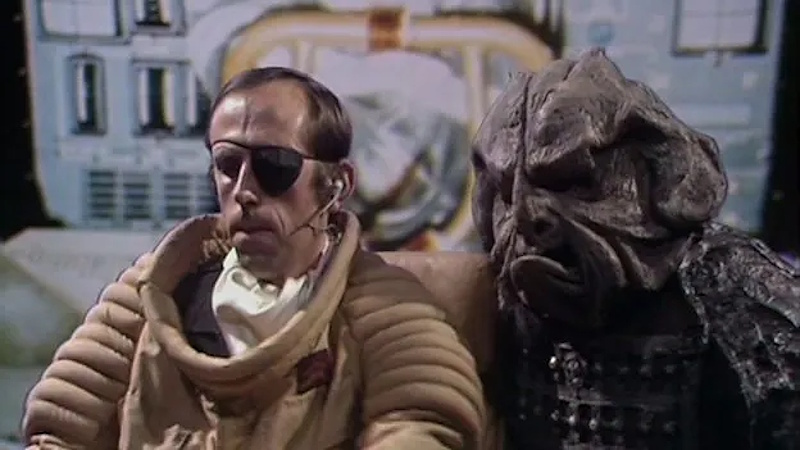
A bigger problem might be that the Kraals aren’t terribly memorable villains. They look good – rubber masks that vaguely resemble Bernard Ingham – and have nice proto-Brian Blessed voices. They’re also terribly derivative, with the Sontarans’ militarism, the Draconians’ cod-samurai dress, and servants who resemble knock-off Autons. Two of their big selling points – their weird organic technology and their ability to duplicate the Doctor and his friends – have been seen before this very season, both in Terror of the Zygons. That isn’t Nation’s fault – he couldn’t have seen a serial that was being worked on at the same time. It does seem to represent a rare instance of Holmes being asleep at the wheel.
What does work is Nation’s core philosophy, that a Doctor Who story should just keep moving. By the time he wrote his second story, The Keys of Marinus, he’d already worked out that most Doctor Who stories longer than five episodes are a drag, so he created a kind of picaresque structure where the Doctor and his friends went on a quest around various locations. The Android Invasion is one of the rare Terry Nation stories that takes place across a normal number of locations, but he still displays his signature restlessness, completely reinventing the setting and stakes of the story at the start of episode three. The third episode of a four-part Doctor Who story is rarely a highlight, all too often serving as mere padding before the conclusion. The third episode of The Android Invasion isn’t a masterpiece, but it is at least full of new things happening, new locations, new characters.
The expected point of a robot doppelgänger story – the series regulars meeting replicas of themselves – only surfaces occasionally. There’s an episode two cliffhanger that genuinely terrified me as a child and an outrageous blow-out of a final episode where Tom Baker fights Tom Baker. Baker and Elizabeth Sladen are both on fantastic form, even though Nation doesn’t get Sarah’s character. Once again, he writes her as a 1960s companion, constantly pining after her home despite the fact she visited present-day Earth, um, two stories ago. But this hardly matters, since Sladen plays every scene with such pluck and conviction. Perhaps no previous companion had visibly enjoyed adventures as much as she did; it would be no exaggeration to say the revival series’ conception of the companion as a match for the Doctor’s daring begins with her.
There is also some eerie stuff with aggressive duplicates of Sergeant Benton and Harry Sullivan, two regulars from the UNIT formula whose last appearances are in this story. Some fans find this a rather disappointing send-off, but even I, a bigger fan of the UNIT set-up than most, have to recognise this is the point. Holmes didn’t want to give UNIT a send-off – he wanted to bin it entirely, and in any case the show had given them no shortage of valedictory moments. They could have bowed out with the Mike Yates arc in Pertwee’s final season, or in Baker’s first story, or when the Brigadier left earlier this season… hell, Pyramids of Mars ends by burning down a building on the future site of UNIT HQ, which is pretty final. Instead there’s this, which is thematically perfect; a story about duplicates with a weird off-brand version of UNIT, headed by a guy who clearly isn’t the Brigadier and infiltrated by robots.
Holmes and Hinchcliffe had already done bold things with the show, and the next season would see them taking even more gambles. For this radical reinvention to work, the comforting old model of the show had to be broken, and The Android Invasion helps that process along the road. It’s not quite a case of “no Android Invasion, no Deadly Assassin” – but the two are more closely connected than most would admit.
Next: The Brain of Morbius (1976).