Aside from the grand experiment of The Deadly Assassin, most of the scripts Robert Holmes was primarily responsible for during his time as script editor were heavy reworkings of other writers – John Lucarotti in The Ark in Space, Lewis Griefer in Pyramids of Mars, Robert Banks Stewart in The Talons of Weng-Chiang. As a result, our interest in the history of these scripts is archival, rather than aesthetic. We may wonder what the original scripts were like, but not if they were any good – if they were, someone with Holmes’s strong artistic instincts would have let them through. The Brain of Morbius is the exception. Aptly, the Doctor Who version of Frankenstein is itself a stitched-together monster made of the show’s two most beloved script editors – Holmes and Terrance Dicks.
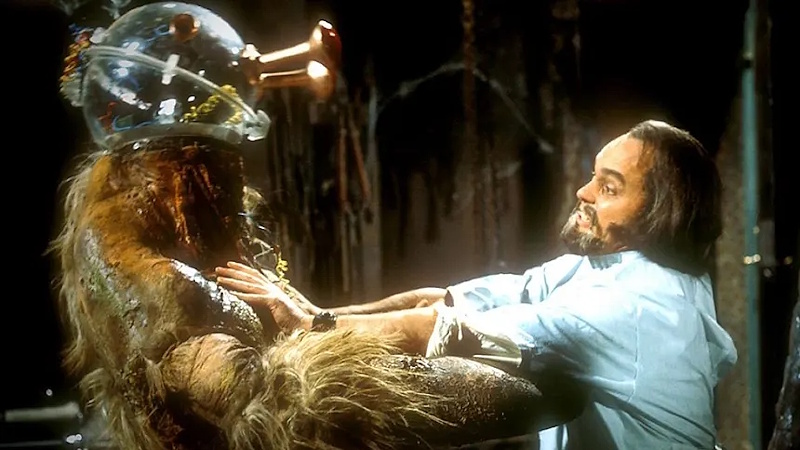
Holmes presumably commissioned his predecessor thinking he’d be a safe pair of hands, and sure enough the sticking point turned out to be budgetary rather than artistic. Indeed, Dicks’s core idea was about aesthetics. The first twist he brought to Mary Shelley’s story was that this Frankenstein – Dr. Solon – is not creating life but bringing a terrible Time Lord criminal back to life. This is a good idea – Frankenstein meets They Saved Hitler’s Brain – but his second twist was more of a problem. In Dicks’s original draft, the war criminal Morbius was restored to life by a robot servant who, lacking any artistic sense, created a perfectly functional but hideously ugly body for his master. This would drive the vain Morbius insane, in much the same way that existential doubts drive Shelley’s Monster insane.
This is obviously perfect for Holmes and producer Philip Hinchcliffe’s Gothic vision for Doctor Who. The problem is, this is very late in Season Thirteen and there’s a lavish continent-hopping six-parter lined up after it. You have the budget for a weird monster or a scary robot, but not both. You could, I suppose, have a robot who looked essentially human… except, whoops, we’ve already done that in the previous story. The rest of the story is fan legend: Holmes rewrote it with Dicks’s Frankenstein, Dr. Solon, as an organic being, Dicks objected, demanded the story go out under “some bland pseudonym”, the story is credited to Robin Bland, we all laugh, including Dicks, once he’s had some cooling-off time.
The resulting script is often cited as a classic, albeit with a major plot hole: if Solon needs a Time Lord head for Morbius’s brain, and he recognises the Doctor as a Time Lord, why does he not simply put Morbius’s brain into the Doctor’s body rather than try to stick the Doctor’s head on top of this weird patchwork lobster-monkey thing he’s created? Except… we interpret this as a plot hole because we know how Dicks would have solved it. The robot, presumably, would not have understood why simply using the Doctor’s body would be an advantage; why, it doesn’t even have a cool giant claw. But because Dicks’s chosen solution isn’t in Holmes’s script, we assume there must be no solution at all. But that does Holmes a disservice. I think Holmes has found a solution, and it’s a very good one.
Solon, you see, is a sap. This is the knock-on effect of changing the story of Frankenstein to make the Doctor a servant of the Monster, rather than intending to be its master. For all Solon’s surgical genius, he becomes a pathetic, subservient character. And the brilliant thing about Holmes’s script – not to mention Philip Madoc’s superb performance as Solon – is that he knows it. Solon is not the ranting megalomaniac villain you expect from this era of the show. He’s vain, fragile, hesitant and extremely susceptible to flattery. He probably could transplant Morbius’s brain into the Doctor’s body, but that would mean all his effort making a patchwork body would be wasted, and what would be the use of that?
This, then, is one of Holmes’s revengers’ tragedies; Morbius’s quest for a new body to pursue vengeance against the Time Lords fails not just because the Doctor intervenes, but because of his and Solon’s inherent tragic flaws. The question of the Doctor’s feelings about the Time Lords remains open. As I noted in my Pyramids of Mars review, the Doctor appears to have renounced his Time Lord status, a development that the rest of the series has simply ignored. When he suspects the Time Lords are behind his unscheduled trip to the planet Karn – a suspicion which is never confirmed, but given Morbius’s clear threat to Gallifrey it can’t be ruled out – he sulks, choosing to play with his yo-yo instead.
He’s quickly snapped out of it when Sarah Jane finds a decapitated alien corpse – a Solonian, ironically – and this spurs him into entering the story. But the Fourth Doctor’s childishness is a vital part of the action; the subplot about the Sisterhood of Karn is resolved by the Doctor giving them a packet of firecrackers. It’s a big part of Tom Baker’s charm, and also why his relationship with Sarah Jane works. They spend almost as much time bickering as the Sixth Doctor and Peri, but here the power differential between the Doctor and his companion is neutralised by the Doctor’s refusal to take an authority role. Sarah Jane, too, is far more empowered than Peri to push back on the Doctor’s petulance. This is a very violent story, even by Holmes and Hinchcliffe standards – the scene of Solon shooting his servant Condo results in a still-shocking Peckinpah-size blood squib. But Sarah never backs away. She even stifles the usual companion scream when she sees Morbius’s headless body twitching, a moment that would absolutely justify a full freak-out. Atta girl.
Next: The Seeds of Doom (1976)