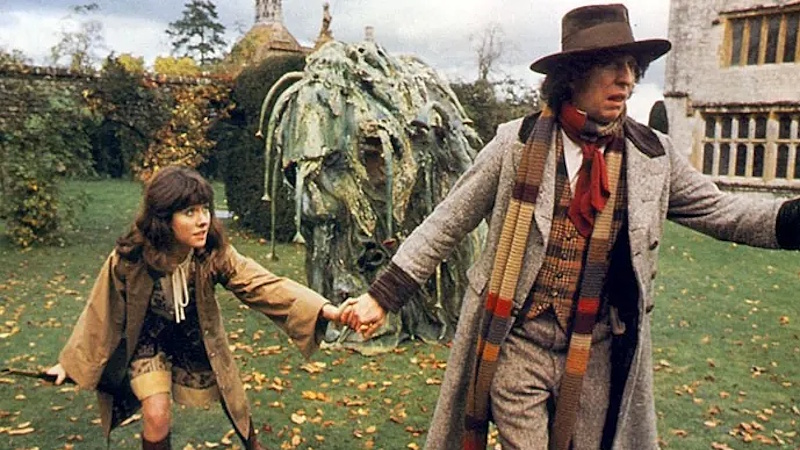
Doctor Who has existed for just under sixty-two years, and in all that time it has produced one (one) era which all fans agree is really good. That’s part of its strength: every stage of the show is someone’s golden age and someone else’s nadir. You would struggle, though, to find someone who sincerely hated the first three seasons of Tom Baker’s Doctor, produced and script-edited by the dream team of Philip Hinchcliffe and Robert Holmes. There are a few stories that people don’t love, but they’re very rare and – more notably – generally agreed-on: Revenge of the Cybermen is nobody’s highlight. What strengthens the consensus around this era is that there isn’t much to argue about.
Perhaps the nearest thing it has to a truly divisive item is The Seeds of Doom, which is well-loved but has a few obvious flaws and vulnerabilities. The most common criticism is that the writer, Robert Banks Stewart, didn’t really understand Doctor Who. He wrote for a number of other British TV adventure serials around this time, including The Avengers, and The Seeds of Doom is very obviously a rejected Avengers script. (Presumably it was rejected because that show had already done killer plants in 1966’s ‘Man-Eater of Surrey Green’) The Doctor is called to deal with a mystery in Antarctica by the World Ecology Bureau, who apparently have his phone number, whereupon he is transported to a polar base by helicopter. Towards the end of the story Sarah Jane Smith says they were taken to Antarctica in the TARDIS, which on its own is the kind of dull continuity error that pads out CinemaSins videos. Here, it’s as if the story is retconning itself, trying to rework itself to be more like Doctor Who.
This isn’t necessarily a problem – under Jon Pertwee, Doctor Who spent quite a lot of time trying to be like The Avengers. Since then, the zeitgeist had moved away from that programme’s eccentric whimsy and into a new era defined by shows like The Sweeney. The Sweeney‘s USP was a level of violence British television had never seen before, and that leaks into The Seeds of Doom, which features a version of the Fourth Doctor who jumps through windows, disarms assassins and threatens them with their own guns, knocks people unconscious and even tries to snap a man’s neck at one point. A decade later, Tom Baker’s successor Colin Baker would be crucified for less than this, so what went right? Why is The Seeds of Doom, with all its weird, off-brand elements, not just good but great Doctor Who?
The obvious answer would be that Hinchcliffe and Holmes’s stewardship of the show is now so strong it’s essentially an immune system, turning potentially disastrous elements into ways of making the show stronger. And it’s true that every production decision works here. Holmes always encouraged his writers to personalise the story’s threat, producing a string of memorable human villains alongside the show’s more characteristic monsters. The Seeds of Doom has one of the best, with The Italian Job‘s Tony Beckley as the fey, creepy Harrison Chase. The serial’s monster, the Krynoid, is revealed to be a tentacled giant non-humanoid creature, three elements which normally go embarrassingly wrong in 1970s Doctor Who. But the Krynoid looks fabulous, aided by a detailed model of Chase’s mansion to loom over and fondle.
Credit here must go to Douglas Camfield, one of Doctor Who‘s greatest directors who’d been with the show since the Hartnell days. He directed a broad range of different stories but his particular genius lay in handling epic-length action stories: The Daleks’ Master Plan, The Invasion, Inferno and this. The Antarctica sequences are a case in point. They’re obviously a soundstage with a painted backdrop and polystyrene snow. But the way Camfield directs them, the way he keeps the actors acting cold and windswept, the way he keeps the pace moving too fast to linger on the flaws, the use of Geoffrey Burgon’s lush, ominous, jazzy score, makes it all feel brilliantly, bristlingly dangerous.
And if we’re talking about the Antarctica scenes, we have to talk about Robert Banks Stewart again, because he is far more than the savant some fans paint him as. His minor misunderstandings of Doctor Who‘s format pale in comparison with what he understands about writing six episodes of relentlessly paced action, a length which defeats most writers. Stewart and Holmes seem to have jointly come up with the idea of setting the first two episodes in Antarctica then moving back to Harrison Chase’s English country manor for the last four, and the change of scenery does a lot to keep the serial feeling varied. But it’s Stewart who spots something else in this format, a trick so good Holmes would borrow it a year later for the episode four cliffhanger of his own The Talons of Weng-Chiang.
What Stewart seems to have noticed is this: if a two-part adventure in Antarctica is going to join up with a four-part adventure in England, the two-parter must end with the Doctor losing. The Seeds of Doom is set up as a story in which the Doctor and Sarah must stop Harrison Chase’s men capturing a Krynoid pod at all costs; episode three begins with Harrison Chase taking delivery of his shiny new Krynoid pod. For the rest of the story, the Doctor and Sarah are on the back foot doing damage control. It’s this – combined with the brilliant decision to keep the Krynoid mutating, changing the nature of its threat throughout – that makes a standard save-the-world plot feel genuinely dangerous and out of control.
Once you realise this, a lot of Stewart’s writing decisions make a lot more sense. The Doctor’s uncharacteristic use of violence, for example, isn’t there from the start; it begins at the start of episode three, when he knocks out one of Chase’s hitmen. Is this really the Doctor behaving out of character, or is it the Doctor loosing his moral responsibilities in the face of a threat he’s already failed to contain, in the manner uncontroversially depicted in new series episodes like Dalek, A Good Man Goes to War and Hell Bent? And in any case the story cuts straight from this to the Doctor and Sarah meeting an eccentric elderly flower artist called Amelia Ducat, proving that any attempt to make Doctor Who into The Sweeney will always founder on the rocks of the show’s inherent camp weirdness.
Ducat is played delightfully by Sylvia Coleridge, who went on to play Mrs. d’Urberville in Roman Polanski’s Tess. It’s a seriously classy cast all round, with the aforementioned Beckley and Coleridge joined by John Challis as Chase’s brutish contract killer Scorby, and Mark Jones getting the maximum horror out of the appalling idea of being transformed into a Krynoid while perfectly lucid. Stewart’s hyper-aggressive writing means Sarah Jane Smith actually acts a little like the feminist firebrand she was conceived as, a notion which Elizabeth Sladen clearly finds refreshing. Even the episode three cliffhanger, where she is overpowered and exposed to Krynoid spores, feels less like a hackneyed screaming-girl scene and more like a real, three-dimensional person in mortal danger.
And then there’s Tom Baker, who at the end of his second season as the Doctor is already so assured in the part that he can take any situation and make it feel quintessentially Doctorish. For all he’s remembered for his skill at playing comedy, the Fourth Doctor is most compelling to me when he’s angry, and there are plenty of opportunities for that as the situation gradually slips out of his control. He helps to make The Seeds of Doom feel less like an out-of-character mis-step for the show and more like one of those stories which, like Remembrance of the Daleks, Human Nature or Heaven Sent, forever marks out the limits of one interpretation of the Doctor’s character.
Next: The Masque of Mandragora (1976).