There is a temptation when writing about classic series Doctor Who to treat all of its controversies as items in the fossil record, but the ones surrounding The Deadly Assassin are still live grenades. As evidence, I watched this on Britbox, where the original final shot of episode three – a virtual-reality vision of the Doctor’s pale, lifeless face being held underwater by the Time Lord Chancellor Goth – is still removed.
This image wasn’t the one that persuaded Mary Whitehouse to focus her ire on Doctor Who. Tom Baker’s two preceding seasons had given her plenty to rail against; her response to The Seeds of Doom bequeathed the phrase “obscene vegetable matter” to the fan vocabulary. But this was the occasion where the BBC admitted that she had a point. Previously, Whitehouse had been regarded as an amusing irritant by British broadcasters. Ben Thompson’s book Ban This Filth: Letters from the Mary Whitehouse Archive reproduces years of responses she received from programme-makers, most of which are written with barely-concealed amusement. This time, the Drama Department conceded that the cliffhanger was an unacceptably disturbing image. The serial’s writer and current script editor Robert Holmes was fired, as was producer Philip Hinchcliffe, and the master tape – no pun intended – was edited. The uncut version is rumoured to reside in the BBC Legal and Royal Vault, full of material that, while not banned exactly, is not to be reshown without context – sat alongside Ghostwatch, several Chris Morris music shows and news footage of the Bradford City football ground fire.
There is a certain achievement in this. Holmes and Hinchcliffe arrived with a dual mission to make the show scarier and more convincing. By the middle of their third season, they had accomplished this so successfully that they were forcibly moved on, albeit not before they had the chance to make something even more expensive and objectionable for the end of the season. The true obscenity of The Deadly Assassin is not the serial’s content, it’s the fact that the BBC validated Whitehouse’s campaigning, transforming her from a low-level busybody to a major force for evil in British public life. In the same year that she claimed Holmes and Hinchcliffe’s scalps, she would sue Gay News for the now-obsolete offence of criminal blasphemy, providing a test run for the Thatcher era’s wave of homophobic legislation and policing. She would later be a key figure in the Video Nasties panic, bravely sending corner-shop owners to prison for stocking a copy of Don’t Go in the Woods. 1976 was the year when she graduated from attacking fantasy to actively destroying the lives of real, flesh-and-blood people. Inasmuch as it emboldened her, the editing of The Deadly Assassin was an immoral act even by the standards of censorship.
Whitehouse was not the only person offended by The Deadly Assassin. It’s part of fan legend that Jan Vincent-Rudzki, founder of the Doctor Who Appreciation Society, wrote a lengthy diatribe about how the serial’s portrayal of Gallifrey as a stuffy world full of out-of-touch old men had killed the magic of the show. This is often humorously cited as a rejoinder to anyone complaining too much about the show’s current incarnation, a reminder that sometimes a serial needs to be judged by its legacy rather than the mood it leaves you with as the credits roll. But judging The Deadly Assassin‘s legacy in continuity terms doesn’t really defend it against Vincent-Rudzki’s initial charges. The most direct influence Holmes’s script has had on the series can be found in the mostly boring later stories set on Gallifrey, or its introduction of the twelve-regenerations limit for Time Lords, which was an albatross around the show’s neck until it was retconned in The Time of the Doctor. If The Deadly Assassin‘s legacy was the best thing about it, it wouldn’t be worth defending.
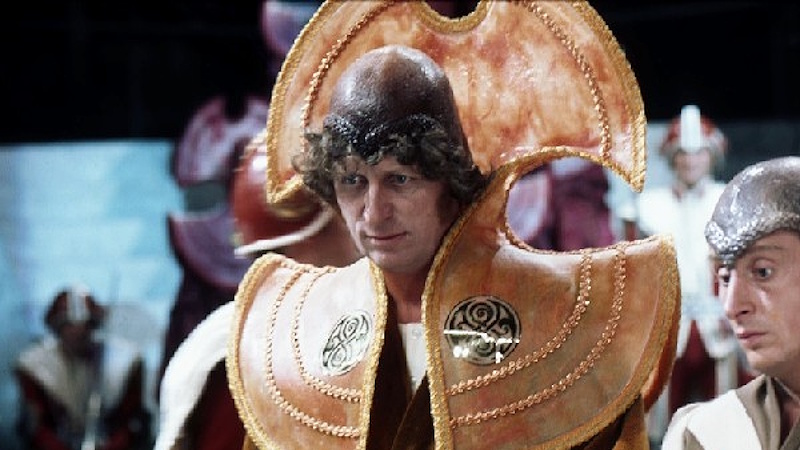
Looking back at Vincent-Rudzki’s core complaint, it’s hard to understand why this version of Gallifrey was such a shock. Visually it resembles the planet’s last appearance, so much so that you could interpret the Time Lords’ straitened status here as them failing to get back on their feet after Omega’s power drain. This raises the question of why a species who’ve mastered time travel are still subject to linear cause-and-effect, but The Deadly Assassin has an answer for this too. The Time Lord high council are initially disbelieving when the Doctor claims to have had a prophetic vision, and yet soon afterwards it’s revealed that they have a supercomputer – the Matrix – whose stated use is to predict future events. The disjunct is explained with a constant emphasis on how exclusive the Matrix is, how few people have access to it, how carefully guarded it is. The godlike power of the Time Lords is very real, it’s just also very restricted. Gallifrey is a society where everything is possible but nothing is permitted.
Rather than destroying the show’s continuity, this is a restatement of Doctor Who‘s founding myth: Gallifrey was corrupt, so the Doctor fled. The myth is strengthened by Holmes’s confirmation that the Time Lord High Council oppresses its own citizens, rather than just alien ones, and also by heavily implying that the Doctor was being set up for a cushy life on Gallifrey before he stole his TARDIS. This aligns him with one of the totemic figures of the 1970s British Left, Tony Benn, who resigned his birthright in the House of Lords in order to practice frontline politics, and that’s not such a strange parallel as it sounds. The oft-cited influence of The Manchurian Candidate only scratches the surface of The Deadly Assassin‘s political inspirations: Gallifrey seems trapped in the same kind of long-term malaise as mid-’70s Britain, there is an underclass of “Shabogans” who are blamed for the Time Lords’ mistakes, and the acronym “CIA” is allowed to hang in the air for a second before it’s confirmed as the – ahem – Celestial Intervention Bureau.
But that’s not just a silly gag, that’s confirmation that the Time Lords have been betraying the non-interventionist philosophy which they put the Doctor on trial for ignoring. Again, this is not unprecedented – Tom Baker’s own first season saw his Doctor being used left, right and centre to carry out Gallifrey’s dirty work. That, though, could have been a mere retcon if The Deadly Assassin didn’t make it clear that Holmes had been thinking long and hard about what the Time Lords’ role in the series is these days. The true value of this story is not what other serials would later copy, it’s what they couldn’t copy, which includes but is not limited to this very 1970s political pessimism.
Really, every single thing in The Deadly Assassin is so extreme, it’s no wonder it was never followed up. The reinvention of the Master as a very Holmesian monster-in-the-catacombs is a triumph, and Peter Pratt might just be my favourite Master overall, but it’s almost impossible to reconcile this twisted, decomposing, hate-fuelled freak with the wry criminal genius Holmes himself introduced just five years ago. The Doctor, too, is a remarkably un-comforting figure here. There’s a great physical acting moment in episode two, where he silences Engin simply by standing up and looming over him, and he seems to be doing this metaphorically to the whole script. Without a companion for the first time, all of the cold, unknowable qualities of Tom Baker’s Doctor come to the forefront. The first episode cliffhanger – in which the Doctor appears to shoot an innocent man dead for no reason – would not be as upsetting if we hadn’t spent the previous twenty minutes worrying that the Doctor did, indeed, seem to be losing his mind.
That cliffhanger is, for my money, more disturbing than the one which got Mary Whitehouse all flustered. Perhaps she settled on that one because, without a single target to focus on, The Deadly Assassin offers far too much to object to – the sight of the usually invulnerable Doctor bleeding profusely, the sight of him apparently trying to murder Goth, the gas-masked surgeons and cackling clowns who beset him in the Matrix, the horrible physical decline of the Master, the sly reference to Harold Wilson’s resignation honours list. (Rumours about the authorship of that list were causing lawsuits to fly as late as 2006 when BBC Four premiered The Lavender List, a drama about it that’s probably currently buried next to the uncut version of The Deadly Assassin). She picked her target, she aimed and – unlike the Doctor – she hit a bullseye. In doing so, Whitehouse accidentally confirmed that The Deadly Assassin is a powerful work, exceptional and daring not just by the standards of Doctor Who, but by the standards of television as a whole.
Now that the goal of most television is to tell one continuous story, there’s less leeway to experiment with style and tone – everything is sacrificed to the ruling objective of producing a comfortable, homogenous binge-watching experience. The Deadly Assassin has its flaws, certainly, and its effects and video quality are as dated as you’d expect from a near-50-year-old TV show. The possibilities it demonstrates, though, look more alien and unique than ever; its formal innovations, its willingness to take bold risks with its parent show’s characters and core ideas, its daringness in taking on political and horrific subject matter. I don’t want to mourn the fact that modern television isn’t like this any more. I would rather ask: why not?
Next: The Face of Evil (1977)