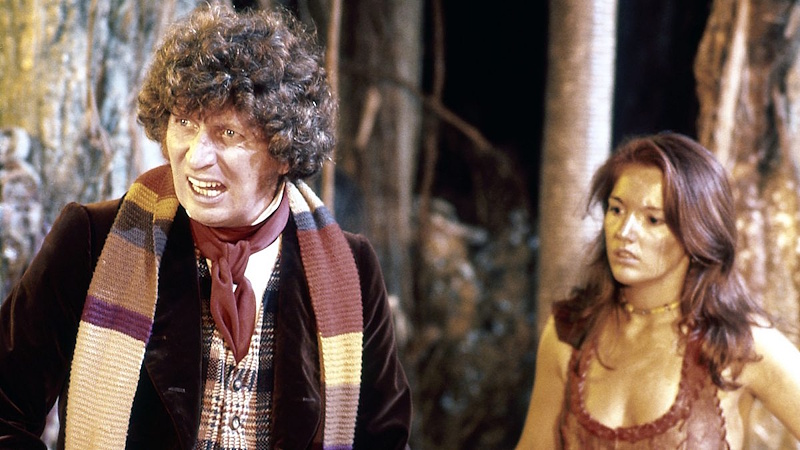
The longer Season Fourteen of Doctor Who gets talked about in hushed tones as an all-time pinnacle of the show, the more it’s worth rewinding back to its transmission and remembering that it wasn’t always one discrete block of nigh-on flawless episodes. The Face of Evil is the first story of what you might call Season 14B, broadcast in the new year after a festive break. It also introduces a new companion, which always causes a noticeable shift in the show’s tone, never more so than here. For the whole of the 1960s the Doctor travelled with multiple companions; every time one left, there would be at least one more around to maintain continuity. The Jon Pertwee era changed that, but even if the Doctor didn’t have a companion in the traditional sense in between Liz leaving and Jo arriving he still had the Brigadier, Yates and Benton around to anchor him.
Between Sarah Jane Smith leaving and Leela arriving, though, there’s been a whole story where the Doctor is on his own. As such, The Face of Evil becomes the show’s first exploration of a theme that Russell T Davies, for one, will keep returning to: what, exactly, does the Doctor get out of travelling with someone? When we first see the Doctor here, he’s so used to his own company that he talks to himself, breaking the fourth wall to wonder aloud where he’s landed. You can imagine – particularly if you’re Tom Baker – a parallel universe version of the series where the Doctor keeps going like this, a science-fiction equivalent of a Western hero like Django or Shane who travels from town to town, occasionally meeting someone he knows but always arriving and departing solo. As it happens, The Face of Evil is the story where that attitude reverses, and the Doctor realised he needed someone else in the ship with him.
The first thing to note is that it deals with this issue fairly lightly. The original series didn’t often tell stories dealing with the Doctor’s emotions, but there are some: tellingly, one of the most notable ones saw the First Doctor worrying about the prospect of travelling without a companion (The Massacre). The Face of Evil does not come across as a deep dive into the lead character’s psyche. Its main aim is to fuse together the three key elements of Doctor Who at this point: mind-expanding science fiction, relentless adventure plotting and child-traumatising horror. You could enjoy it purely based on how well it achieves those three aims and it would be no disrespect to writer Chris Boucher’s achievements. Even in the context of Season Fourteen, where every story includes something new to scar the mind of ’70s kids, the episode three cliffhanger with Xoanon screaming in the voice of a child stands out as one of the most disturbing things in Doctor Who history.
What’s more, Boucher has recognised that the relentless pace and twists demanded by adventure fiction can actually make his science fiction storytelling more, rather than less, sophisticated. It’s easy to imagine a Hartnell-era version of The Face of Evil where the big reveal – namely, that the Sevateem tribe are descended from the crew of a crashed spaceship, whose equipment they unknowingly use in their rituals – is held back for the final episode. By 1977, a Doctor Who audience has seen enough spacesuits to figure this out immediately, so the Doctor works it out in episode one. It’s always gratifying when the show acknowledges its audience’s intelligence like this, but it would be a grave misstep if Boucher didn’t have enough fresh ideas to keep the remaining three episodes just as intriguing.
Thankfully, he does, and one of his biggest ideas sets up another of the revival series’s running concerns. This time, it’s Steven Moffat and Toby Whithouse who are most indebted to Boucher raising the question of whether the Doctor is always a force for good in the universe. We’ve heard the Doctor talk of unseen adventures before, mostly in the context of throwaway quips involving historical figures he’s met. This, however, is the first time a whole story has rested on something the Doctor has done off-camera, and it doesn’t paint a glowing picture of what he does on his holidays. The crisis the Doctor is dealing with in The Face of Evil is entirely of the Doctor’s doing, a development which makes him uniquely qualified to fix the matter but can’t help undermine him as a hero. In his novelisation, Terrance Dicks will position the Fourth Doctor’s first encounter with Xoanon as taking place during his post-regenerative mania, an explanation which fits neatly but defuses a little of the story’s critique of the Doctor’s morality. An audience who can’t remember a minor detail of a story broadcast over two years ago may have assumed the Doctor did all this during his time alone after dropping off Sarah Jane Smith. This raises the unsettling possibility that the Doctor has been alone for much longer than we can imagine. It might be as long as the centuries his Eleventh incarnation spends alone after Whithouse’s The God Complex, or during Moffat’s The Name of the Doctor – long enough to forget trips he’s made, long enough to become erratic and unreliable.
Which brings us back to the question of why he needs a companion. The answer Davies will settle on – that he needs someone to stop him doing irresponsible things like this – is certainly applicable to The Face of Evil, but it doesn’t explain why the Doctor chooses Leela. If all he wants is someone to be a level-headed voice of reason, one of Leela’s rival tribe, the Tesh, would fit the role – except the Tesh are boring and rule-bound, and this Doctor is the one who most explicitly establishes that the Doctor can tolerate everything except that. Leela announces herself as a potential companion straight away by being independent-minded enough to challenge the Sevateem’s dogma, but also being open-minded enough to reassess her views when she sees the Doctor and realises that at least one of her tribe’s myths must have some truth to it. Because it takes place at a point where the Doctor most needs an active reason to choose someone to travel with, The Face of Evil is the story which fixes these as the qualities a companion needs.
Well, that and bravery, but with Leela that’s never in question. It is still shocking how matter-of-fact both the character and the production are about Leela’s violence. She murders two people before the end of episode one, and although the Doctor is around to admonish her for the second one, Louise Jameson plays her with no remorse, and director Pennant Roberts barely lingers on the killing or its aftermath. This is, famously, something Tom Baker was uncomfortable with, and which poisoned his relationship with his co-star for a long time (that and, you suspect, as soon as he saw Jameson in costume he realised his days of being the unquestioned centre of attention in every scene were numbered). But it adds to the sense that the Doctor needs not just a companion but a challenge, someone who can stand up to him, a question that his next companion will answer in a completely different but equally satisfying way.
There’s a small moment during the final episode where the Doctor wakes up and asks how long he’s been unconscious for. Leela casually responds that it’s been two days, which means that for two days she’s been in charge of the narrative. (We haven’t seen that, but if ever there was a story which is all about what the audience hasn’t seen it’s this one) This places her in a position no companion has been in since Ian and Barbara back in the very first episode – the position where they’re in charge of telling the story. And, of course, An Unearthly Child‘s core theme of primitivism and progress is reprised here as well. Doctor Who‘s ability to hop between time periods means this is even more of a core theme than it is in most science fiction shows. It’s fuelled everything from the technophobia that created the Cybermen through Malcolm Hulke’s experiments in explicitly postcolonial SF, as well as the uncountable number of stories where the Doctor themselves is a catalyst for progress. Now, with a Doctor who’s more proactive and revolutionary than ever before and a companion whose supposedly ‘primitive’ nature allows her to see through the lies and blind spots of more technologically advanced societies, this undercurrent is the central focus of the show.
Leela was my childhood favourite companion, and for a while during this rewatch project I wondered if this was a three-ages-of-man deal: as a child I enjoyed the child-like bluntness of Leela, then as a teenager I empathised with Ace’s growing pains, and now I just want to be a proper grown-up like Romana. Rewatching The Face of Evil and seeing Leela unfiltered, written by her creator in her natural environment, reminds you just how great she is, and how there is an essential part of Doctor Who‘s thematic and moral character which is best expressed by her. She’s perfect. The story’s perfect.
Next: The Robots of Death (1977)