The American conceptual artist Marcus Rakowitz has a piece called The Invisible Enemy Should Not Exist, which honestly seems a bit harsh. If you lost The Invisible Enemy you’d lose one of the precious few stories with the Fourth Doctor and Leela, one of the show’s most fascinating, rewarding and iconic pairings. You’d also lose the introduction of K9, and it’s still one of his best showcases. Later, the production team would take any excuse to stick the robot dog in the TARDIS, particularly when they were out on location. But the studio-bound space station setting of The Invisible Enemy is perfect for him, and for once he seems credible in the action scenes.
The praise bit stops here. If K9 is given an enviable rollout, Leela is treated appallingly. The key to writing Leela is very simple: she’s extremely bright but completely uneducated, meaning she can ask the Doctor questions without coming across as dim or subservient. Frankly, the chances of the knife-throwing, kill-happy Leela coming across as subservient would normally be so low it’s not worth mentioning, but The Invisible Enemy begins with her cowering in the corner of the TARDIS from the story’s threat, and reaches a nadir when said threat – an intelligent alien virus – fails to infect her because, as Frederick Jaeger’s entertaining Professor Marius notes, her brain is too primitive. Yes. This week, the companion is saved by eugenics.
That’s unforgivable, but Leela’s fear initially seems reasonable. The virus can invade the TARDIS, after all, which at this point in the show’s history is a reliable indicator of a seriously powerful enemy – Sutekh did it, and look at the trouble he caused. Then it infects the Doctor, proving none of the series’ sacred cows are safe this week. How, then, does The Invisible Enemy balls this up? As early as the first episode, there is a tension between the story – which is going all-out to sell us on a truly unprecedented threat to the Doctor – and the design elements. The first-episode cliffhanger, which reveals the extent of the Doctor’s infection, is a case in point. Director Derrick Sherwin films it in one virtuoso dolly movement, blocking expertly to end on a close-up of… Tom Baker’s hand covered in silly white fluff.
But picking on an old Doctor Who story for its special effects is too easy. There is a deep scripting problem here, and you can see the root of it in the decision to have the Doctor succumb to the virus. Presumably, having decided on the story’s threat, writers Bob Baker and Dave Martin settled on the Doctor as the most dramatic character to infect. And you could argue that something is already going wrong here, that if you’re telling a story about a viral outbreak, a space station is the worst science fiction setting you can have. I mean, even Boris Johnson could lock that one down. Still, there’s an evil virus on the loose, our hero has contracted it, this seems to be set up pretty well.
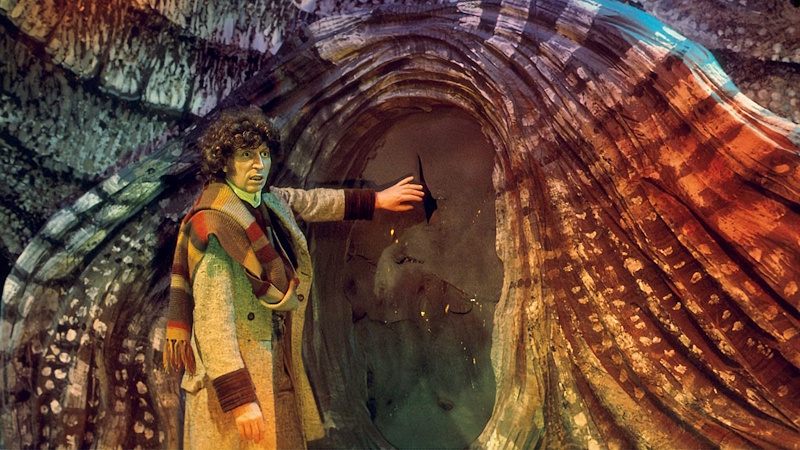
The problem is, this is one of those Tom Baker stories where the core concept seems to be “what if we did [film], but as a Doctor Who story?” This time, it’s Fantastic Voyage, which is a perfectly good concept to apply to this show – many years later, Into the Dalek proved that. But if the Doctor is the patient, you’ve committed to having the show’s central character take an entirely passive role, lying on a gurney while someone else runs around inside the admittedly very impressive sets representing his brain.
The right thing to do, at this point, would be to go back and rewrite the script so you’re not backed into this corner. But Bob Baker and Dave Martin, writing their first of two scripts this season, seem pushed for time. Every time they encounter a problem they get out of it by inventing something out of whole cloth which they ride until they hit the next obstacle. In this case it’s the Kilbracken Technique, a kind of 3D printing which creates limited-lifespan clones who are psychically linked to the originals, in this case the Doctor and Leela. This is the kind of weird SF concept which could be terrific if the writers were interested in exploring its implications, but here it’s lazily pasted over an original draft where the Doctor and Leela were clearly meant to be miniaturised. How can I tell? Well, despite the Kilbracken clones being completely disposable, Professor Marius still has some kind of re-bigulator, a concept so ridiculous it makes me want to laugh out loud [Frink noise], but is nevertheless used to return the Doctor and Leela clones to full size, along with… oh… oh dear…
Yes, there’s no getting around it. In pointlessly enlarging his doomed replicants Marius accidentally enlarges the virus itself, which spends the last episode in the form of a three-foot-tall prawn. Unthreateningly voiced by John Leeson, it also keeps clattering and clanking audibly as it waves its puppet limbs around. The prawn is so objectionable, not just because it looks awful (although it does), but because it represents a final failure of nerve in a story that keeps betraying its plentiful good ideas. The idea of an intelligent virus – one which, it is implied, can transmit itself verbally a la Pontypool – is an interesting, different idea for a Doctor Who villain. The potential is diluted immediately when the infected humans start behaving like standard, sneering SF baddies, and the concept finally has its last vestiges of originality crushed when it turns into a monster that could be easily defeated by, say, someone kicking it over. The Invisible Enemy should probably exist, but that’s as much praise as I’m willing to give it.
Next: Image of the Fendahl (1977)