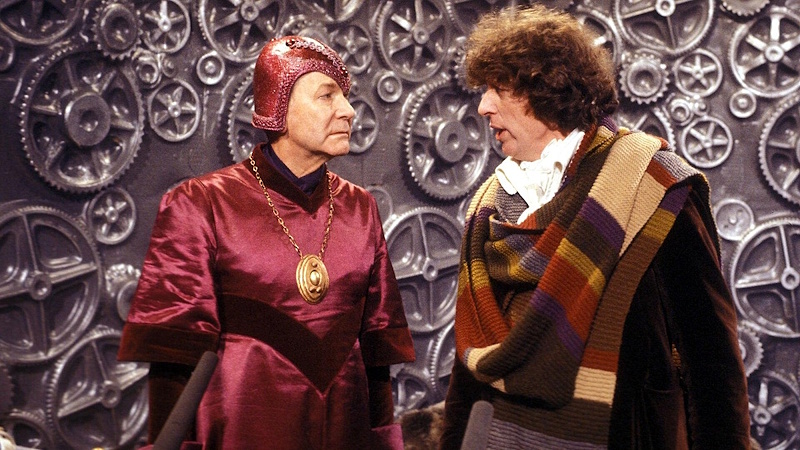
By Season Fifteen, Tom Baker’s Doctor is moving towards his most consistently anti-authoritarian characterisation – someone who, just two seasons ago, sulked at the idea of involving himself in Sarn’s politics now seems to hop out of the TARDIS and ask where the nearest workers’ uprising is. As such, there’s a certain promise in taking this version of the Doctor and bringing him back to Gallifrey. It implies we might be about to get something that pays off the series’ founding premise – that after travelling the galaxies destroying so many alien dictatorships, the Doctor is about to destroy the dictatorship that forced him into this life.
The Invasion of Time doesn’t deliver on that promise, and it doesn’t deliver on most of its other promises either. The idea of the Sontarans wreaking havoc on Gallifrey is silly but entertaining – the ultimate meatheads-versus-eggheads clash – but we’ve spent a whole season deflating the prestige of Gallifrey, and then it turns out that these Sontarans can be easily thwarted by a metal door or a sun lounger in their way. The chase through the TARDIS also has serious potential; revealing the Doctor’s ship to be even bigger and weirder than we thought now harks ahead to Andrew Cartmel’s desire to add the mystery back to the show’s standard ingredients. But again, the realisation of this as a series of brick factory interiors and swimming pools doesn’t inspire much wonder.
The final two episodes of The Invasion of Time see the story crash down to earth with a deafening thud, which isn’t to say that the preceding four are flawless. It’s more that they’re a mixed bag, capable of maddening longueurs and sudden, redemptive flashes of genius. There are lots of excellent Doctor Who stories that have rather perfunctory cliffhangers, but this might be the only example of a middling Doctor Who story where every single cliffhanger is a knock-out, particularly the one for episode two. The idea that the Doctor has turned evil and assisted a Vardan invasion of Gallifrey is compelling enough to make you forgive the story for not doing enough ground-work. I realise the three-parter in Peter Capaldi’s final season is not everyone’s cup of tea, but when the Twelfth Doctor appears to side with the villains in The Lie of the Land, we’ve at least had two episodes establishing the Monks as a deeply sinister force who are trying to invade Earth. Here, by contrast, I’m not entirely convinced a Vardan-occupied Gallifrey is going to be much worse than a Time Lord-occupied one.
The storyline grips because Tom Baker grips, frankly. It would be no exaggeration to say this era of the show caused Baker to be loved by a whole generation, and yet his Doctor is a surprisingly unreassuring presence to inspire such love. It’s easy to think of scenes and stories where the Fourth Doctor is callous, self-absorbed or contemptuous of human priorities and pieties. He can be as rude as the Third Doctor, but without the fallibility; he can be as bad-tempered as the First Doctor but without the reassuring knowledge that this characterisation will soften over time. Usually, Baker’s dazzling charisma and wit smooths over these moments, and that’s still the case in The Invasion of Time – you are always thinking “why is the Doctor doing this?” rather than “I can’t believe the Doctor is evil now”. But there’s still a little voice in the back of your mind, saying: he might…
Leela is much more poorly-served by the script, but she similarly benefits from Louise Jameson remaining laser-focused on the good qualities of her character even when writers Graham Williams and Anthony Read don’t. The decision to have her leave the TARDIS to marry a Gallifreyan guard is rightly infamous as one of the most out-of-nowhere companion departures the show has ever done; despite what Big Finish want me to believe, there is no way she stays on this planet, when she could follow her mentor and steal a TARDIS at the first opportunity. It’s especially perplexing seeing as The Invasion of Time doubles down on The Deadly Assassin‘s portrayal of Gallifrey as an utterly ossified, rule-bound society. What could possibly attract Leela – Leela! – to such a place?
It has to be said that this is one of the poshest stories in Doctor Who‘s history, with every Gallifreyan from the Time Lord High Council to the wasteland tribes Leela encounters speaking in perfect RP, and the ultimate threat coming from a distinctly Cockney-accented Sontaran commander crashing about and acting like a ruffian. In its defence, the revelation that those tribes are “drop-outs” from Time Lord society does fit neatly with Robert Holmes’s earlier portrayal of Gallifrey as Space Oxbridge, a degree of metaphorical consistency that normally only happens in Dalek stories. It figures that this would appeal to Williams, whose vision for the show will incorporate lots of satirical humour, and who’s just one story away from bringing Douglas Adams in as a writer. The Deadly Assassin is one of the few stories from Philip Hinchcliffe’s tenure as producer that offers some precedent for this. Yes, the aliens in Genesis of the Daleks were meant to reflect real-world human foibles and political causes, but no-one could call that story a barrel of laughs.
Going back to Gallifrey, then, makes some sense for the show at this point, but the comparison is not a flattering one. Part of the brilliance of Holmes’s script for The Deadly Assassin is how it parcels out its new information about the Doctor’s home-world; there are things like the Matrix, which are explored in-depth, and there are things like the Shabogans, which are mentioned briefly enough to be tantalising. The Invasion of Time aims straight for the middle, which means everything is skipped over too quickly to be satisfying, but also discussed in too much detail to be mysterious and intriguing. We see our first Time Lady since Susan and our first Gallifreyans living outside the Time Lord establishment. Both of these things will be hugely important to the show going forward, particularly in the revival era, and I’d have swapped any amount of the tedious waffle about constitutional rights and elections to hear some more about them.
The structure, too, imitates Holmes without quite grasping why his stories work. I’ve noted before that the decision to break down the six-parters he script-edited into a two-parter and a four-parter affects the storytelling in more interesting ways than people realise. The most startling thing about episode two of The Seeds of Doom isn’t that the story shifts location afterwards, it’s that it ends with the Doctor and Sarah failing to save the world, a crisis that then sets the tone for the remaining four episodes. The Invasion of Time shines much more of a spotlight on the moment when the Doctor fails, but in the end it just cruelly exposes how much worse the last two episodes are compared to the already-shaky preceding four.
Every time you’re about to give up on The Invasion of Time, there’s another twist or inspired cliffhanger that ups the momentum a bit, but this is still a frustrating grab-bag of a show. It wasn’t a happy ship behind the scenes, either, with Tom Baker’s burgeoning ego and limelight-hogging being the subject of several internal BBC memos afterwards. In this context, the decision to feature a scene where a crown is lowered onto the Doctor’s head seems somewhat reckless. For the viewers, the chief irony is that this scene comes at the end of a season which has seen the show’s crown slip for the first time since Jon Pertwee regenerated.
Next: The Ribos Operation (1978)