Before I started this rewatch project, I always found it funny that Robert Holmes, Doctor Who‘s most beloved writer, wrote two Patrick Troughton stories nobody likes before suddenly becoming a genius as soon as the calendar flipped over to 1970. But actually sitting down and watching The Krotons and The Space Pirates for this project – something I’d avoided doing previously – made me realise two things: firstly, The Krotons isn’t that bad. Secondly, those two stories, for all their shaky execution, set out the two central themes he will stick with for the rest of his seventeen years on Doctor Who. The Krotons is a story about gods, The Space Pirates is a story about greed, and the decision to commission two stories from Holmes in Season Sixteen allows us to see this duality play itself out once more.
Ten seasons earlier, it was the story about gods that pointed the way to the brilliance that would follow, and the story about greed that just didn’t work. In the Key to Time season, when the show is ostensibly more about gods than it ever has been – and we’ll get onto that change soon enough – it’s the other way round. I have a soft spot for The Power of Kroll, but you couldn’t argue that it’s better than The Ribos Operation, the story that starts the whole saga off.
This is possibly because, in the interim, Holmes has said all he has to say about gods. Terrance Dicks would often say that Holmes’s reinvention of the Time Lords in The Deadly Assassin was motivated by his disdain for aloof, god-like characters, yet Holmes’s time as script editor introduce Tom Baker’s Doctor, whose first character note from producer Philip Hinchcliffe suggested he play the part with “Olympian detachment”. And he did, and so did many of the other actors Holmes wrote parts for during this time. Magnus Greel might have been a man playing a god, but Sutekh was the real deal, and if The Deadly Assassin dragged the Time Lords down it was only to elevate the Doctor and the Master’s struggle to the Miltonic level it’s frequently occupied since.
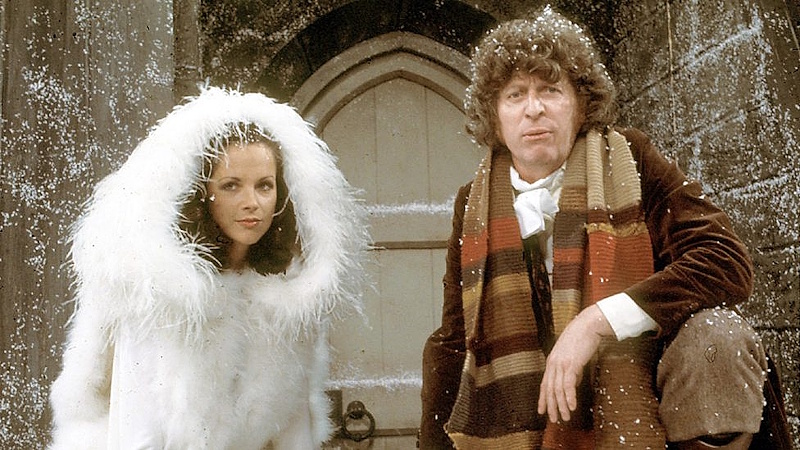
In her first appearance, Mary Tamm effortlessly hovers above Tom Baker’s scene-stealing in a way no-one else ever managed
Maybe it was the unjust circumstances that forced his and Hinchcliffe’s exit from the show, maybe it was just the massive tax bill that inspired The Sun Makers, but Holmes’s writing changed after this. The theme of greed surfaced frequently in his scripts for Jon Pertwee, but in a more colourful, tongue-in-cheek register: the broad anti-consumerist satire of his two Auton stories, Linx’s hare-brained plan to sell nukes to medieval warlords, the endearing fraudulence of Vorg and Shrina. From The Sun Makers onwards, greed will often be the entire subject matter of a Holmes script, and in a much darker, more desperate register. The Caves of Androzani is the ultimate expression of this, but The Ribos Operation runs it a close second.
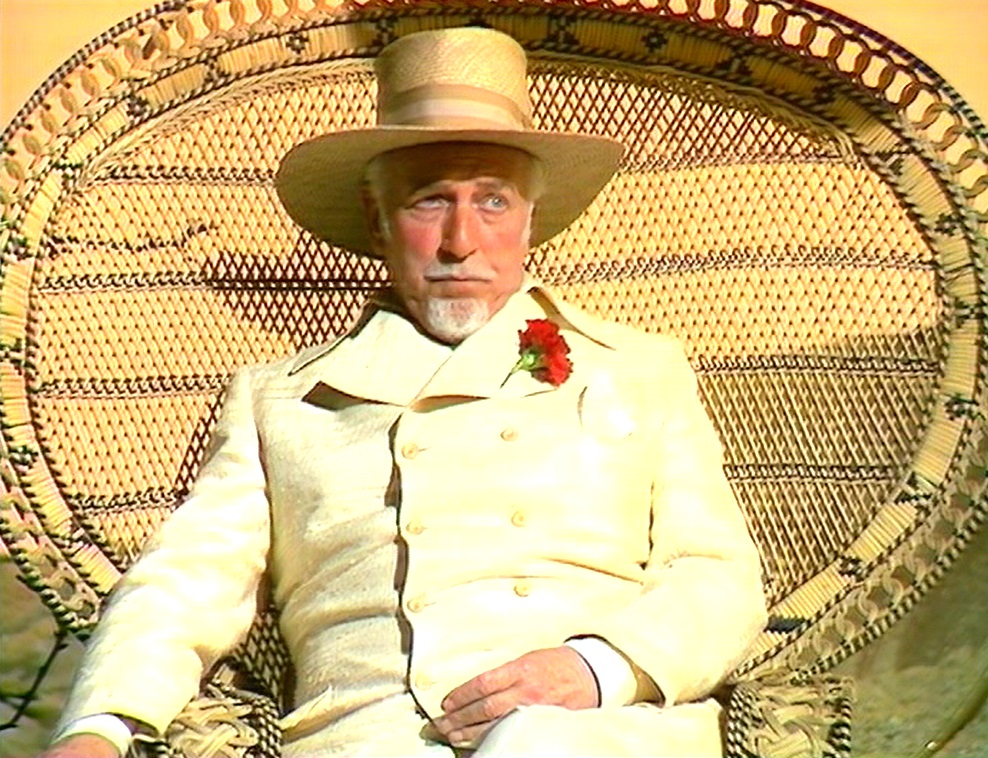
Indeed, The Ribos Operation might be a better example of Dicks’s observation about Holmes’s distaste for gods than anything he did to Gallifrey. Tasked with being the first writer to make sense of producer Graham Williams’s outline of the Key to Time and the White and Black Guardians (no small task, given that it reads like Erich von Danniken and Ramtha collaborating on the sleeve notes to a prog rock album), Holmes immediately drags the whole quantum-mystic mythology down to street level. Rather than being the Doctor Who equivalent of a just God, Cyril Luckham’s White Guardian is depicted as a white-suited, white-bearded English colonial gentleman who hijacks the TARDIS, threatens the Doctor and imposes a companion on him against his will.
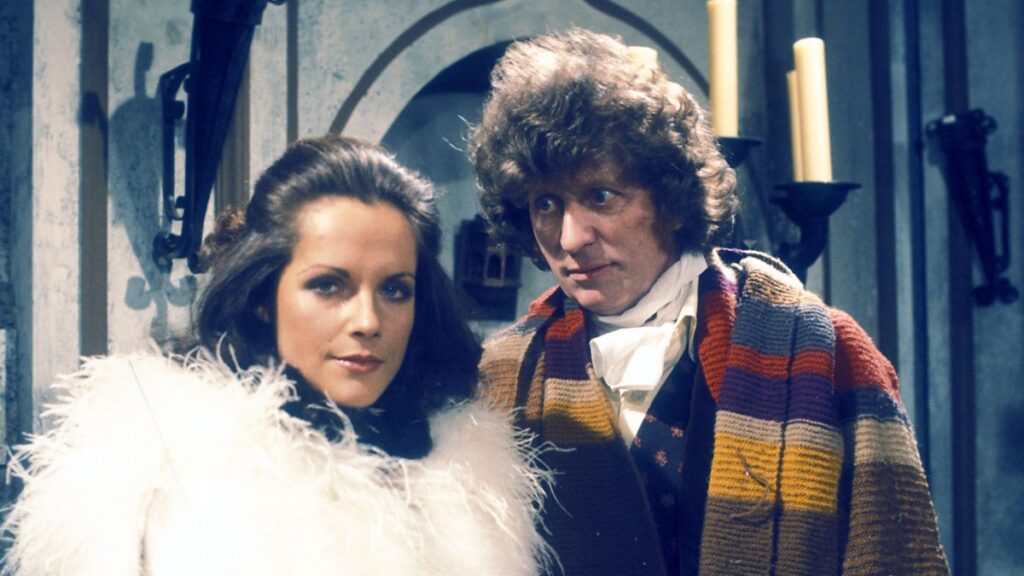
In fairness, Williams’s outline hints at something similar; since the Guardians must be of equal and opposing power, it is more accurate to describe them as forces for stasis rather than for good or evil. By this point, we’ve had four years to observe the Fourth Doctor’s response to authority figures who refuse to use their power to enact change, and sure enough he immediately resents having to go along with the White Guardian’s plan. He’s not that keen on Romana either, although Romana’s status as a character designed to be equal if not superior to the Doctor means this prickliness never tips over into outright nastiness. In her first appearance, Mary Tamm effortlessly hovers above Tom Baker’s scene-stealing in a way no-one else ever managed, helped along by the genuinely entertaining back-and-forth Holmes gives them. This version of Romana comes out with off-the-cuff psychiatric diagnoses for everyone she meets, a character trait that was wisely rested after this story but which doesn’t get old over these four episodes.
The situation on Ribos turns out to be a microcosm of what we’re told is happening to the universe, with the inhabitants carrying on in total ignorance of the interplanetary plot unfolding around them. The first hint we get towards this is a delightful jab at the series’ own ingrained biases; when we hear an ostensible alien on Ribos speak with a Somerset accent, we assume that the series is coding him as a Ribosian peasant in that somewhat classist way old Doctor Who tends to do. Then the Doctor identifies the voice as an actual Somerset accent, tipping him off that there are off-worlders on this apparently isolated, primitive planet. There are some wonderful actors playing wonderful characters here; Iain Cuthbertson and Nigel Plaskitt delight in Holmes’s renowned skill for writing double-acts as the unscrupulous Garron and Unstoffe, while Paul Seed maintains a careful, subtle level of menace as the tyrannical Graff Vynda-K. Most of all, there is Timothy Bateson as Binro, the character where the redemptive part of Holmes’s otherwise cynical vision coalesces.
In its depiction of humans interfering in the affairs of a medieval world, The Ribos Operation reminded me of Boris and Arkady Strugatsky’s 1964 novel Hard to Be a God (and its extraordinary 2013 film adaptation by Aleksy German). But the differences tell you a lot about how Holmes’s worldview works in a Doctor Who context. The humans in Hard to Be a God arrive on the planet Arkanar with hopes of bringing about a Renaissance; when this fails, they become as brutal and calculating as the aliens they meet. Garron and Unstoffe, by contrast, land on Ribos to make a fortune ripping off a poverty-stricken planet, yet in doing so they accidentally bring about hope and positive change, before leading the Doctor to the first part of a universe-reshaping gadget. The moment when they embrace this change in their purpose comes when Unstoffe meets Binro, exiled for his heretical belief that there are other inhabited planets in the universe. Unstoffe finds himself unable to resist telling the hapless outcast that he’s right – those lights in the sky at night are not ice crystals.
The fact that we haven’t heard this belief before it’s rebutted is a wonderfully sophisticated writer’s trick from Holmes. It tells us immediately that Ribos has a weight of religion and mythology far bigger than we’ve encountered, and also that Unstoffe has been stuck here long enough to hear it all. In this, then, Holmes’s themes of greed and godhood dovetail. Even if Holmes wasn’t personally invested in these themes, they would be excellent choices to dramatise something as abstract as the Key to Time; the theme of greed allows us to emphasise the Key’s scarcity, the theme of godhood spotlights its awe-inspiring power. If Holmes’s script about greed turns out to be better than his script about a god this time around, so be it; this is what late-period Holmes will be focusing on from now on.
Next: The Pirate Planet (1978)