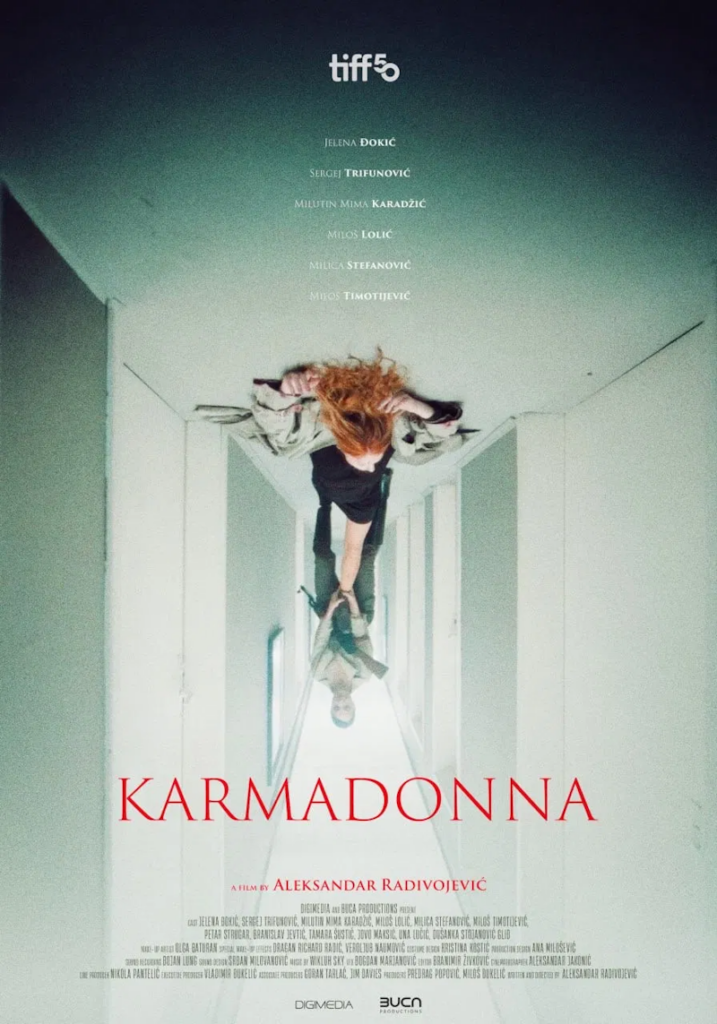
Biases and expectations are inherently and exceedingly dumb, as they often prove to be, but they remain – no matter how much you’d like to beg to differ. A case in point from Glasgow’s iteration of FrightFest is Karmadonna, a Serbian thriller/horror directed by Aleksandar Radivojević. As a fan of often subversive genre movies, it’s impossible to not have crossed paths in some way with Srđan Spasojević’s notorious cult classic A Serbian Film, but that doesn’t mean all Serbian films are on a comparable level of danger – even if they share a writer/director with an edgelord favourite (sorry, I couldn’t resist). Justifiable connections aside, it would be unfair to go into Karmadonna with that bias intact as all movies have to be judged on their own merits.
Karmadonna follows Jelena (Jelena Đokić), a slightly older than usual expectant mother-to-be who’s beamingly happy, and on the phone with a friend expressing her joy – which is short-lived when she receives a call from an “unknown number”. The voice on the call belongs to a god (Sergej Trifunović), who proves his divine power by forcing a badly behaved child in a park to run headfirst into a nearby tree. This mean-spirited, angry god has decided to use a pregnant woman as his vehicle to travel about a nameless Serbian town, killing people in order to make the world a better place – a task he doesn’t really help with, leaving the whole assassin routine up to the mother-to-be.
This “kill list” as it were, starts with a corrupt cop ripping off merchants by selling fake gear out of the back of his car. Next is a media tycoon whose politics, ethics, and loose morals are coded to read like an Andrew Tate, but as you’d expect, this one goes badly because Đokić isn’t exactly equipped like a Neil Maskell or Michael Smiley. After that the film sashays into a tale about one of the god’s offspring who’s been manipulated by the media class to do their bidding, and according to the inner mythos of Karmadonna, the god on the phone is unable to influence them due to their control of his progeny.
What do they do with this godly control? They make an anti-smoking advert (which opens the movie), and a reality TV programme that seems somewhat confused – but I say that as someone oblivious to the ways of “reality TV.”
Radivojević’s film has two distinct halves, the first of which has a certain on-the-nose pleasure to it as it’s interested in more earthly concerns, and follows the central duo moving from one situation to the next. The subtext and targets of the writer/director’s ire aren’t exactly subtle as his script literally takes any and all opportunity to explain itself. In essence he takes aim at corruption and exploitation for personal gain – which would make the angry god’s job endless if the film adopted a less Serbian, more global outlook. The second half looks at media control, and the exploitation of people’s neuroses and interpersonal issues for profit – an equally rife playground as although rudimentary in its text, Karmadonna does scratch an itch.
Being a movie about assassinations and gods, the methods of murder do vary, initially being more enjoyable as the script allows Jelena to talk to her targets (the worst scumbags), and letting situations bubble up to a point where their deaths feel both accidental and inevitable. Unfortunately there’s a turn where the assassinations stop being cathartic and start becoming mean-spirited, and the long sequence featuring a pregnant woman being violently teased sits very uneasily. It’s baby terror compared to Radivojević’s earlier work in A Serbian Film, but that doesn’t lessen the impact.
Later, after endless philosophical sparring between a deity and a crass, avaristic media class, the violence escalates, and the only way to describe the final act is as an erosion of inhibitions. One character taking cannibalism to a level of presentation informed by magazine TV shows – which is an odd contrast as the extent of the violence, though impressively staged by the production and effects teams, is utterly icky. Another by-product of this breakdown is that the control of the first half goes awry, the ideological hyper-focused satire being replaced by wanton violence. In the right context it’s something that I both love and respect, but here something interesting with a clear line to the satirists of classic Polish cinema, has been traded for something lesser.
While it does lose its way in the last act, there’s enough in Karmadonna to recommend to audiences that frequent horror festivals up and down the land. Biases aside, the viciousness here will click for those who loved movies like Rob Jabbaz’s The Sadness (2021), or the work of Gaspar Noé – even if it doesn’t hit the same extremes as those touchstones. What I cannot abide, however, is the twist in the final few moments as, although key to the film’s message, the scale asks questions the movie cannot answer.
KARMADONNA HAD ITS UK PREMIERE AT GLASGOW FRIGHTFEST 2026