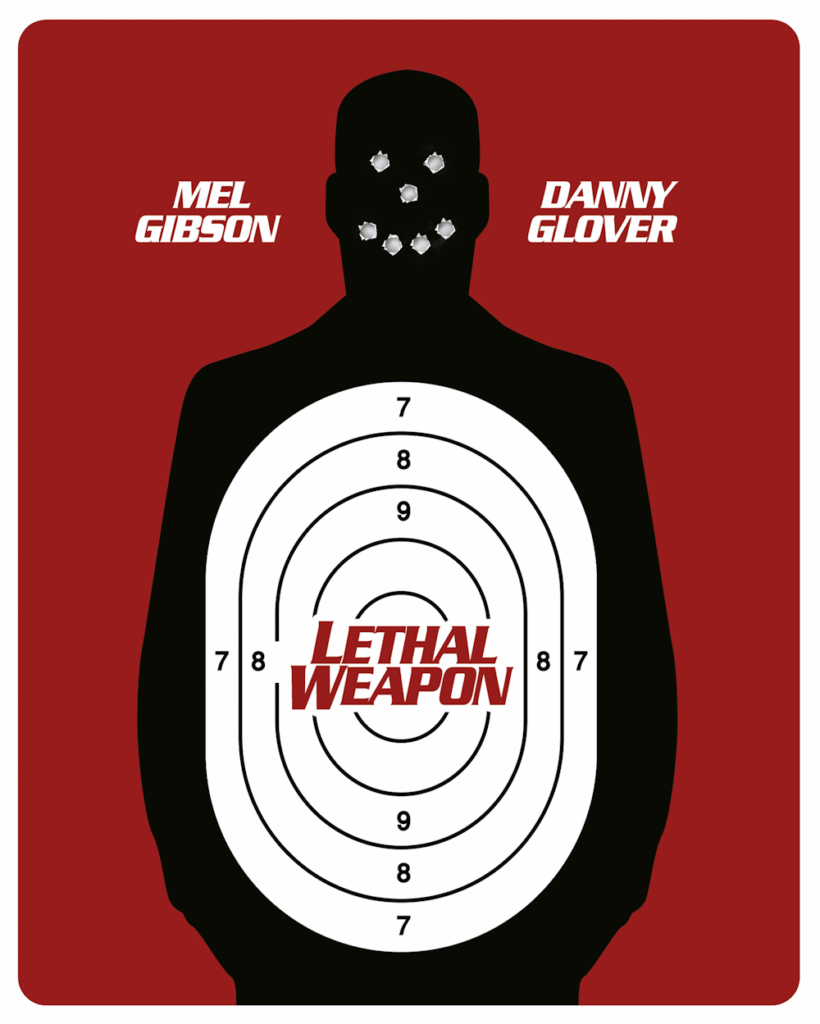
When approaching movies from prior decades, there is always the question of whether they will hold up. Sometimes this concern relates to outdated attitudes or forms of representation, and other times it relates to more recent discoveries about the people involved. In the case of Lethal Weapon, there is a question over Mel Gibson, who rose to mega stardom, not least as a result of this film, then fell to pariah status while also demonstrating that ‘cancel culture’ is hardly effective. One may ignore Gibson’s controversial statements or declare all his previous work null and void. Or one can accept questionable things about one person, and look at the film as a whole. With Lethal Weapon, the film as a whole stands up in various ways, some of which are quite surprising.
Released in 1987, during the run of action cops that also included Cobra, Tango & Cash, Red Heat and perhaps most enduringly, Die Hard, Lethal Weapon sees director Richard Donner realise Shane Black’s script into a brutal and blood-soaked yet witty and warm action thriller. It is a very Los Angeles film, the freeways, high rises and neighbourhoods that are simultaneously distinct and anonymous brought to vivid life. Cinematographer Stephen Goldblatt captures dazzling sunlight, hazy smog and a surprising amount of falling water including rain and, in a key scene, a burst fire hydrant that turns a front lawn into a jungle-like environment complete with scattered light from the flying moisture.
It is also very 80s. The opening sequence focuses on a young blonde woman, her body exposed and shot in a highly eroticised manner. The high-rise apartment in which we find her, taking drugs before plummeting to her death, oozes glamour and sleaze in equal measure, and oddly feels like a precursor to Twin Peaks despite the vastly different tones. The soundtrack with Eric Clapton features extensive use of saxophones, and composer Michael Kamen would create similar suspenseful beats in his score for Die Hard the following year. The big hair, especially Gibson’s mullet, the clothes and the interesting portable phones all help to make this a clear expression of its time.
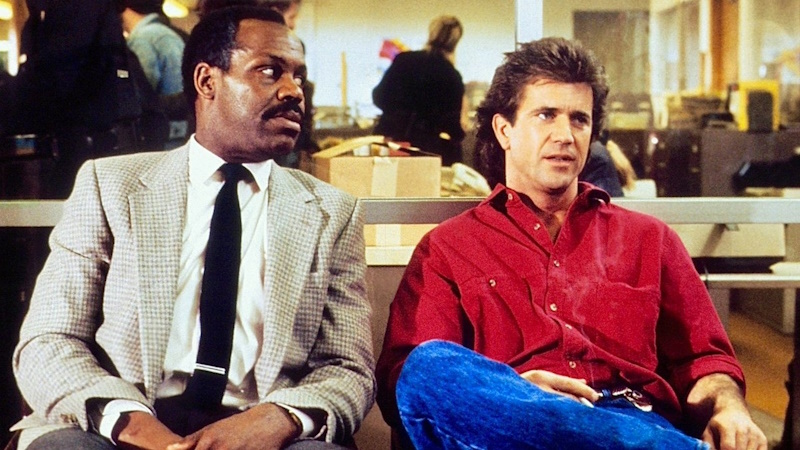
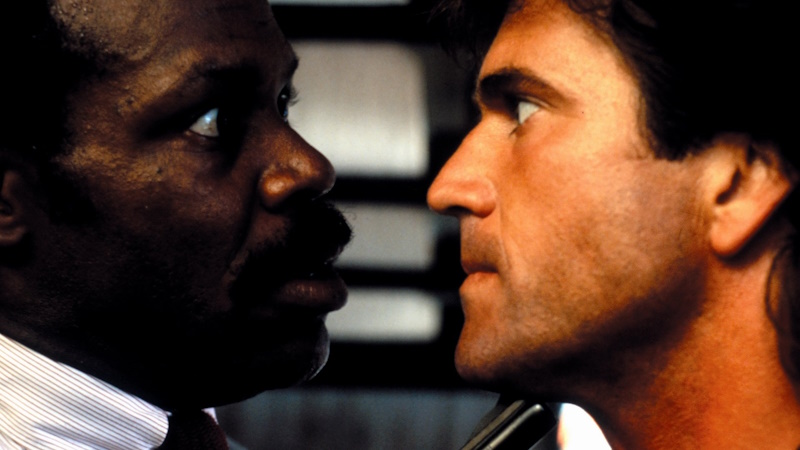
Nonetheless, Lethal Weapon still delivers for a contemporary audience. It is an unashamed action movie, with dramatic set pieces that steadily deliver suspense and then quite shocking violence. The action is fluid and kinetic, and the gunshots often very loud. The highly versatile Donner directs with visceral aplomb, including sweeping crane and aerial shots that show the expansive spaces of the area our heroes move in, as well as tight close-ups on faces and especially the eyes of the two leads, LAPD detectives Martin Riggs (Gibson) and Roger Murtaugh (Danny Glover).
As a portrayal of mismatched cops, it is easy to see why this became one of the great buddy movies, and indeed franchises. This is partly down to the chemistry between Gibson and Glover, and also due to Shane Black’s razor-sharp script that balances snappy dialogue with character depth and, in several cases, severe mental baggage. All the men here are Vietnam veterans, having either nearly died and indeed killed extensively. Despite the clear moral lines, parallels exist between Roger’s family man – something of an authority figure – and lead villain General McAllister (Mitchell Ryan) as the authority of his ‘family’. There are more overt parallels between Riggs and lead henchman Mr Joshua: Gary Busey matching Mel Gibson for crazy eyes and a thousand-yard stare. While trauma is not as narratively or thematically central, the legacy of Vietnam is clearly alive and well.
This serious undertone is notable because, while the future films became increasingly comedic, this original film has genuine melancholia. This release includes both the theatrical as well as the director’s cut – the latter is the more interesting, because of the additional scenes that add to the melancholia by showing more of Riggs’ backstory, juxtaposed with Roger’s domestic scenes. We see Roger in the bath with his family gathering around him to celebrate his birthday, captured in a medium shot with his head in the top right of the frame. The film then cuts to a similar shot of Riggs, his head in the top left of the frame, in his trailer and accompanied only by his dog. Subsequent scenes continue to establish the contrast between the two men, beyond the obvious distinctions of older, black, family man and younger, white, solitary loose cannon.
This is partly down to the chemistry between Gibson and Glover, and also due to Shane Black’s razor-sharp script that balances snappy dialogue with character depth and, in several cases, severe mental baggage.
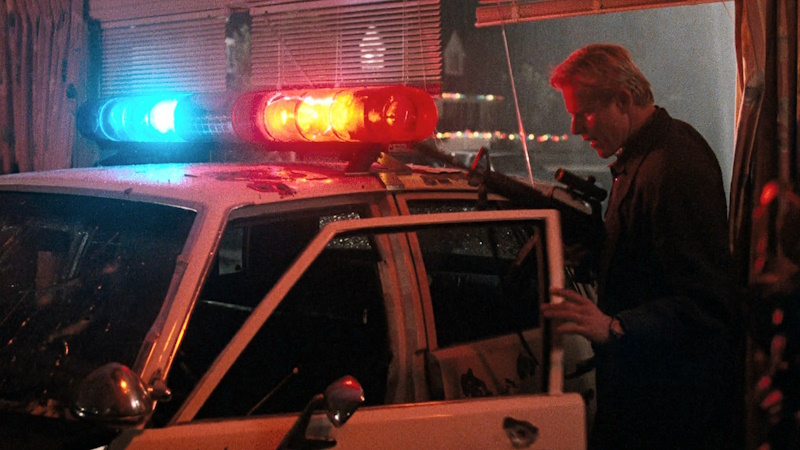
Speaking of identity politics, and despite the centrality of firearms, the politics of the film are not as regressive as might be expected. Sure, cops are presented as fundamentally good, a position that is harder to swallow post-Rodney King and George Floyd, not to mention more cynical cinematic treatments such as Training Day, Dark Blue and Street Kings. Despite this valorisation of police (someone has to be the hero after all), the threat is very much internal, the dubious legacy of Vietnam continuing to poison America, the black family as the pinnacle of middle-class America, an innocent black teenage girl threatened by violent white men who are, fittingly, the greatest enemy.
Furthermore, for all the violent death on display, this is fundamentally a film about balance. The narrative conflict between good guys (cops) and bad guys (drug dealers) provides the highflying shocks and motivates the action, but the film’s central conflict is between violence and domesticity. The tension between the domesticity of the Murtaughs and the violence of Roger’s job provides a human, emotional weight, as well as winning humour in the scenes with his family. Just as Roger cannot keep his home separate from crime, the incorporation of Riggs into the Murtaugh family to is an act of balance – Riggs himself becoming stabilised despite his continued lethality, weapons able to be put aside in favour of Christmas dinner.
The 4K transfer of Lethal Weapon looks great, LA bathed in sleazy beauty much as the actors’ skin is frequently bathed in sweat. There are, unfortunately, some points where you can see the faces of the stunt doubles – long shots in the 80s did not anticipate 4K digital upgrades. But these are very brief and, hopefully, you’re sufficiently engaged in the action not to care.
The disc comes with two background extras, recorded in 2024. A Legacy of Innovation: Remembering Dick Donner, commemorates the late director through interviews with such figures as associate producer Jennie Lew Dugand, producing partner Lauren Shuler Donner, writer Shane Black and actors Danny Glover, Traci Wolfe and Jackie Swanson. While rather superficial, these recollections include insights of Donner’s approach to directing, such as his love of improvisation. The talking heads are intercut with scenes from the movie, which provides wry humour. The shoot sounds like an exciting one, thanks to the high stakes of the stunt pieces and the warmth and infectious enthusiasm of Donner. The recollections do become platitudinous, but also come across as genuine, especially as some of the interviewees shed tears over their departed friend and colleague.
The same figures appear in ‘I’m Too Old For This…’: A Chemistry That Became Iconic. This retrospective includes interesting anecdotes such as speculation over Lethal Weapon being possibly the first film to be based around reluctant partners, and the origin of Murtaugh’s famous catchphrase. There is praise for casting director Marion Dougherty, who first suggested that Murtaugh be black as well as recommending the two leads, which is great to see as casting directors are often overlooked. The strongest impression is of the immediate chemistry between Glover and Gibson, commemorated by Glover recalling that they never clashed and his great gratitude for working on the film.
As a package, this 4K release does not do full justice to an iconic, enduringly popular and influential piece of cinema. Cynically, one can imagine further retrospectives will appear on similar releases of the remaining films in the franchise, or on a four-film ultimate edition boxset. However, as a remastering of the film itself and the provision of two versions, it is a must for any fan of Lethal Weapon, and indeed 80s action.
LETHAL WEAPON IS OUT NOW ON WARNER BROS (4K) BLU-RAY