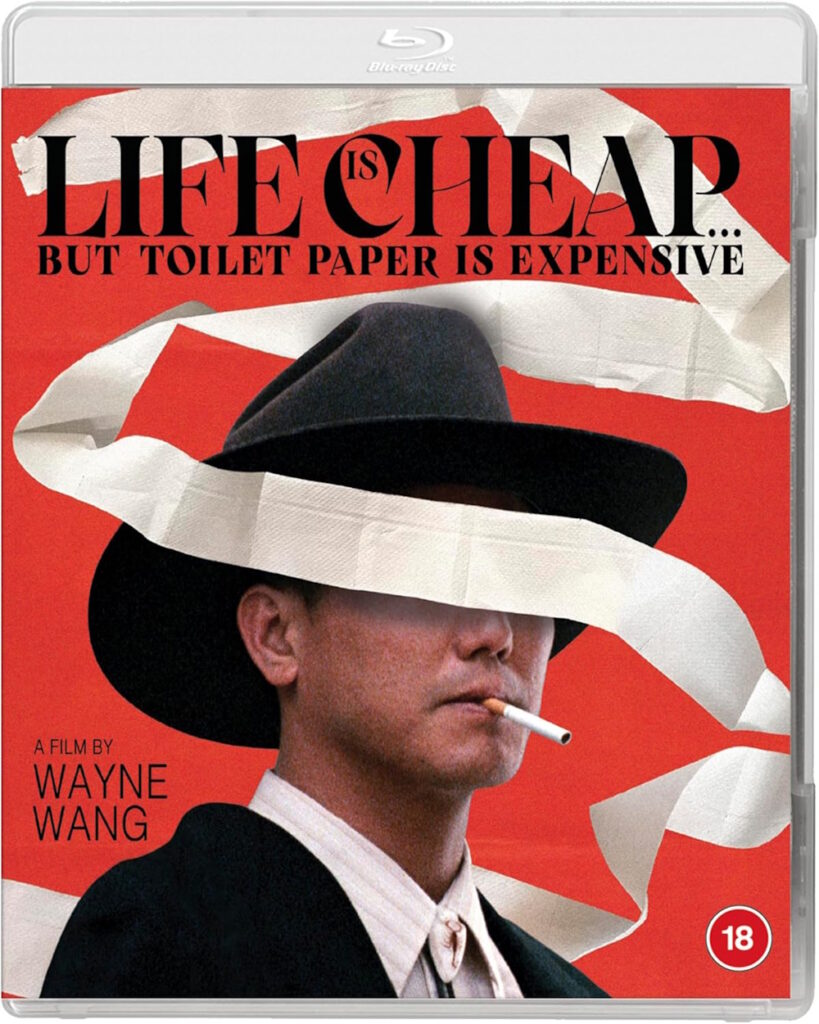
For all its association with high style, there’s always been a documentary element to film noir. The genre is rooted in social commentary, and took every opportunity to get off the sound stages and into the streets once camera technology became lightweight enough to do that. You can even point to actual documentaries like Errol Morris’s The Thin Blue Line or Bart Layton’s The Imposter which adopt noir cinematography. But there has never been anything like Wayne Wang’s Life is Cheap… But Toilet Paper is Expensive, released on limited edition Blu-Ray by Radiance Films. How wild does it get? Sufficiently wild to make that title look like the least extraordinary thing about it.
Plot-wise, Life is Cheap… But Toilet Paper is Expensive is built on the kind of sturdy, simple amoral dilemma that noir films often use as a springboard. The film’s co-writer Spencer Nakasako plays a mysterious drifter in late ’80s Hong Kong who agrees to transport a briefcase to a mysterious client. The briefcase is extremely important, important enough for Nakasako to be handcuffed to it, and he becomes understandably concerned that he’s working for the mob. His paranoid imagination conjures up repeated, flash-cut visions of his hand being severed, another splatter of red in a film which is overall redder than the cover of Quotations from Chairman Mao Tse-Tung.
The film’s politics can be inferred from the title. The handover which placed Hong Kong under Chinese governance is still eight years or so into the future; Wang’s vision of Hong Kong is a taut rope in a tug-of-war, fearful of Communism but thoroughly disillusioned with capitalism. What’s truly remarkable about the film is not the insights themselves, but how they’re delivered. Most of Life is Cheap… But Toilet Paper is Expensive (you’d better believe I’m typing it out in full every time) toggles between two modes: quick-cut montages narrated by Nakasako, and to-camera interviews with the other characters in the story. I say “characters”; sometimes the documentary style appears to be documentary substance, by which I mean there are quite possibly a few real people being interviewed here.
Wang doesn’t just want to tell this story, he wants to use it as a window into what he sees as the fervid psyche of Hong Kong in the late ’80s, and if that means completely obliterating the line between reality and fiction then so be it.
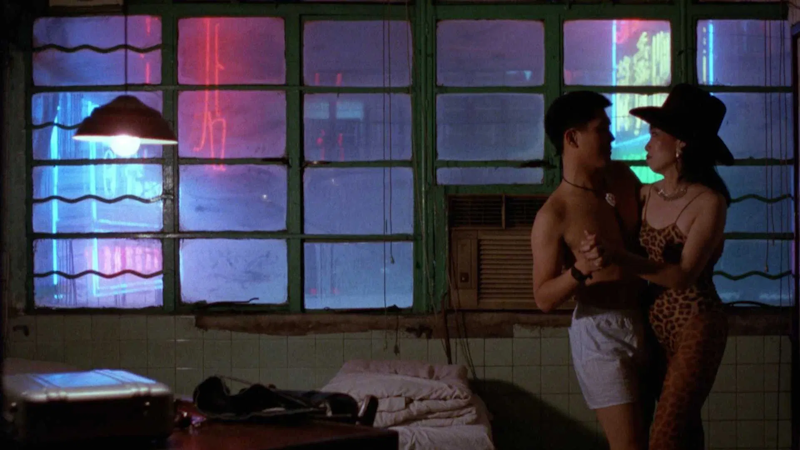
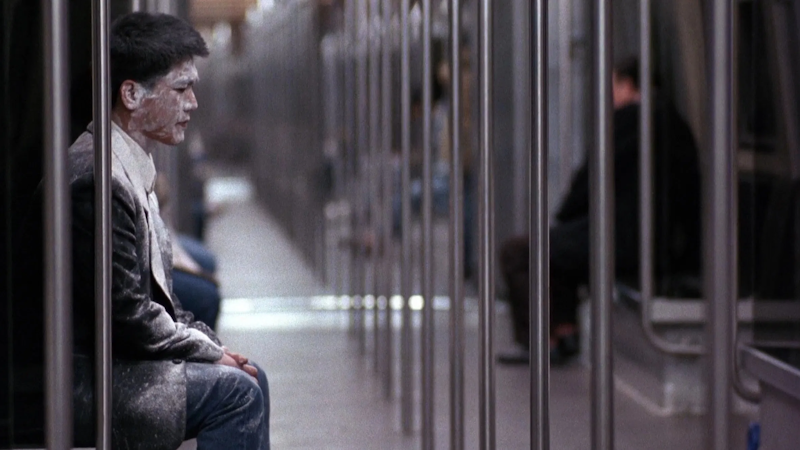
The miracle is not that this adds up to a coherent story, but that there aren’t other film-makers doing the same thing. There are antecedents: it feels a bit diminishing to call something as radical as this a mock-documentary, but you could if you wanted. It reminded me of Godard at his most fourth-wall-disregarding, or – casting ahead to films which may be influenced by this – Joshua Oppenheimer’s The Entire History of the Louisiana Purchase, or Justin Kurzel’s contribution to the anthology film The Turning. Both of them repeat the trick of telling a fictional story through to-camera interviews with the characters, but neither of them are as destabilising in their mixture of real and fictional footage. Wang doesn’t just want to tell this story, he wants to use it as a window into what he sees as the fervid psyche of Hong Kong in the late ’80s, and if that means completely obliterating the line between reality and fiction then so be it.
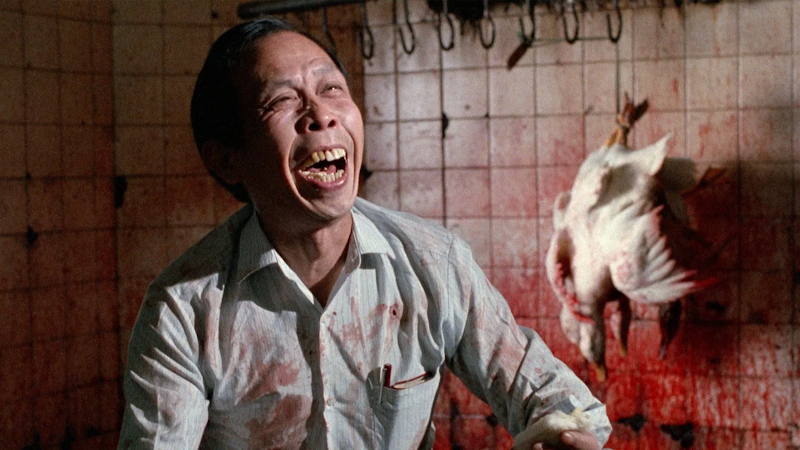
It’s a punk film, a shocking film, with scenes of real-life animal slaughter that make me a little hesitant to recommend it. That said, there’s a clear metaphorical reason for them to be there: who isn’t being trussed up and bled dry by the economy in this movie? It belongs to that canon of films, along with Breathless and Killer of Sheep, whose mixture of visible cheapness and remarkable invention make you want to go outside and film your neighbourhood right now. It’s all the more remarkable coming from someone whose most famous 21st-century work is probably the Jennifer Lopez rom-com Maid in Manhattan, although his work immediately following this film shows a clear path. After Life is Cheap… But Toilet Paper is Expensive he collaborated with one of the greatest literary exponents of this postmodern noir style, the late Paul Auster, on the duology of Smoke and Blue in the Face. But in between, he made The Joy Luck Club, a humane, beloved modern take on what Golden Age Hollywood called the “women’s picture”, which prepared the ground for his very different later pictures.
Radiance’s extras include an interview with Wang about this film and his remarkably diverse career, as well as another interview with Wang and Nakasako talking about the writing and production of a crime film unlike any other. There are also extended scenes, new writing by Aliza Ma, and a 4K restoration which justifies the purchase on its own. You’re never going to make a film this low-budget look like Lawrence of Arabia, but there’s something about being able to practically feel the peeling paint on the walls which adds significantly to the experience.
LIFE IS CHEAP… BUT TOILET PAPER IS EXPENSIVE IS OUT NOW ON RADIANCE FILMS BLU-RAY