

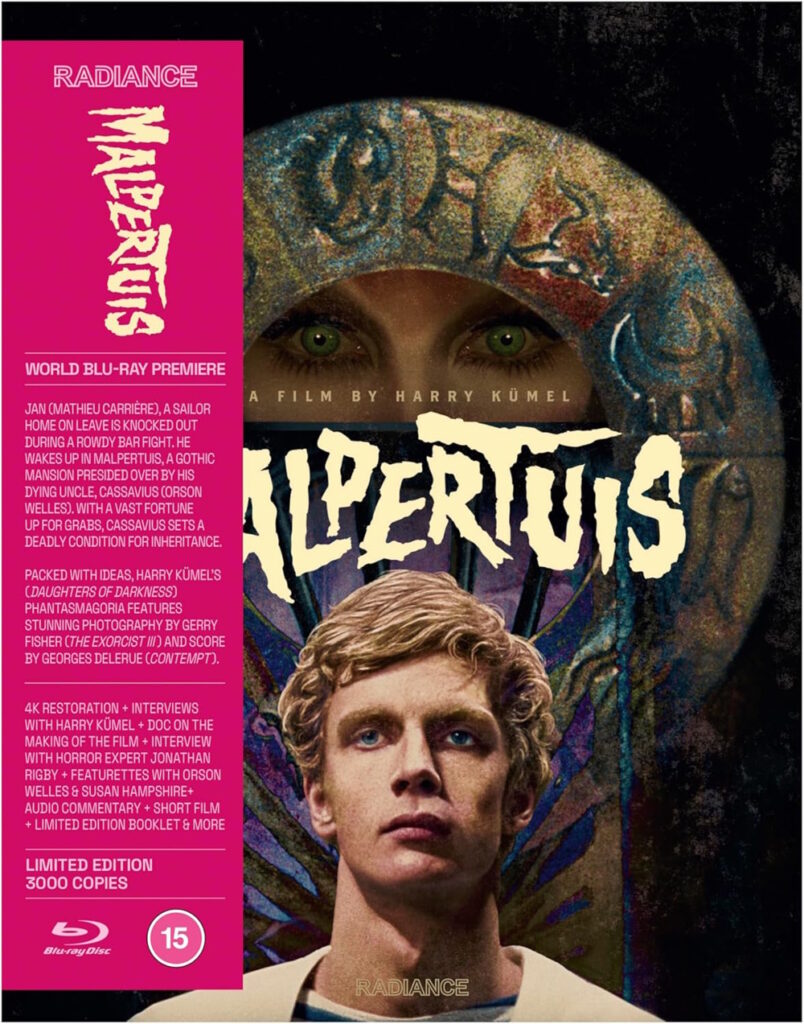
Based on Jean Ray’s 1943 novel of the same name and coming to Blu-ray courtesy of Radiance on 13th October, Malpertuis is a bizarre Belgian odyssey from director Harry Kümel. The film had its premiere at the Cannes Film Festival in 1972, before subsequently fading from view into cinematic oblivion, and stars Orson Welles, Jean-Pierre Cassell, and Susan Hampshire in a whopping five roles.
The swift obscurity of Malpertuis lies in the fact that Kümel’s English language version of the film had been unceremoniously butchered by U.S. film distributors in order to screen it at Cannes. Under the tacky and unoriginal title of The Legend of Doom House, Kümel’s film was initially shorn of twenty minutes, but suffered further savage cuts from other distributors as it limped its way towards release. Overseen by Kümel and the Royal Belgian Film Archive, this is the original uncut Flemish version of the film which was previously released in 1973 as “the director’s cut”. Unfortunately, the restoration to its native Flemish means that while this version is the most complete, it loses the original vocal performance from Orson Welles.
Malpertuis tells the story of innocent and pure of heart sailor Jan (Mathieu Carrière), who arrives ashore and sets out to visit his childhood home of Beacon Quay, but his search proves fruitless and he’s led to believe that the place is no longer there. He’s drawn instead to the flamboyant den of iniquity Bar Venus, which is presided over by yé-yé girl Sylvie Vartan’s cabaret artiste Bets. She’s an alabaster-skinned blonde who Jan initially mistakes for his dear sister, Nancy (Hampshire), only to discover in the nick of time that she’s no pure maiden. Trapped in this gaudy Soddom and Gomorrah, our hero is caught up in an altercation which leaves him knocked out and mysteriously abducted. Waking up in a gothic mansion, Jan learns that he has arrived at Malpertuis – a decaying estate presided over by his tyrannical uncle, Cassavius (Welles), who’s confined to his bed while awaiting death.
Remember that line about work, “I wouldn’t get out of bed for x amount of money”? I don’t know how much Welles pocketed for Malpertuis, but he did so whilst not having to get out of bed, and I suspect that’s why he signed on the dotted line!
Jan is finally reunited with his sister and reacquainted with several relatives, including resident grovelling madman who lives under the stairs, Lampernisse (Cassell), and bowler-hatted dirty postcard collector, Dideloo (Michel Bouquet), who seems to be the mastermind behind Jan’s kidnapping. Jan learns that they’re all hoping to inherit the old man’s considerable fortune, but Cassavius is an occultist who has one more trick up his sleeve – anyone who inherits the estate must stay there forever. If they try to find a way out amongst the labyrinth of corridors, staircases and secret chambers then they’ll meet a mysterious and horrible demise.
Malpertuis is a film that sacrifices narrative clarity and cohesion for dreamlike atmospherics and wilful obscurity
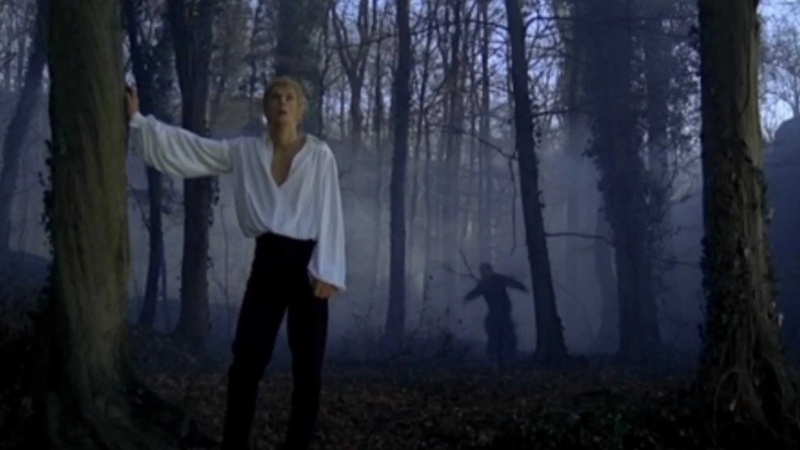
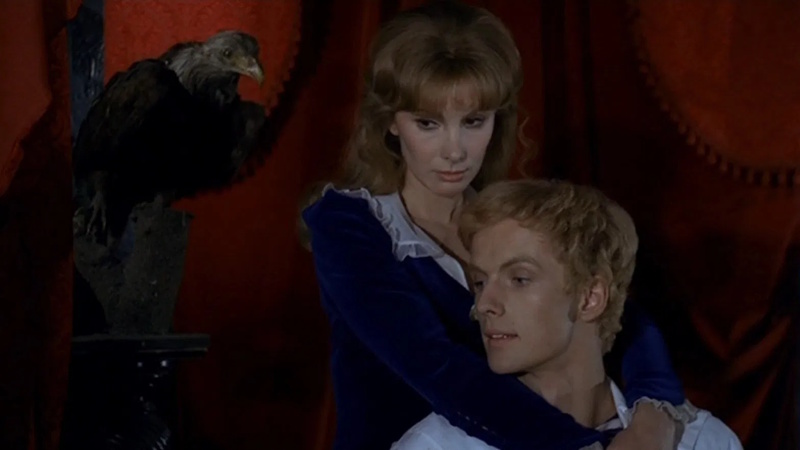
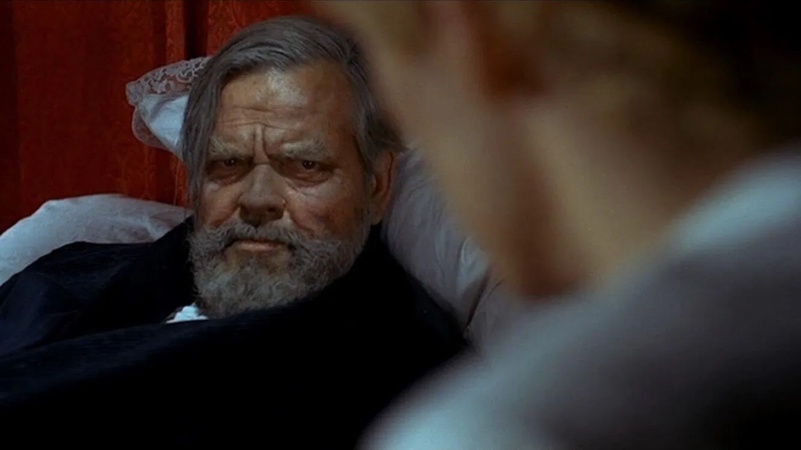
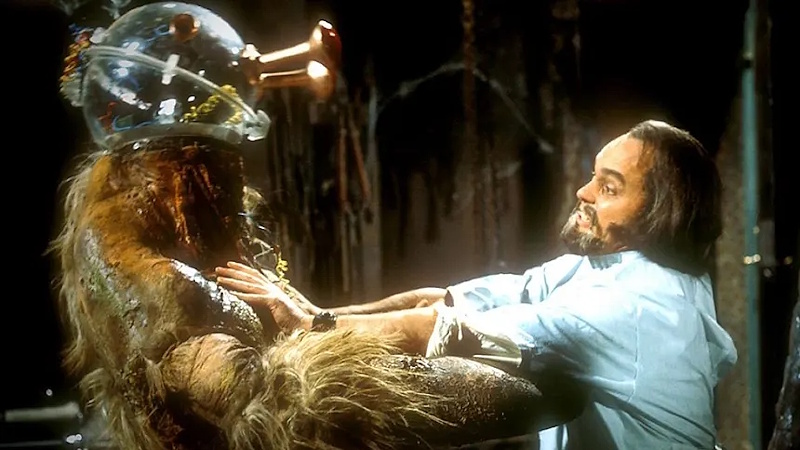
“Nobody must know what is going on at Malpertuis!” one character exclaims, and Malpertuis is definitely a film that sacrifices narrative clarity and cohesion for dreamlike atmospherics and wilful obscurity. Sitting here around an hour after watching the credits roll, I’m still at a loss as to what was really going on. Kümel fills his movie with symbolism and surrealism that all hints at something, and while there’s indeed a pay-off and reveal about what Cassavius has been up to, it never really coalesces into anything truly fulfilling. Without giving too much away (even though there’s nothing you can really give away since it’s all so elusive!), Cassavius’ scheme seems to consist of imprisoning his greedy relatives within the gothic, inescapable environs of Malpertuis and forcing them to play the roles of gods from Greek mythology.
There’s a bit more to it than that of course, but that’s the gist of it.
Quintessential English rose Susan Hampshire defies her usual casting to play several roles in Malpertuis – Alice, one of the trio of black-clad, repressed spinsters who are clearly inspired by the Furies, and Euryale, who was one of the Gorgons. Fanny Winkler and Robert Lussac’s weary old servants explicitly recall their youthful days as Venus and Eros, and long for those heady days to return. I believe that Cassell’s tormented Lampernisse is Prometheus, tasked with keeping the lights on and endures a squalid existence of punishment, but I may be wrong. If you know your myths well then you may get a little bit more from Malpertuis, but it remains mostly impenetrable stuff, and perhaps purposefully so as at times it reminded me of Mervyn Peake’s Gormenghast or the work of Doctor Who writer Marc Platt – specifically the 1989 serial Ghost Light and his 1997 Virgin New Adventures novel Lungbarrow. They’re all tales of oddball inhabitants of gothic abodes, and I wonder if Platt is a fan of either this movie, Jean Ray’s original novel, or Peake’s fantasy series.
The plot is a head scratcher alright, so what does Kümel offer to those of us lacking in the intelligence department as a means to grasp his message? Well, Malpertuis is very colourful, looks beautiful, and is full of striking imagery, but it’s also staged rather inadequately, and it’s often left to somewhat poor actors to convey the meaning, most notably Mathieu Carrière’s deathly dull protagonist. It’s all very beautiful, but rather useless in that regard, which reminds me of the words of William Morris – “nothing useless can be truly beautiful”.
This new, limited edition 4K restoration of the film offers a range of special features, many of which are from 2005, including an audio commentary from Harry Kümel and assistant director Françoise Levie, and an archival documentary about the making of the film featuring Kümel, Mathieu Carrière and director of photography Gerry Fisher. There are also new interviews with Kümel and author/gothic horror expert Jonathan Rigby, as well as old interviews from 2005 with Susan Hampshire (which includes screen tests and contributions from cast and crew), and Jean Ray, who wrote the original novel and was co-writer on the film. Also included is Orson Welles Uncut – a featurette about his casting that includes rare outtakes of the actor, a short film where Harry Kümel revisits the filming locations almost thirty-five years later, and a Belgian TV interview from 1971 with Michel Bouquet and Kümel.
The new version also includes Malpertuis: The Cannes cut – the rejected version of the film that premiered in Cannes (viewable in French or English), and The Warden of the Tomb – Kümel’s 1965 film based on Franz Kafka’s play. Rounding out the set is the usual trailer, a reversible sleeve featuring original and newly commissioned artwork by Time Tomorrow, and a limited edition 80-page booklet featuring new writing by Lucas Balbo, Maria J. Pérez Cuervo, David Flint, Willow Catelyn Maclay, and Jonathan Owen.
MALPERTUIS IS OUT NOW ON RADIANCE FILMS BLU-RAY


One thought on “Malpertuis (1971) Dreamlike atmospherics and wilful obscurity”
Comments are closed.