The process of producing a television show as complex as Doctor Who is no mean feat. Once the scripts are written, the locations scouted, the sets built and the tea bags purchased, the actors begin their job of bringing the stories to life. Another aspect of production, arguably one of the most important, is the music chosen to accompany our favourite show. For the best part of the Doctor’s revival, music has been helmed admirably by TV composer Murray Gold. Gold’s earned his place as one of TV’s greatest orchestrators, combining multiple musical genres to create some truly epic soundtracks, adding atmosphere and pathos to electric scripts, creating true television magic. So how on New Earth did a Northern Irish pop star fit into Gold’s musical opus?
The Divine Comedy burst on to the UK music scene in 1996 with their fourth album Casanova and in particular the single ‘Something For The Weekend’ which was championed by inexplicably popular DJ Chris Evans on his BBC Radio 1 breakfast show and Friday teatime madhouse TFI Friday. Hailing from small town Northern Ireland, the group had been slugging away since 1989 (albeit with a few cast changes) with limited success in the Irish music charts, leading to the band’s song ‘Songs Of Love’ being used as the theme to the popular Irish priest-based sitcom Father Ted and penning two songs including ‘My Lovely Horse’ for their Eurovison-themed episode. Front man and lead lyricist Neil Hannon gained notoriety for his distinctive voice and imaginative lyrics – often basing his songs around social issues, movies and the aspects of love. His childhood in Northern Ireland led him to music as a form of escape, citing his early influences as OMD and the Human League. The band enjoyed more single success in the late nineties with ‘Becoming More Like Alfie’, ‘Everybody Knows (Except You)’ and ‘In Pursuit of Happiness’. The latter lent itself to the theme to BBC stalwart Tomorrow’s World, cementing the bands TV-theme friendly status and bringing their music further into public consciousness. 1999 saw the groups national anthem-esque ‘National Express’, ridiculed by critics at the time as ‘mock-pop’ by NME for it’s subject matter and plain-talking lyrics, but charting at number 8 in the UK charts. Further albums and collaborations for Hannon followed, bringing us to 2006 and a shock TV regeneration that shook the nation.
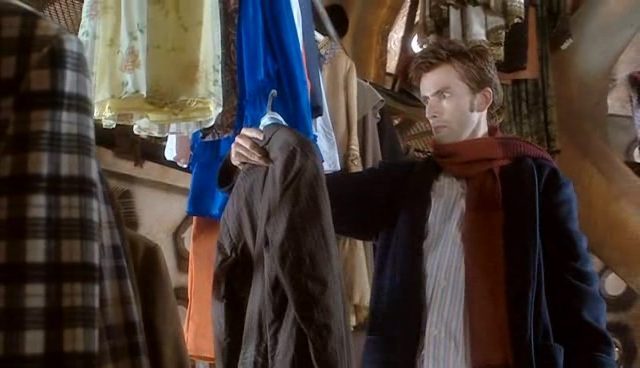
Christopher Eccleston departed Doctor Who in 2005 after just one series and David Tennent entered the fray. With him came a new era of the show, presenting composer Murray Gold with a dilemma. His music for Eccleston’s era had been richly praised, it’s motifs both melancholy and dramatic, piano ballads and moody orchestral swells framing a Doctor scarred by war and full of regret. This new Doctor was younger, more fun, brimming with excitement and his soundtrack needed to express that. The Christmas Invasion, Tennant’s first story, offered the opportunity to do that, with Gold composing an original song to be played while the Doctor’s new persona tried on their new clothes – a pivotal scene in the characterisation, allowing the audience to get to know the Doctor they’ll be watching for the foreseeable. ‘Song for Ten’ is a departure from the norm, it’s a punchy lament about personal growth, referencing Christmas and the Doctors relationship with companion Rose (“And I followed my star/Coz that’s what you are/I’ve had a merry time with you”) and displaying the personality of Tennent’s Doctor – young, vibrant, modern. Gold asked singer/songwriter Tim Phillips to perform the song which aired on Christmas Day. Phillips is himself a TV composer with a number of high-profile credits and he did an admirable job, his distinctive voice bringing a new feel to this new style of Doctor.
Perhaps what makes the collaboration so successful is Hannon’s love for the show coming through


Tennent’s Doctor wowed audiences across series 2, instantly becoming a fan favourite. The departure of companion Billie Piper was watched by 8.2 million and is often cited as one of the most devastating series ends in the NuWho era. 2006’s Christmas special would prove to be a departure from the preceding series, pairing Tennant with Catherine Tate’s Donna Noble, an outspoken, reluctant companion, desperate to get back to her wedding from which she’d been mysteriously beamed from and into the Tardis. For Tate, Gold had crafted a jaunty theme fitting ‘Donna’s Theme’, suiting the character perfectly. Once again, an opportunity presented itself to include some third-party music, at Donna’s wedding reception, featuring a large group of people dancing and celebrating. Gold turned to Neil Hannon, asking him to collaborate on the lyrics for an original composition, ‘Love Don’t Roam’, an upbeat take on ‘The Snake’ by Al Wilson.
Wilson’s song is a story about a woman falling for a helpless snake who proves to be a destructive force at the cost of the songs “tender woman”. Hannon and Gold flip the narrative, telling a story about a travelling man who wants to settle down, a direct parallel with the Doctor’s story with Rose Tyler, given he had all but confessed his love to his former companion before she disappeared from his life forever. Given its influence, the song has a retro feel, making it feel very familiar and incredibly fitting for the love sick Doctor, who pictures himself and Rose in flashback as the song plays (“Well you took me in/You stole my heart/I cannot roam no more/Because love, it stays within you/It doesn’t wash up on a shore”). The combination of Gold’s music and Hannon’s lyrics and distinctive voice create not only a perfect accompaniment to the scene, but a perfect snapshot of the Doctor’s mentality at that point in his story. Following this collaboration, when the BBC soundtrack was being compiled for Series 1 and 2, Gold turned to Hannon again, asking him to record a version of ‘Song For Ten’ for the soundtrack. Hannon’s voice lends itself to Gold’s lyrics perfectly, resulting in a superior version of the track, bringing gravitas to the song, once again capturing the Doctor’s mindset in that moment perfectly.
Looking at Hannon’s back catalogue with The Divine Comedy provides an insight into why Gold chose to give him these songs at important moments in the Doctor’s story. Hannon is a natural storyteller, his songs telling tales of the human condition. He has a rare talent for song writing, with ‘Something For The Weekend’ building a story throughout about a couple enjoying a weekend away, resulting in a woodshed-based narratively bloody crescendo. Another song, ‘Generation Sex’ is a social commentary on late nineties/early two thousand UK culture, citing the story of Princess Diana’s death as well as the grotesque modern beauty techniques available to highlight the ridiculousness of modern society. With Hannon, Gold was able to work with an artist who could combine storytelling and narrative with music, resulting in songs which perfectly encapsulate the story of our main protagonist is feeling, while evoking familiar musical genres. Gold’s other lyrical compositions have had varied success, from the highs of ‘Abigail’s Song’ sung by Katherine Jenkins in 2010’s A Christmas Carol, lauded as a beautiful, haunting operatic song complimenting the bittersweet episode it’s a part of. Alternatively, ‘My Angel Put The Devil In Me’ sung by Yamit Mamo in series three’s Daleks in Manhattan (the only original song not to be featured in a Christmas special) doesn’t offer much in the way of character insight or storytelling and therefore is remembered less favourably than its fellow original compositions.
Following his contribution to Who, Neil Hannon continued to write and record music with The Divine Comedy, releasing multiple albums and pushing the boundaries of what’s considered ‘pop music’. The band moved firmly into the genre of ‘chamber pop’ – a mix of rock music with strings, piano, horns and orchestral aspects alongside layered vocals alongside aspects of 1960’s lounge music. Hannon obviously enjoys his collaborations, having lent vocals to songs by Robbie Williams and Tom Jones, as well as the movie version of Douglas Adams sci-fi epic Hitchhikers Guide To The Galaxy in 2005. Prior to his work on Who, the group also composed the theme music to the Channel 4 sitcom The IT Crowd, premiering in 2006. Still recording as a group, The Divine Comedy’s latest tour kicked off in October 2025. While he hasn’t done any TV collaborations lately, Hannon should be proud of his contribution to the program. In an interview with Bullz-Eye.com, Hannon explained that, “literally, I was asked to add my vocal by the composer of the songs, who writes for the show. And I didn’t feel that I could say no, simply because I spent my childhood watching this programme. It would be just plain wrong to not do it”. Perhaps what makes the collaboration so successful is Hannon’s love for the show coming through; either way, Gold got to collaborate with a talented storyteller who managed the rare task of telling the Doctor’s story through song.
DAVID’S ARCHIVE – Antigone (National Theatre Live, 2012)