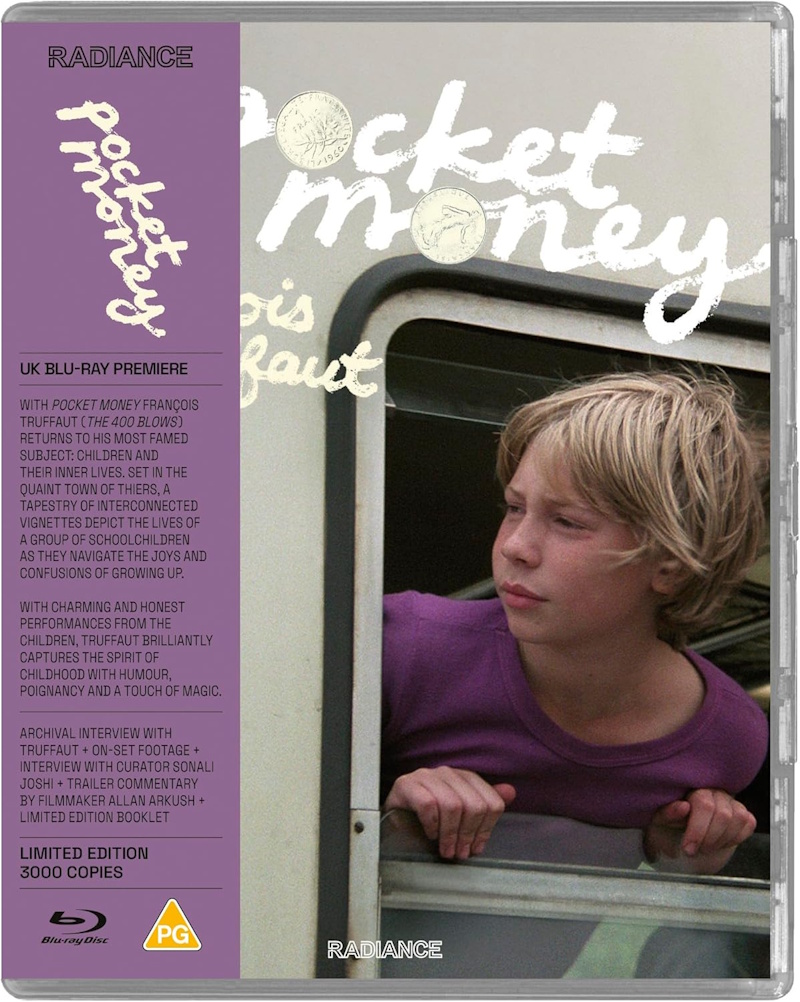
François Truffaut’s empathy for, and skill at directing, children stretches all the way back to his first feature The 400 Blows, which launched the career of Jean-Pierre Leaud and is frequently cited as one of the all-time great directorial debuts. Pocket Money, released on Blu-Ray by Radiance Films, is rarely cited as an achievement to match it, but in its time it was one of the biggest hits of Truffaut’s career. During its 1960s heyday, the French New Wave was rarely as commercially important as it was culturally significant, with its innovations being too new and jarringly original for a mass audience. The temptation is to assume that Pocket Money must have prospered by abandoning some of the movement’s bleeding-edge artistry and social criticism, watering the Wave down for the general public.
While Pocket Money isn’t as hard-hitting as The 400 Blows – or Truffaut’s other great film with a juvenile lead, The Wild Child – it has to be said that experimental aesthetics and confrontational politics were never central to Truffaut’s work. Even at the outset of his career, when films like Shoot the Piano Player and Jules and Jim made a good fist of matching his peers for formal radicalism, he was easy to recognise as the tender, humanistic, nostalgic McCartney to Godard’s abrasive, radical, misanthropic Lennon. With Pocket Money, Truffaut deliberately set out to make the antithesis of the wrenching, autobiographical The 400 Blows. He’d earned that right, and more importantly the resulting film is brilliant. There’s no special pleading required here. It might have committed the cardinal sin of making money, but if you can get past that you’ll be rewarded with one of Truffaut’s best films, ripe for rediscovery.
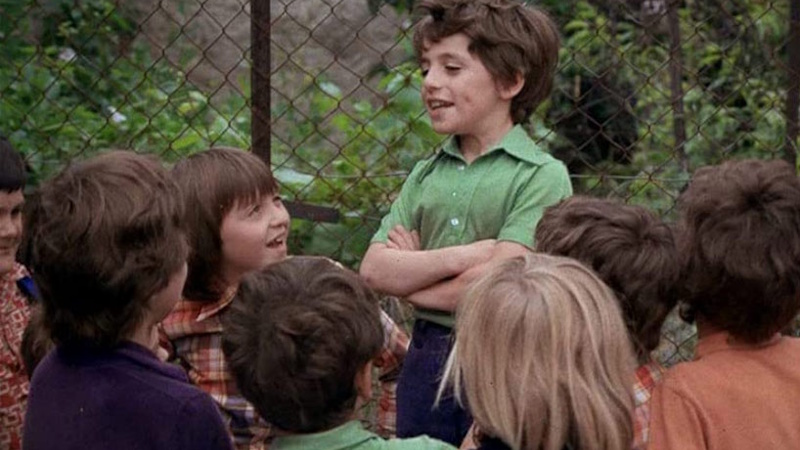
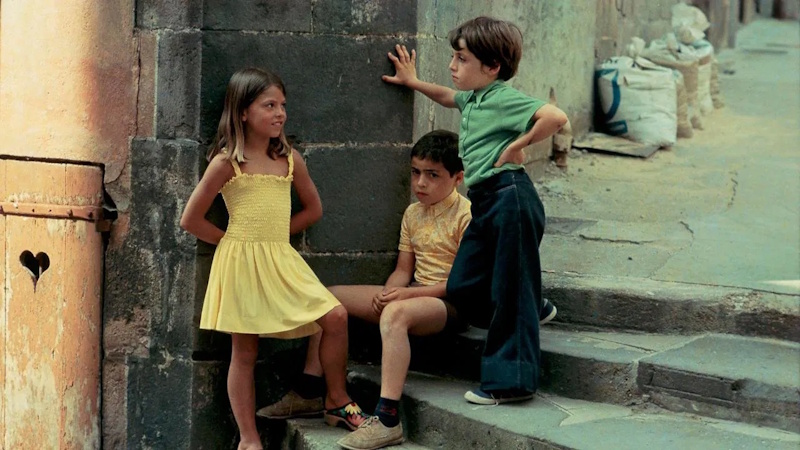
Ever since the publication of the seminal Hitchcock/Truffaut in 1966, Truffaut had flirted with becoming an author as well as an auteur. He originally conceived Pocket Money as a series of short stories, drawing equally from his own childhood memories and stories he’d heard about modern kids. A key source for the latter were his own two daughters, Laura and Eva, both of whom appear in Pocket Money‘s teeming juvenile cast. Truffaut believed that adults could never write children’s dialogue convincingly, so maybe it was inevitable that his short story collection became a movie script. But it wasn’t like most movie scripts. By some estimate, the shooting script for Pocket Money was just six pages long, consisting mostly of sketchy outlines of individual scenes and character arcs. Truffaut staked the success of his film on collaboration with his cast, numbering some 250 children among the odd token adult.
It might have committed the cardinal sin of making money, but if you can get past that you’ll be rewarded with one of Truffaut’s best films, ripe for rediscovery.
CLICK THE BOXART AT THE BOTTOM OF THE PAGE TO BUY POCKET MONEY AND SUPPORT THE GEEK SHOW
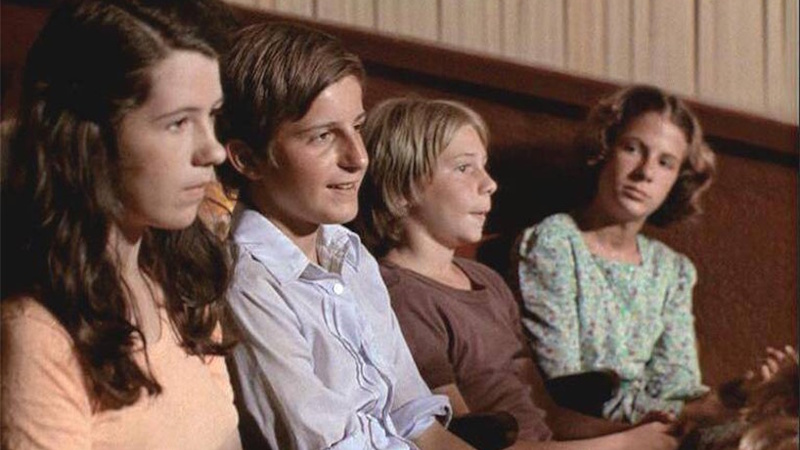
The gamble paid off. Even now, when you have superlative child actors in everything from Adolescence to 28 Years Later, the relaxed naturalism of the children in Pocket Money is remarkable. There isn’t a moment when they don’t feel completely real, and the occasional moments which should break your immersion – a child looking at the camera to see if he’s meant to keep going after a milk spillage, for instance, or Truffaut’s own flourishes like scene-ending freeze-frames – only serve to remind you that quite a lot of what’s happening is real. Its most infamous scene, in which the casually destructive toddler Gregory tries to follow a cat out of a very high window, clearly isn’t real on that level. It does, nevertheless, feel almost unbearably real, as nerve-shredding as anything you’ll see in a Safdie brothers film. Then it ends, and the film moves on, just as it does from every incident in Truffaut’s outline, whether happy or sad.
At first, it appears that the last word on the window scene will go to one of the local parents, who responds to little Gregory’s brush with death by saying children are simply indestructible, that they can get up and walk away from things much easier than an adult can. There are two contradictory views of what childhood was like in the ’70s, and despite being contradictory they’re often held by the same people. Some will argue that the 1970s were a golden age of childhood, where kids were allowed to stay out all hours and get into dangerous situations without adults hovering nervously over them. But there is also a close link in the popular imagination between the 1970s and child abuse – abduction, neglect, molestation.
Pocket Money hews closer to the first view of the era than the second. Someone who both wrote and lived the childhood of Antoine Doinel is unlikely to see the 1970s as uniquely dangerous for children. Yet it also manages to work in a more mature, concerned perspective without bursting the film’s bubble of innocent fun. In one of the extras on this disc, curator Sonali Joshi notes that the parental figures in Truffaut’s movies are often absent. When they’re not, they’re coldly uncaring, like the disciplinarian Dr. Gaspard in The Wild Child. Truffaut played that role himself, but his true reflections on parenthood can be found in Pocket Money. He accepts that some home situations aren’t ideal, but they can still work. One of the children, Patrick, has a confident swagger that comes in part from him playing a parental role at home, as the carer for his disabled father. One teacher, Ms. Petit, initially seems as strict as Dr. Gaspard, but she reveals her tenderness and fears for her charges in conversations with her colleague Mr. Richet. Richet, played excellently by Jean-François Stévenin, is a new father himself, and this is not the only part of his character that is clearly inspired by Truffaut’s own experiences and opinions.
It is such a joyful, humane work, and it’s easy to see why it finally won over an audience who had somehow resisted films as great as Shoot the Piano Player and The Soft Skin. Extras include the aforementioned, information-packed piece by Joshi, who saw the film as a teenager before she’d seen any other Truffaut films and was completely won over by it. There is also a trailer, an in-depth half-hour talk show interview with Truffaut which makes it almost impossible not to fall slightly in love with the director, and a short but fascinating news item about the shooting of the film. Delightfully, it ends with one of Truffaut’s young cast admitting to being a fan of the film-maker, saying he really liked The 400 Blows and Stolen Kisses. It must have been a thrill for him to be in one of Truffaut’s films, and it must have been an even bigger thrill to find out it was this good.
POCKET MONEY IS OUT NOW ON RADIANCE FILMS BLU-RAY