You can’t move for nostalgia in the cinema today. People go to the movies to escape into the reassuring, and studios are only too happy to supply them with cinematic safety blankets made from IPs of old, the comic book hero, the remake, the TV reboot. But for those of us who watch films to be challenged, it’s become suffocatingly sterile. Even if you venture into the arthouse, you’ll be met with several incarnations of the same aesthetic in different accents. The truly worthwhile films, the ones that turn the medium on its head, are the ones people turn their noses up at. These are the films found on the festival circuit, usually at the bottom of the competition rankings for Berlin or Cannes or Venice, that end up shuffled onto VOD months after their debut. They’re too difficult. Too complicated. Too weird. So audiences and critics alike choose uncomplicated nostalgia, and that’s what keeps getting pumped onto our screens.
But the duo of Hélène Cattet and Bruno Forzani make exciting cinema by repurposing that longing. In four features over a period of sixteen years, they have consistently crafted a universe based on a single premise; what would the Eurocinema of the 60s and 70s feel like? The aesthetics of Sergio Martino and Mario Bava are distilled into a potent cocktail where colours are terrifyingly bright, the sound uncomfortably intimate. You want to escape the torrent of sensation the duo pushes under your skin, but there’s no saving you. Cattet and Forzani have lined up these moments one after another for an hour and a half, and you’re only five minutes in. Get ready to forget who you are by the time the credits roll.
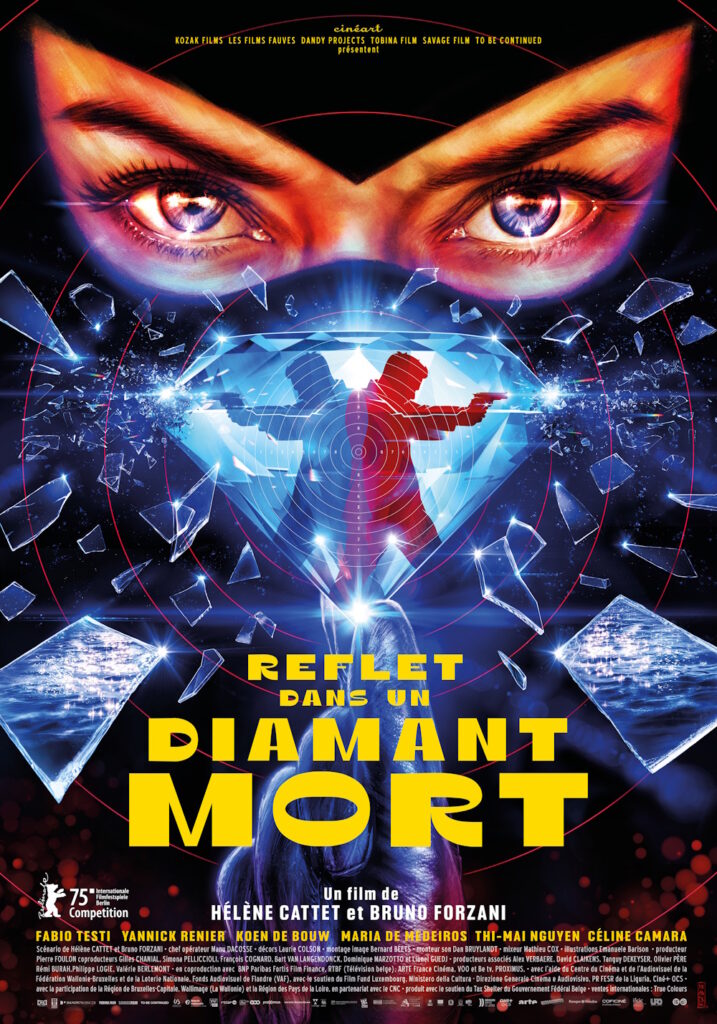
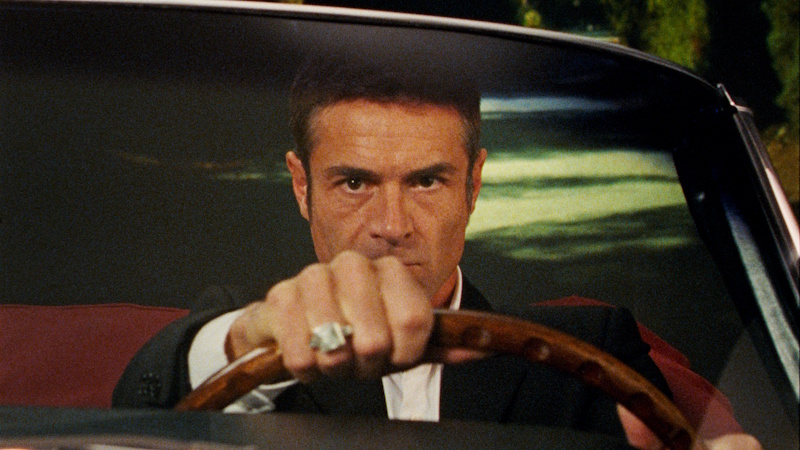
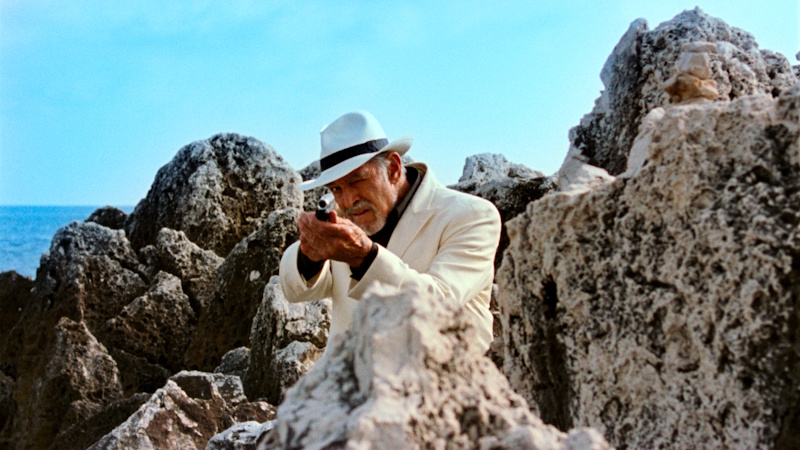
Reflections in a Dead Diamond is easily the couple’s most disorientating film yet. Here, filmmaking becomes a central part of their narrative structure, the directors turning the gaze on themselves to ask not just who is spinning a tale, but how much of the story is a fiction made from other fictions. The first half sets up an archetypal Euro Spy story. An elderly ex-agent, living in a hotel on the Riviera, finds that his pretty neighbour has gone missing. In flashback, we see his life as a young man, a continental James Bond pursuing an international oil magnate who may or may not enjoy killing women to make art. The older man, played by Euro-Cinema icon Fabio Testi, increasingly struggles to separate fact from fiction, lost in one too many martinis on the beach and the morbid memory of a lost partner, who may have been turned into that art.
You would expect that I would find a film that so heavily references classic cinema to be entirely lacking in such new imagery. But it is the way that Cattet and Forzani reconstitute their influences and add their own preoccupations that makes what they do exciting and new.
FOR MORE ON REFLECTION IN A DEAD DIAMOND, CLICK ON THE POSTER AT THE BOTTOM OF THE PAGE
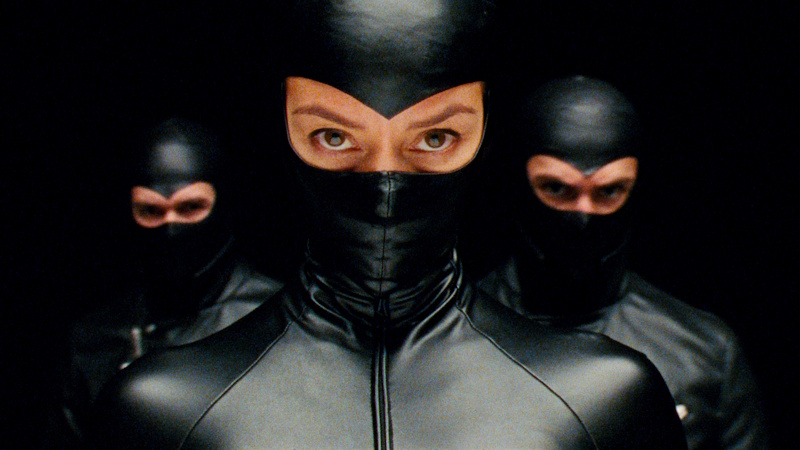
And then, through a series of smart reveals, it becomes apparent that our elderly spy may have been slipping far more into fantasy than previously thought, confusing reality with fantasies about a pulp figure named Serpentik. Anyone familiar with their Italian genre cinema will clock the Danger: Diabolik-esque getup of this female agent, a tightfitting leather catsuit and mask complete with a snazzy set of poison-tipped red fingernails. It’s pure fetish, but what Cattet and Forzani explore is the fear of female sexuality that exists in that fetish. The final thirty minutes are best seen, rather than described, but the closest analogue is the impossible dreamworlds of Raúl Ruiz. The Chilean filmmaker made a career out of exploding pulp stories and showing the dizzying terrors beneath the surface, how easy it is for our identities to merge with fiction, and that’s something Cattet and Forzani are clearly gesturing to here.
Ruiz also adapted Proust in his 1999 film Time Regained, and there’s something incredibly Proustian about Cattet and Forzani’s narrative structures, the way that tiny details spin out into a world of memories filled with longing. There’s a real erotic charge to the memories in Reflections…, especially the pre-credits cut from a jewelled nipple piercing to a couple lost in a sea of diamonds, the connection between lust and money made palpable. That the duo chooses to question how memories are made, and by extension how seductive a fantasy world of fetishes can be, marks this out as their most intelligent and insightful film yet.
Something that I increasingly look for whenever I see a new release is a new image. A shot that makes me see the world differently, that makes me re-evaluate what a film can tell me about being human. You would expect that I would find a film that so heavily references classic cinema to be entirely lacking in such new imagery. But it is the way that Cattet and Forzani reconstitute their influences and add their own preoccupations that makes what they do exciting and new. You may leave the cinema disorientated by what you’ve seen from them, but you’re never in doubt that it is distinctly their own invention. Reflections in a Dead Diamond is their most accomplished and mature work, and one of the best films of the decade.
REFLECTION IN A DEAD DIAMOND PLAYED AT IMAGINE FILM FESTIVAL 2025