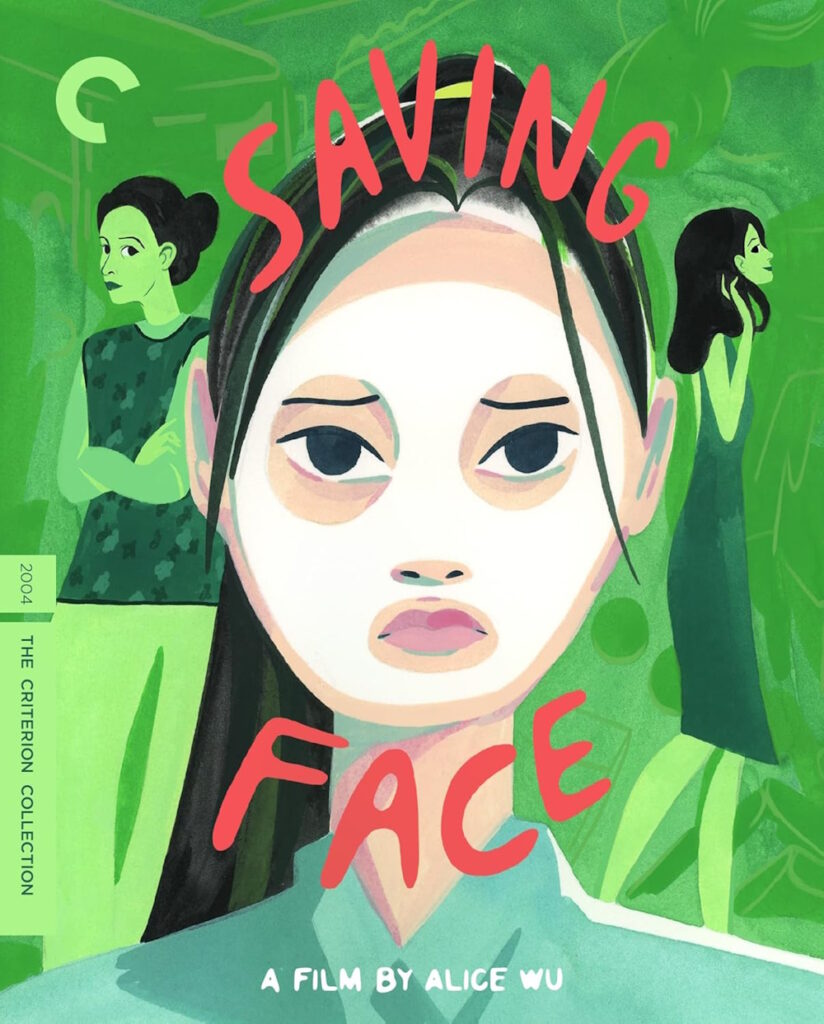
The late Patricia Highsmith was not widely known as a ray of sunshine, yet for much of her life she was the recipient of fan mail from women saying she’d saved them from despair, suicide or simply a lonely, unfulfilling life. The reason for this was her novel Carol, initially released under a pseudonym as The Price of Salt. Even back in the 1950s, Carol wasn’t the only lesbian romance novel on sale, but it was the only one which ended with two women together, rather than either dead or married to a man. Queer audiences can, for obvious reasons, occasionally need reassurance that they’re going to make it to adulthood and be OK, and they don’t always get that from parents and authority figures. It creates a certain cult following for those artworks that break with the pack and show happy, lasting queer relationships, and this is certainly what happened with Alice Wu’s Saving Face, now released as part of the Criterion Collection.
On its release in 2004, Saving Face had a fair bit going for it. It was sold as a romantic comedy, at a time when romantic comedies were still reliable box office bankers. It was produced by Will Smith – yes, that Will Smith – and it has a prominent starring role for Twin Peaks icon Joan Chen as the heroine Wil’s conservative mother. It was also a film about lesbians released in a year when George W Bush won re-election with probably the most obsessively homophobic campaign in US history. One year later, Brokeback Mountain would become a sensation, and while I do still have a great deal of fondness for that film, comparing it to Saving Face tells you a lot about what kind of gay movies America was ready for in the mid-2000s. In place of Saving Face‘s feel-good wit and warmth, there’s fear and tragedy; rather than a mainstream comedy, the film is positioned as a tough, serious Oscar-season drama. Both have Asian directors, but unlike Alice Wu Ang Lee, like all of the principal cast and crew of Brokeback Mountain, is straight.
As a result, Wu didn’t make another film until 2020’s The Half of It. In the meantime, her film’s flame was tended by generations of people who saw themselves in Wil as she tries to carve herself out an authentic lesbian life while living up to her mother’s high hopes. It’s easy to see why. On paper, Saving Face is a tough balancing act: a film that is unambiguously about bigotry which also has to work as a rom-com. It’s not even just about homophobia, which would be enough of an issue to tackle on its own. Chen’s Ma – she acknowledges no name other than her family role, which tells you a lot – is also deeply suspicious of Jay, the family’s African-American neighbour. There are also other forms of prejudice Ma is the target, rather than the dispenser, of, which deepen and complicate her initially brittle character until it’s obvious how Wu got an actress as great as Joan Chen to play her.
It’s very easy to sink into Saving Face‘s classy, grown-up pleasures, particularly with Harlan Bosmajian’s saturated, shadowy cinematography.
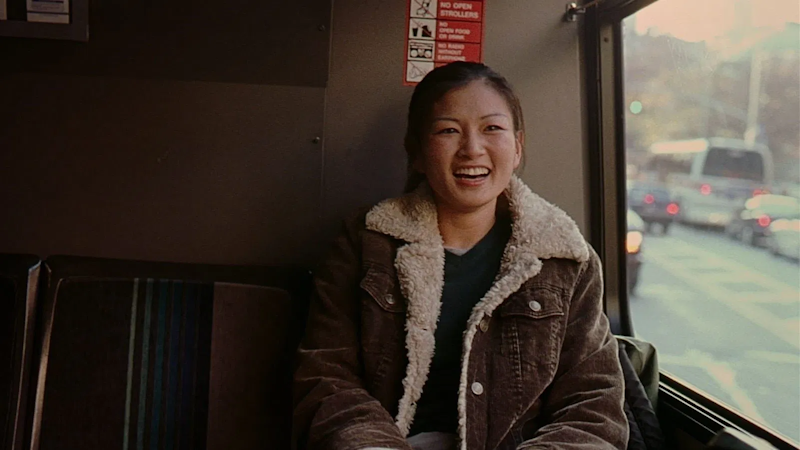
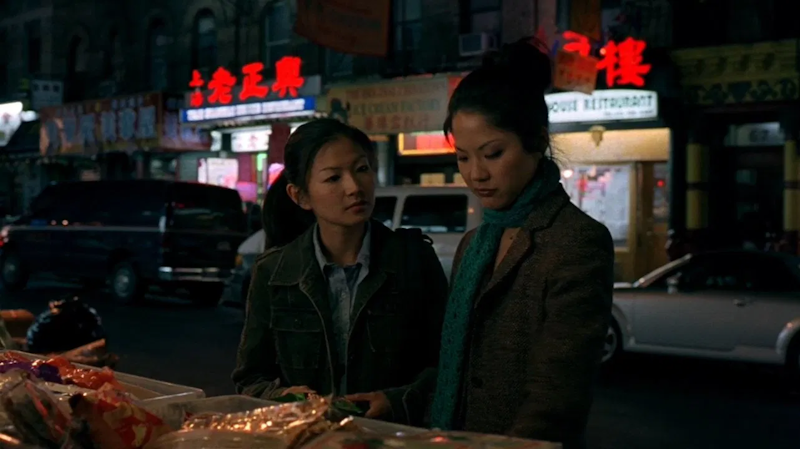
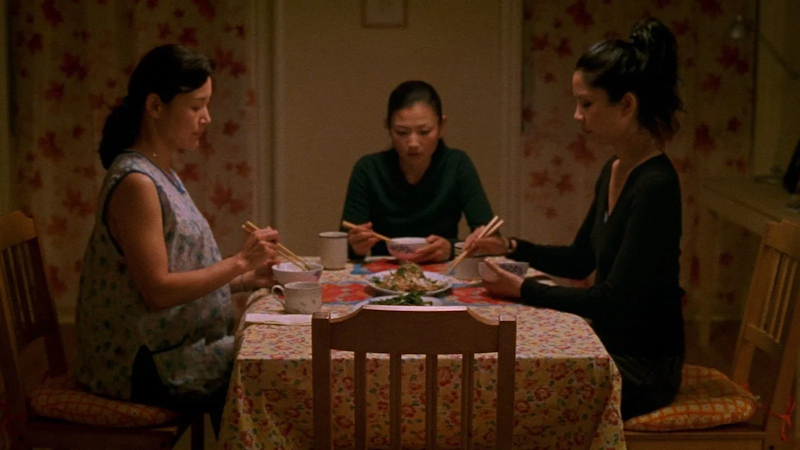
At its best, Saving Face makes this look effortless. As unpalatable as it may be to say this at the moment, it does make you wonder if romantic comedies were simply better back when directors could be openly influenced by Woody Allen. Saving Face is far from an Allen imitation – Wil is a surgeon, rather than a novelist or stand-up, and it’s obviously impossible to imagine Allen making a film about Asian-American lesbians – but it does benefit from the cultural space he opened up for grown-up, well-written NYC rom-coms. After this moment, romantic comedies descended into the kind of crude, gimmicky farces that led to the genre’s commercial decline, while New York indies now seem to be made for about twelve people, all of whom live in New York, most of whom have cameos in the film. It’s very easy to sink into Saving Face‘s classy, grown-up pleasures, particularly with Harlan Bosmajian’s saturated, shadowy cinematography.
At the same time… I love Carol but I love Highsmith’s other, more unwholesome novels even more, and I couldn’t shake the feeling that Saving Face is simply too nice for its own good. You don’t have to be Asian, female and queer to have Wu’s film hit you like a ton of bricks, but it does help, and I only tick the last box. Its queer representation, once groundbreaking, is now familiar enough for a recent Oscar-winning film to play it out as the scaffolding for a story about a bagel collapsing the multiverse. It has its emotive moments, as well as funny moments, and plenty of well-observed moments. But it never coalesced into a convincing whole for me, let alone gave me the emotional punch the film’s fans report.
Still, there are many other directors I’d nominate for a sixteen-year time-out instead of Wu, and this Criterion disc is a deserved, long-delayed laurel for her film. It sits comfortably in Criterion’s library of Asian-American cinema alongside Mississippi Masala and – in the US – work by Wayne Wang and Gregg Araki. Criterion have also recently got back on top of their extras game, and here’s another well-stocked disc: new interviews with Wu and Chen, director’s commentary, a discussion from the 2005 Sundance film festival, and more.
SAVING FACE IS OUT NOW ON CRITERION COLLECTION BLU-RAY