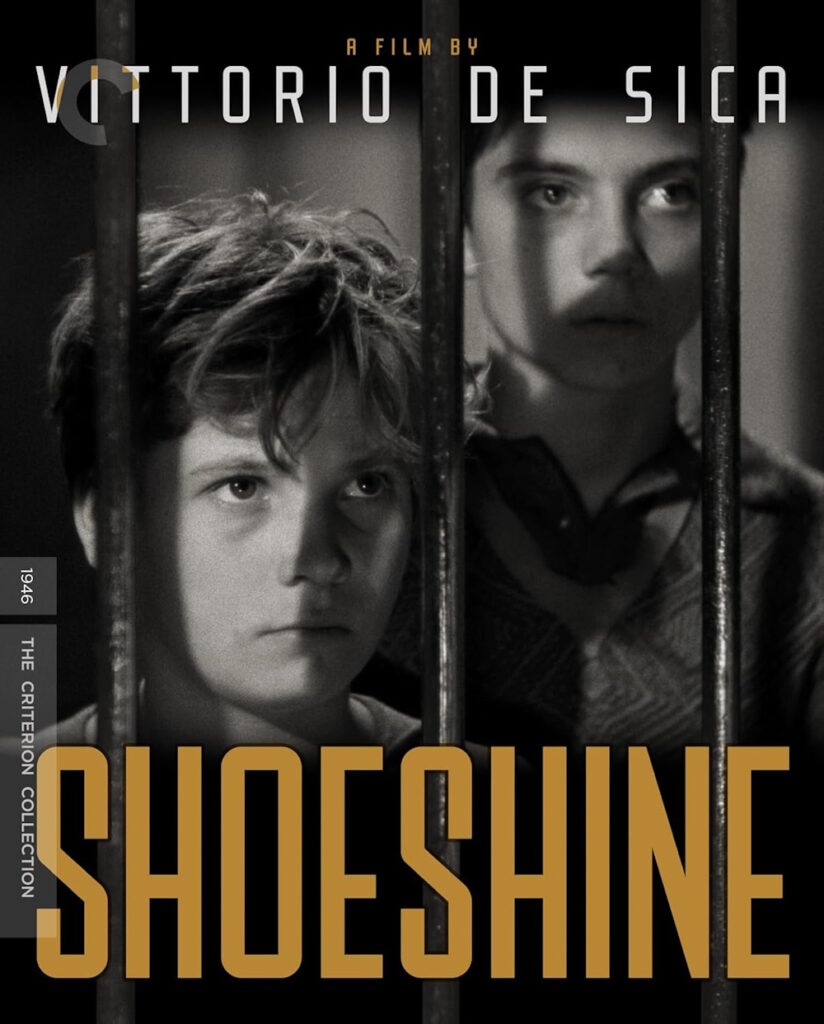
Released with a brand new 4K digital restoration by Criterion to Blu-ray and UHD this week, Shoeshine is a 1946 neorealist drama from Vittorio De Sica that has often been hailed as the Italian filmmaker’s first masterpiece and became the first film to win the Academy Award for Best International Feature Film at the 20th Academy Awards in 1947.
Like his better known Bicycle Thieves, released two years later, De Sica’s film is a story of lost innocence using the non-professional actors and on-location shooting methods that post-war Italian cinema utilised to create the neorealist movement. Set in the remnants of World War II Rome, it tells the story of two boys, Giuseppe (Rinaldo Smordoni) and Pasquale (Franco Interlenghi), who spend their days shining the shoes of American GI’s with the hope to raise enough money to buy the horse of their dreams – a horse they are as devoted to as much as they are to one another. The lives of Giuseppe and Pasquale are hard and meagre and their dream of buying a horse may seem just like that, a dream. However, when Giuseppe’s adult brother Attilio informs them that a fence he knows by the name of Panza has some work for them, the two boys jump at the chance as a means of securing their long-desired ambition. Panza meets with the boys and gives them two American blankets to sell to the local fortune teller. It transpires that Panza and Attilio are playing a long con, the details of which they have not told the young boys about. As Giuseppe and Pasquale attend the palmist’s house to make the sale, the two men burst in, pretending to be policemen. Accusing the woman of handling stolen goods, they seize the two boys and take them into “custody”. Outside, the men pay Giuseppe and Pasquale for their part in the con, amounting to the blanket money, 2,800 lira, and an additional 3,000. Though the pair are confused, they put aside their concerns as they finally have enough money to buy their horse.
It’s not necessarily a misstep, I fully believe that De Sica intended this tonal shift, but I equally believe he would explore such gear changes with considerably more ease and greater polish in his subsequent films.
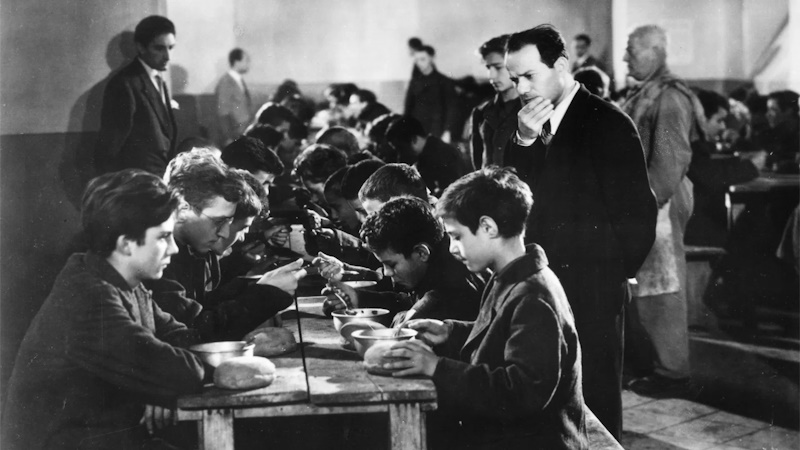
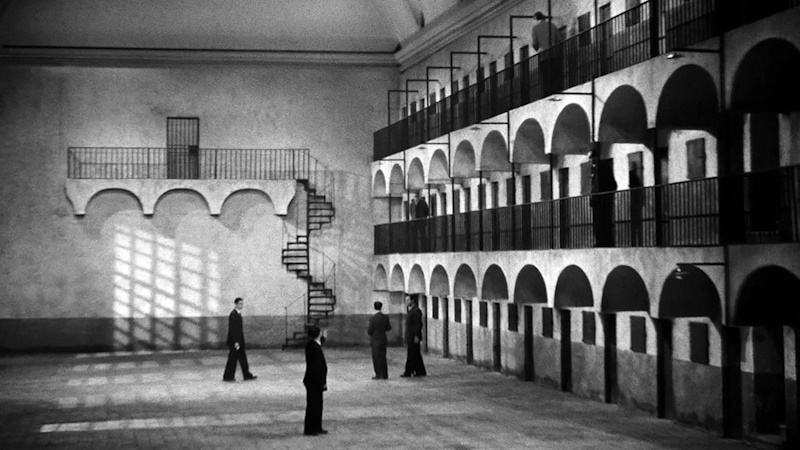
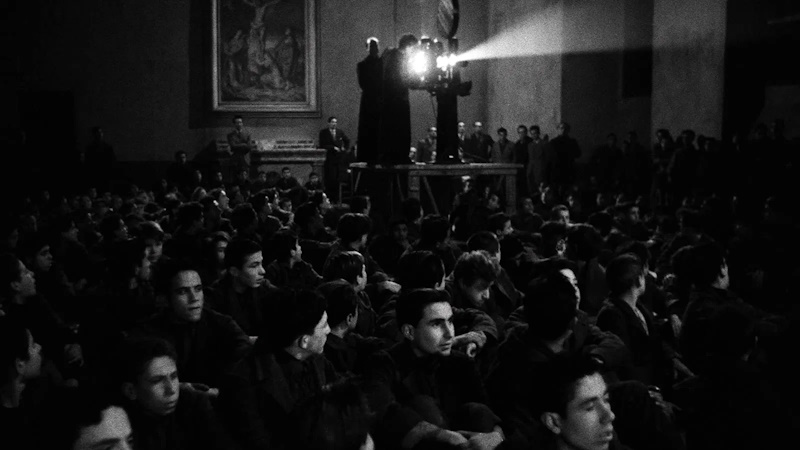
Unfortunately, their happiness is short-lived. The fortune teller has gone to the real police to report a theft from her home of 700,000 lira from men pretending to be the law, and their juvenile accomplices. Scouring the city, she identifies both boys as they ride through the streets on horseback. Giuseppe and Pasquale are subsequently sent to an overcrowded juvenile detention centre for their role in the robbery, where their previously unquestioned loyalty towards one another becomes sorely tested by the brutal regime. The authorities, determined to nail the real criminals in the operation, namely Attilio and Panza, seize Giuseppe and threaten to beat the information they need out of him. Appalled, Pasquale hears the cries of his friend as the officer reins down blows onto him. But, in reality, the officer is only beating a sandbag with his belt, whilst another child mimics Giuseppe crying out in pain for him to stop. Unable to bear what he thinks it is he is hearing, Paquale gives up the names and is earmarked as a grass by his fellow prisoners, destroying the relationship he had with Giuseppe.
Ultimately, as with Bicycle Thieves, Shoeshine sees De Sica consider how it is children who are the true victims of societal crises such as economic struggles, extreme political ideology, in this case, fascism, or war. The children in De Sica’s films invariably lose their innocence and their idyll as a result of coming into contact with the harsh realities that either face or are engineered by adults. Unlike Bicycle Thieves however, Shoeshine sees De Sica arguably struggling with tone. The film’s first half is wholly idyllic, bordering on whimsical as our protagonists dream and scheme their way to purchasing a horse of their own. Once they’re incarcerated and their friendship breaks down, however, the film takes an altogether more sombre and darker turn. It’s not necessarily a misstep, I fully believe that De Sica intended this tonal shift to convey his message and highlight the downward spiral that faces the two boys as a result, but I equally believe he would explore such gear changes with considerably more ease and greater polish in his subsequent films.
What cannot be questioned however is Shoeshine‘s status as an important film in the neorealist movement and its success at the Oscars helped establish this Italian school of filmmaking as a significant development in cinema. It is said that De Sica based his narrative on extensive personal observations with the street children of Rome. In further committing to the neorealist practices, the director recruited several children, all with no experience of acting, as a means to commit the reality of the struggles facing ordinary people onto the screen. Through careful coaching and choreography, De Sica achieves incredibly nuanced and authentic performances here, specifically from his leads Smordoni and Interlenghi, with the latter going on to work as an actor virtually up until his death in 2015.
Extras on this Criterion release include the 2016 documentary Sciuscia 70 from Mimmo Veresca, made to commemorate the film’s 70th anniversary, a look at children in neorealism from film scholars Paola Bonifzio and Catherine O’Rawe, a radio broadcast from 1946 featuring De Sica, and a trailer. Also on this release is an essay by David Forgacs and a 1945 photo-documentary by De Sica, all of which round out an attractive release that is surely a must for all admirers of Italian cinema.
SHOESHINE (4K) IS OUT NOW ON CRITERION COLLECTION BLU-RAY