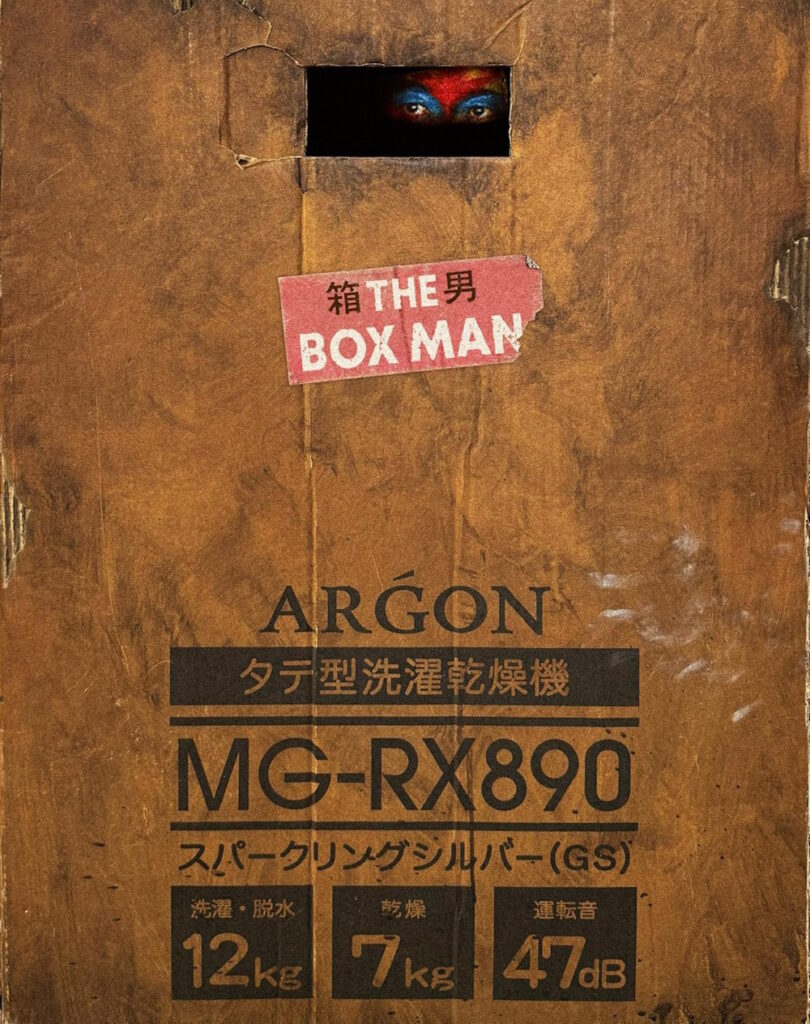
Gakuryu Ishii is one of those artists like Terrence Malick, Thomas Pynchon and Daniel Day-Lewis, whose legend rests in part on their long absences. He spent a decade in the wilderness after directing his extraordinary black comedy The Crazy Family before returning with 1994’s Angel Dust, and he currently averages a feature every eight or nine years, of which The Box Man is his most recent. The obvious risk in taking decade-long breaks from film-making is that the art form changes and advances without you, and you end up looking like a museum piece when you return. Based on a work of social criticism from over fifty years ago that Ishii had been trying to adapt from as far back as the 1990s, it’s a risk that’s particularly high with The Box Man. Now UK audiences can experience it on this Third Window Blu-Ray, and it might just strike you as more alive and vital than any other film you see this year.
The Box Man‘s source is a novel of the same name by Kobo Abe, whose cinematic legacy was secured when Hiroshi Teshigahara adapted four of his works into internationally acclaimed films. Those movies – Pitfall, The Face of Another, Woman in the Dunes and The Man Without a Map – are now regarded as centrally important works of Japanese cinema. Ishii betrays no anxiety of influence in his adaptation, and the opening to The Box Man is a hit of punk fury that matches anything he produced as an angry young man, while establishing the obsession Masatoshi Nagase’s photographer has with a nameless man who lives in a cardboard box. The captions root the film firmly in Japan’s economic downturn of the early 1970s, while the high-contrast black-and-white photographs of said malaise were taken by Kobo Abe himself.
And then things change – or rather, they don’t. Yes, the grainy black and white of the opening sequence dissolves into muted colour while the 1970s setting subtly gives way to a recognisably modern Japan, but none of the characters age, there’s no narrative jump forward, and this is of course the point. Abe was a Japanese Kafka – a poet of the new kinds of alienation and terror caused by modernity, and so was the Ishii who made films like Panic High School and The Crazy Family. If these works still feel bracingly new and relevant, it’s because not enough has changed in society since then. Modern life and modern pressures still leave people feeling broken and adrift, and the strategies Japanese youths created to deal with them – nostalgia, seclusion, screen life – are close to being a monoculture of the developed world.
[The Box Man] might just strike you as more alive and vital than any other film you see this year

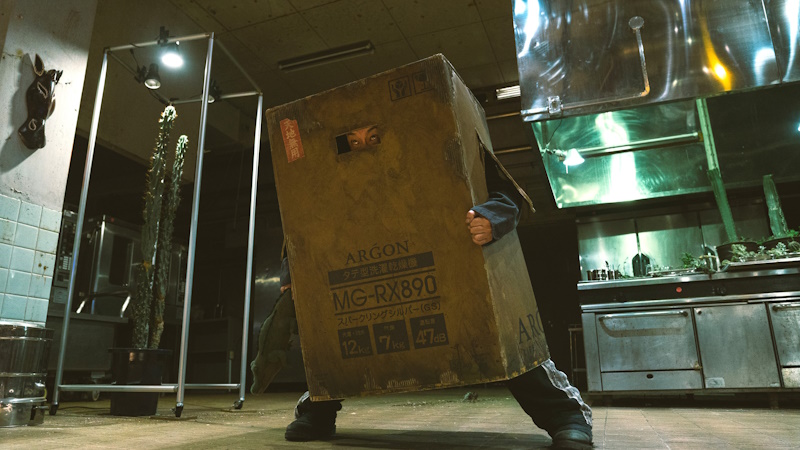
It was Jacques Derrida (stay with me here, this gets good), who coined the term “hauntology” to describe the new feeling of uncanniness that came from looking at a vision of a technologically advanced future that never came to pass. What if the future you’re looking back on isn’t a glorious utopia with flying cars and moonbases, but is simply a previous generation’s predicted dystopia? That’s the feeling you get when you watch The Box Man – a film whose concerns and observations are both visibly 20th century and thrillingly relevant now. The uncanny feeling you get here is more liberating, offering a sense that there are other ways forward, other ways of addressing the malaise that have been forgotten, but are worth rediscovery. Abe and Ishii started working at a time when Dadaism was in living memory, Situationism was relatively recent and there was a feeling that nonsense and absurdity could be the most wounding forms of satire against a world that only pretended to make sense. This is where you get images like the Box Man from – an urban hermit crab whose little feet stick out of the bottom of his container as he scurries away from pursuers, and it’s a scene I’d trade any number of earnest social realist films and political documentaries for.
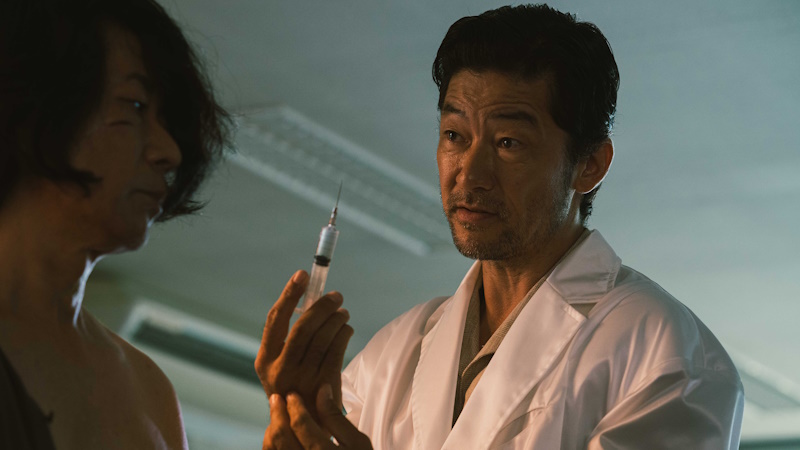
During the whole of its two-hour runtime, The Box Man keeps finding new metaphorical resonances for its central image – a hermit, a hobo, a voyeur, a hold-out against surveillance, an urban legend, a folk hero. It helps that Ishii has a cast who can hold onto the film’s hairpin turns, including two big international names in the form of Mystery Train‘s Nagase and Tadanobu Asano as a sinister doctor. On the commentary track, Tom Mes notes that being a box man is a very gendered activity, in much the same way that the otaku and hikikomori subcultures are often (but not entirely accurately), seen as mainly male. Ayana Shiramoto makes a fine account of herself as Yoko – the story’s only substantial female role, and one who Abe may have named after the most globally famous Japanese woman from the time he wrote the novel.
There is, you’ll have gathered, a lot to unpack in this box, which makes it all the more welcome that Third Window have put together an informative set of extras that include an enlightening interview with Ishii himself; two featurettes interviewing the cast and crew; and the aforementioned Tom Mes commentary. Anyone familiar with Mes’s books on directors like Takashi Miike and Shinya Tsukamoto will know what a valuable interpreter he is for non-Japanese viewers of Japanese punk cinema. This is no exception as he decodes specific linguistic puns that don’t translate, and provides a potted history of Japanese post-war economic development and political activism – which is frankly above and beyond.
THE BOX MAN IS OUT NOW ON THIRD WINDOW FILMS BLU-RAY