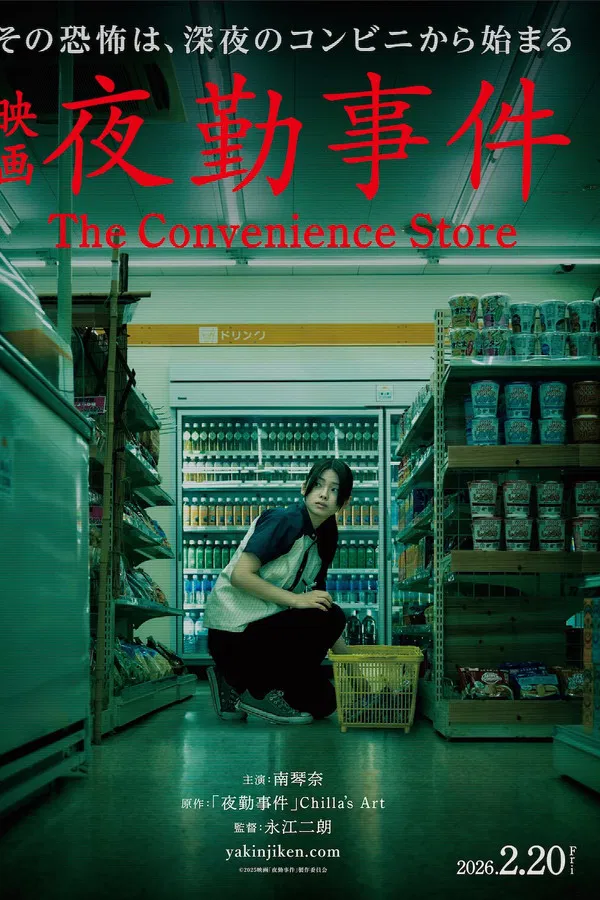
The prolific Jirô Nagae makes his UK debut at Glasgow’s FrightFest with his 38th film, The Convenience Store, hitting productivity numbers that rival peak-era Takashi Miike. Working almost exclusively within horror, it was inevitable that his work would eventually reach the UK’s hungry genre audience. Japanese konbini (the Japanese term for convenience store), differ significantly from Western iterations in that they’re 24-hour, multi-functional hubs that are deeply integrated into daily life, and it’s within one such store that most of this classically themed horror unfolds.
The film opens with the POV perspective of a grungy basement in which an unfortunate soul has been stabbed repeatedly in the eyes, Nagae coming out of the gates with the most violence his latest movie has to offer. From there we meet the two main players: Yukino Tazaru (Kotona Minami), a convenience store employee working the night shift while spooky happenings unfold; and Shinji Saruwatari (Terunosuke Takezai), the detective investigating the opening murder. Things only get more complicated as the murder is just one piece of a larger puzzle, which is completed by duplicitous store management, a mysterious homeless man named Takeo Gozu (Yuukio Matsuura), who lingers around the shop, and a ghostly curse that intensifies with each passing night. If The Convenience Store were to be characterised as anything then it wouldn’t be the detective murder mystery it initially establishes itself as, but instead an old-fashioned curse movie – the sort that catapulted Japan to the upper echelons of world cinema in the late 1990s and early 2000s.
The curse-based machinations are also the best way to approach Nagae’s latest, especially as the mystery is convoluted and doesn’t piece together with the confidence and nuance that fans of modern murder mysteries might expect, and that’s entirely by design. Investigative demands begin and end with Detective Saruwatari, who watches the SD cards that Yukino discovers while she’s alone in the near-liminal space of the shop during her nightshifts. Beyond that we’re dealing with a broad-ranging curse where spirits visit the afflicted, growing more aggressive as the nights pass, and intent on killing their victim by the fifth night. For most of the runtime we watch these entities close in on Yukino, before eventually turning their gaze towards the detective too.
I believe horror reaches higher peaks when a degree of the unknowable is injected, and while I can’t say that this will work for the majority, I appreciate what Nagae was striving for.
CLICK ON THE POSTER AT THE BOTTOM OF THE PAGE TO LEARN MORE ABOUT THE CONVENIENCE STORE AND GLASGOW FRIGHTFEST
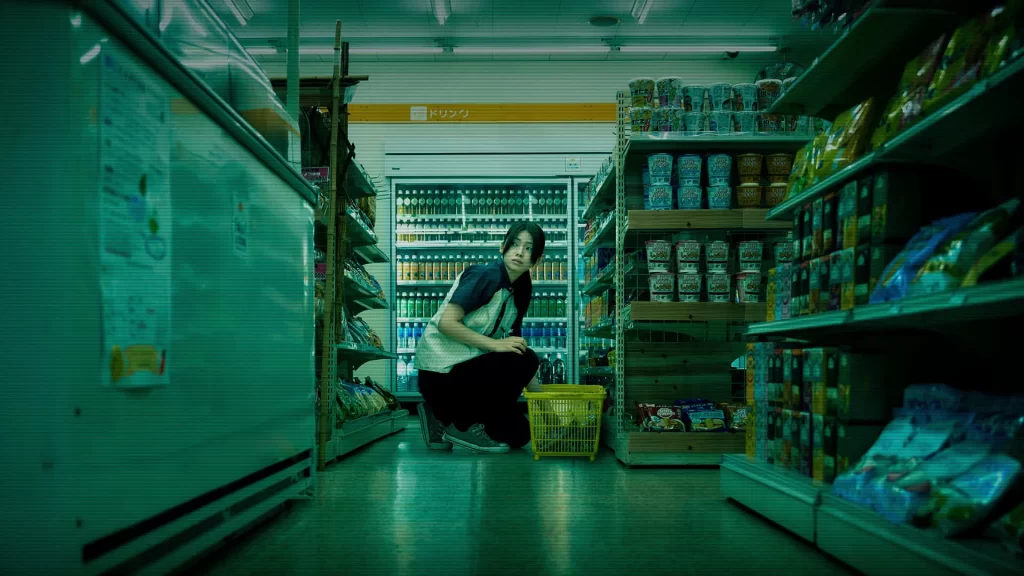
There’s a mysterious young boy, a lank, black-haired woman straight out of Ringu and Ju-On, and a woman offering protection charms who may or may not be real. When you add late-night staff who appear and vanish without notice then it’s no surprise Yukino is on edge, so fair play to her as most people would tap out after one night, but she keeps coming back. The location isn’t just a lightning rod for events, but instead where they’re most potent, and although we see things happen elsewhere in the latter half of the film, they’re never as effective – which is down to the atmosphere. Having worked night shifts myself, there’s nothing like a konbini (or supermarket in my case), at night when no-one’s around. The silence is deafening, which is something Nagae explicitly understands as while many directors would fill these scenes with musical accompaniment, he trusts the quietness as through it, everything becomes far more haunting.
I believe horror reaches higher peaks when a degree of the unknowable is injected, and while I can’t say that this will work for the majority, I appreciate what Nagae was striving for. He could have upped the ante though, as the movie is broken into nights so the tension is regularly deflated just when it’s getting good, but it’s a hard sell to criticise a film for doing exactly what it set out to do. That said, I am much less on board with the cinematography, particularly its occasional adoption of point-of-view perspectives.
For most of the runtime it’s shot traditionally or through the shop’s CCTV system, both of which make sense. Far more confusing are the scenes scattered throughout the film that are shot as found footage as they’re bewildering in a way that offers no tangible benefit, often unnecessarily disorienting, and actively hurts the grand design. Sure, some POV shots are striking, like the introduction of Detective Saruwatari, but in general jumping to this cinematographic profile doesn’t make sense. When a movie is wilfully obfuscating information, the whole production needs to consistently make things as easy as possible so as not to alienate its audience. It’s a fine balancing act – and these random jumps to found footage are simply a jump too far.
That being said, we aren’t talking about an A-grade J-Horror revival piece for the mainstream horror audience. The Convenience Store is the sort of movie that will be best appreciated by people who’ve dug deep into this world and appreciate the stylistic detours – it’s just that this is the first time in a long while (if ever), that such a movie has made it beyond the shores of Japan.
THE CONVENIENCE STORE HAD ITS INTERNATIONAL PREMIERE AT GLASGOW FRIGHTFEST 2026