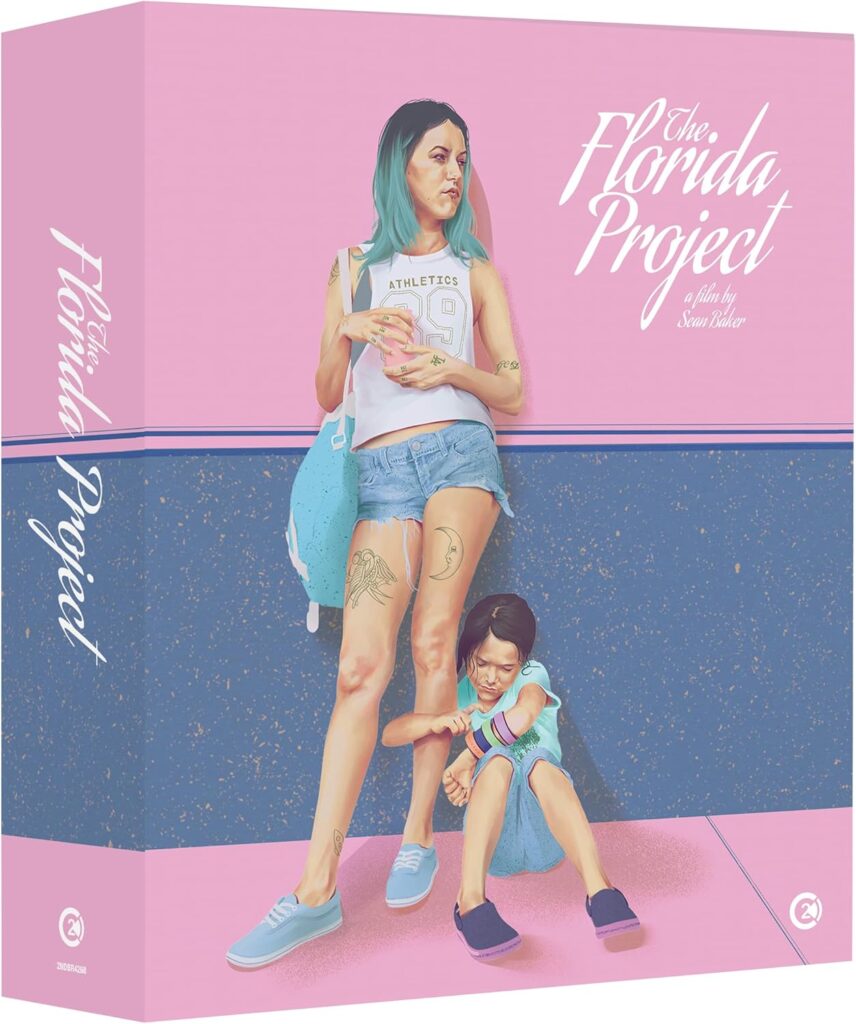
Released on 4K UHD/Blu-ray (limited and standard edition) by Second Sight comes The Florida Project, the 2017 film from Sean Baker – the winner of this year’s Academy Award for Best Director and Best Picture (Anora). Starring Brooklynn Kimberly Prince, Bria Vinaite, and Willem Dafoe, the film has been described as both an Our Gang picture and a piece of American social realism.
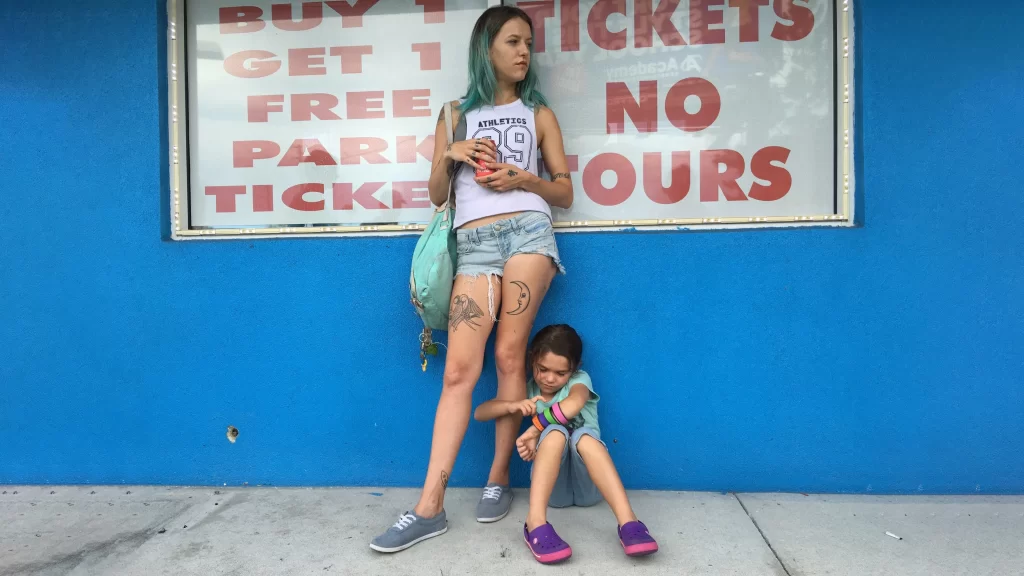
It’s an episodic feature set across one long hot summer that tells the story Moonee (Prince), a precocious six-year-old who lives with her young single mother Halley (Vinaite), in a budget motel near Walt Disney World. Harsh realities exists in the shadow of fantasy and the American Dream as Halley, who’s on government assistance, has recently been fired from her job as a stripper for refusing to have sex with a client. Now struggling to survive on reduced welfare, her financial woes and fight to stay afloat play out on the periphery for much of the movie. Instead, Baker focuses on the playground where Moonee and her friends Scooty (Christopher Rivera), and Jancey (newcomer Valeria Cotto), amuse themselves and get into a variety of scrapes – all under the watchful eye of Bobby (Dafoe), the careworn motel manager. Inevitably, Halley’s problems begin to impact upon the innocent, carefree lives of the children, and when the kids cause an “incident”. Scooty’s mum Ashley (Mela Murder), forbids her son from hanging out with Moonee – making Halley’s situation worse. Desperate for money, Halley resorts to sex work which she solicits online, leading to a violent confrontation between her and Ashley that threatens Halley and Moonee’s already precarious situation.
I’m not very experienced when it comes to Baker as I’ve only seen one of his previous films, 2015’s Tangerine. However, The Florida Project, which the Radio Times praised as “a modern classic, with strong echoes of Ken Loach’s very best work”, along with Baker’s own oft-quoted praise of Loach and Mike Leigh as influences on his work, had me intrigued. As regulars readers either here at The Geek Show or on Letterboxd will no doubt be aware, I’m a huge fan of Loach, Leigh and British social realism in general, so with the movie receiving the Second Sight treatment, I approached it with some curiosity.
Having watched The Florida Project now, I think I can safely say that Baker has somewhat misunderstood Ken Loach and the traditions of social realism. I would also question any claim that Baker is a political filmmaker. Yes, The Florida Project is a film about the failure of capitalism and how it thrusts people to the margins of society where they inevitably struggle to survive, and the decision to tell such a story has obviously garnered Baker critical and commercial acclaim, but I don’t think he’s used it to say anything remotely profound or political about the situation depicted. There’s the somewhat obvious irony that people live hand-to-mouth just a few hundred yards away from a tourist haven, but choosing Disney World, the fairy tale apex of the American Dream, seems be only for the film’s symbolic ending.
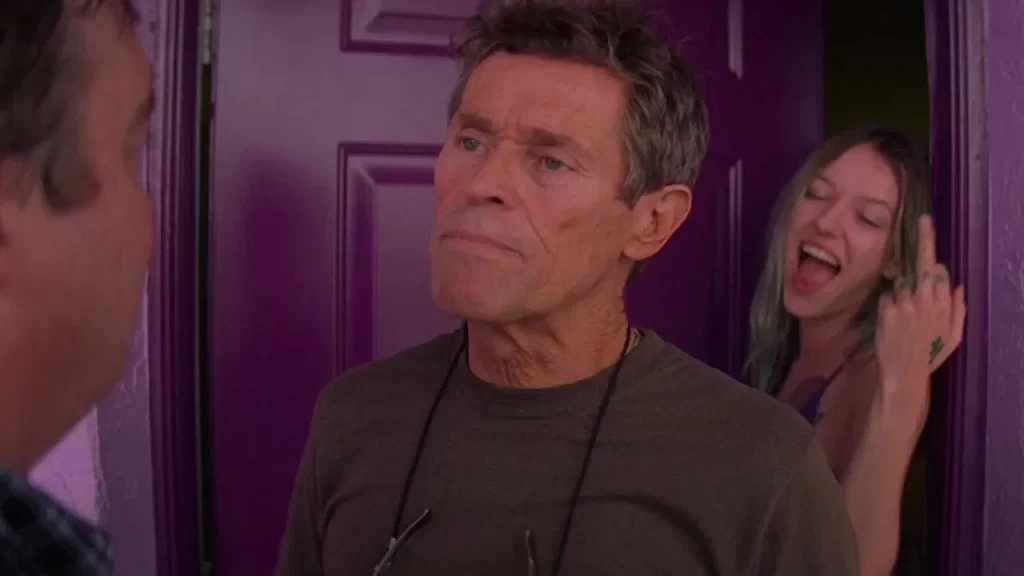
Some of the film’s best scenes include Bobby (Dafoe); whether it’s the dramatic, such as his confrontation with the paedophile who has taken an unhealthy interest in the children in the grounds of the motel, or the comedic like his attempts to get one elderly topless sunbather to cover up.
CLICK THE BOX ART BELOW TO BUY THE FLORIDA PROJECT AND SUPPORT THE GEEK SHOW
Worse than saying very little, he actually approaches it from a position that is fundamentally wrong. Look at Loach’s Cathy Come Home; a Wednesday Play for the BBC from 1966 that carefully and skilfully depicts every flaw in the system that serves to make Carol White’s embattled heroine a victim of circumstance. By the time that Loach reaches his denouement and Cathy’s children are being physically removed from her care, the audience are not only shook, they’re angry at a society that has allowed people to fall through the net and are looking to demand change. Indeed, in the light of public reaction to the film, the charity Crisis was formed the following year, whilst Shelter, another charity for the homeless that had coincidentally launched just a few days after the play’s broadcast, immediately gained many supporters on the strength of Loach’s play.
By the time that The Florida Project reaches its all too similar climax, the audience feels, well, very little actually. This is because Baker just hasn’t put the groundwork in. In fact, rather than putting in any work, Baker has instead been content to depict every negative stereotype of poverty that he can think of. The character of Halley is so singularly unlikeable, an obnoxious young woman who has no respect for anything, that Baker seems to be playing into a dangerous stereotype that implies that it is a person’s “bad” behaviour that leads to their penury, rather than a society that is failing them. When we meet Halley we learn that she has just lost her job, but she shows little inclination in getting other employment, and Baker equally seems disinclined to explore what difficulties may even be present in her attempts to return to the labour market. Instead, we just see her resorting to conning tourists and eventually succumbing to sex work. As it stands, Halley isn’t depicted as someone unable to lift herself up out of poverty, indeed she often seems to be of the belief that the world owes her a living. It’s a world she views with complete disdain, and one she’d happily see burn, as almost literally evinced by the delight she takes in the realisation that the kids have burnt down an abandoned condominium complex. All this is not to fault Vinaite, who delivers a memorably authentic performance, I just wish that Baker would have taken greater care her depiction and the time to explain to audiences her situation in further detail.
Watching this, I got the sense that Baker is only interested in depicted the most negative qualities of marginalised people, almost as a proud and crudely captured “f*ck you” to a liberal bourgeoisie who will no doubt buy their tickets and be amused at how the other half live, whilst also being grateful that they don’t have to live that way themselves. It feels less like social realism and more like Shameless or Benefits Street. I remember the middle class social commentators deriding the participants of that despicably offensive “reality” TV series from Channel 4 for drinking cans of beer in the morning. They completely missed the point; you shouldn’t be focusing on them getting pissed in the daytime, you should be asking what led them to using alcohol as a means to get through the day in the first place. Baker seems similarly disinterested in exploring why Halley and the rest of his characters are poor or why they behave as they do. The Florida Project perpetuates a damaging stereotype that the victims of capitalism are, like pigs, happy to wallow in their own filth. It’s an unashamed depiction of “white trash” America, or “chav” culture as it is has been known here in the UK. This “poverty safari” approach seems endemic in what I know of Baker’s work, particularly his preoccupation with depicting women existing in the sex industry. Make of that thematic concern whatever you will.
If you’re looking for sympathetic characters in The Florida Project, then look no further than Bobby. Though he may initially appear gruff and taciturn, as the film develops, it is clear that he is the anchor of the community. In a brilliantly grounded performance by Dafoe, he is more than just a motel manager, he is a round the clock child minder, a tireless protector, an attentive confidant and a walking Citizens Advice Bureau. Some of the film’s best scenes include Bobby; whether it’s the dramatic, such as his confrontation with the paedophile who has taken an unhealthy interest in the children in the grounds of the motel, or the comedic like his attempts to get one elderly topless sunbather to cover up. Dafoe skilfully captures the infinite care and patience of the man, especially when it comes to Halley. Perhaps the reason for his concern for this single mother lies in her daughter, Moonee. It seems that Bobby instinctively knows that should Halley fall, the impact will shatter this six year old’s world far more than it ever will her mother’s.
Moonee is, of course, another example of a sympathetic character, and there’s an argument to be made that, in telling the story from her perspective, Baker is emphatically depicting poor people positively living, rather than just existing. The chief delights that The Florida Project affords audiences are the shenanigans that Moonee and her gang get up to, and its easy to see the Our Gang influence here in Baker’s work. My particular favourite scenes included Moonee and Scooty somehow convincing Jancey to help them clean her mother’s car after they’ve been caught spitting all over it, switching the motel’s power supply off on the hottest day of the year, getting free ice cream from tourists with the most unbelievable of sob stories, and patiently waiting to see if a passing spider might fart (guess what, it doesn’t). Prince gives a remarkable performance far beyond her years as Moonee, indeed all the child actors are first rate and wholly naturalistic here, which really helps to sell the film as it simply would not work with lesser child actors.
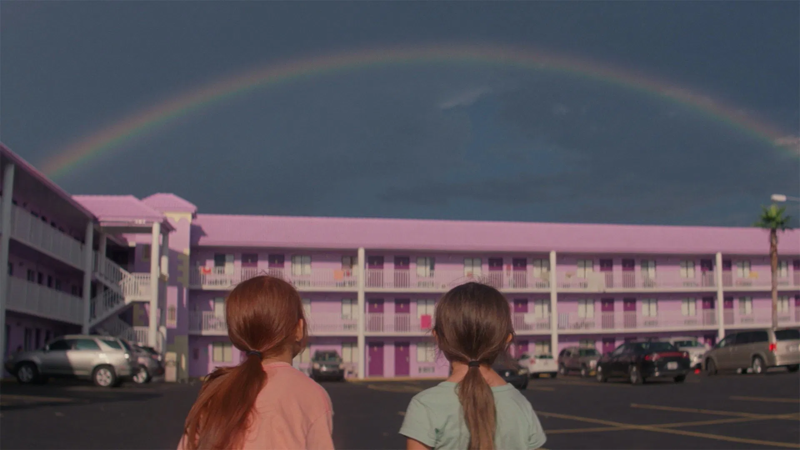
Other than its solid performances, another good reason to watch The Florida Project lies in the fact that it is a very striking film visually. Beautifully shot by DoP Alexis Zabe, the purple paintwork of the motel adds a vibrant Tati or Demy-esque splash of colour that enhances and illustrates the fantastical wonder of Moonee’s childhood, whilst also proving an ironic contrast to the harsh realities of a life that lurks beyond her immediate peripheral vision. Certain images stay in the memory long after watching it, I’m particularly thinking of Bobby standing on one of the balconies smoking a cigarette as the night grows dark. It’s a silent moment that says so much about his character; tired, but always there. Always available for his residents.
This release is positively bursting with extras across its three discs, clocking in at over four hours of new bonus material. There’s two audio commentaries; one from Sean Baker, co-writer Chris Bergoch and Alexis Zabe, plus one from Kat Ellinger and Martyn Conterio. A raft of new and archive interviews with cast and crew, a critical retrospective from Rohan Spong, a Making Of feature, bloopers and outtakes. The release also comes with a rigid slipcase featuring new artwork from Michael Dunbabin, and a 160 page hardbook book with new essays from Tim Coleman, Martyn Conterio, Elena Lazic, Hannah McGill, Dawn Stronski and Nadine Witney, plus an on-set photo gallery.
THE FLORIDA PROJECT IS OUT NOW ON SECOND SIGHT FILMS BLU-RAY & 4K UHD