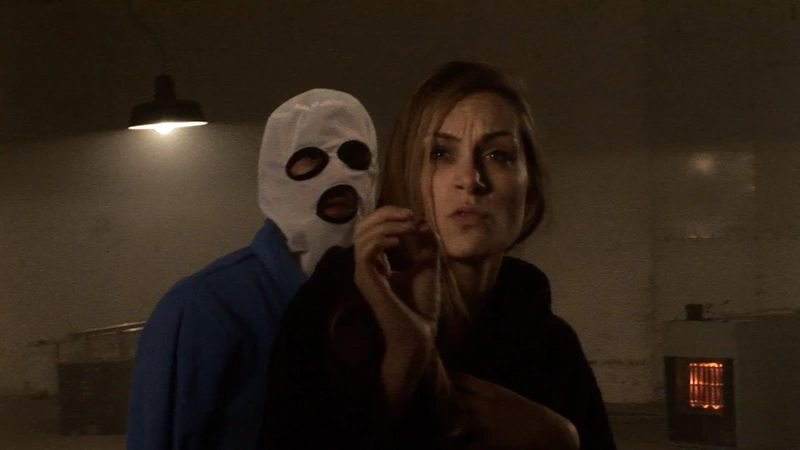
“Screen life” or “livestream” films have become prominent in contemporary horror, and from Unfriended to Deathstream to Dashcam, this concept has many of the same ideas as found footage. Viewers are vicariously put in the position of the characters, and therefore experience a sense of immediacy – the trend reflecting the increasing number of online content creators who make videos or livestream games, discussions or reactions.
Written and directed by Stephen Staley and Natasha Tosini, these contemporary developments of digital culture come together in The Haunting at Jack the Ripper’s House. The film features a group of protagonists known as Haunt Hunters – content creators who investigate sites of alleged paranormal activity, and we’re introduced to Joe (Will Wickham), Jake (Jack Hoy), Darren (Stephen Staley), Belle (Natasha Tosini), and Demi (Kelly Rian Sanson). They’re exploring a haunted abbey, and their footage is bookended by a livestream where the five talk to their viewers as comments appear in an adjacent chat area. This demonstrates the filmmakers’ awareness of their theme, which is further illustrated by the creation of a genuine YouTube channel for Haunt Hunters that blurs the line between fact and fiction. In a similar fashion the Haunt Hunters appear on another streaming channel, complete with a like and subscribe button and a “Tube” logo in the top left corner.
There’s a charm to presenting streaming footage alongside shots for film from an “objective” camera, but there’s a very clear distinction between the two so at no point is there a sense of ambiguity, and little engagement beyond that initial feeling. Furthermore, other than the obvious device of the group behaving differently when not performing for the cameras, there’s little exploration of what online presentation can mean. Jake and Belle appear as a loving couple for their audience, but behind the camera there’s clearly trouble in paradise – including a betrayal that’s introduced late and goes nowhere. This fallout between two characters fails to generate any drama due to its quick appearance, disappearance, and subsequent reappearance (complete with monologue).
There’s a charm to presenting streaming footage alongside shots for film from an “objective” camera
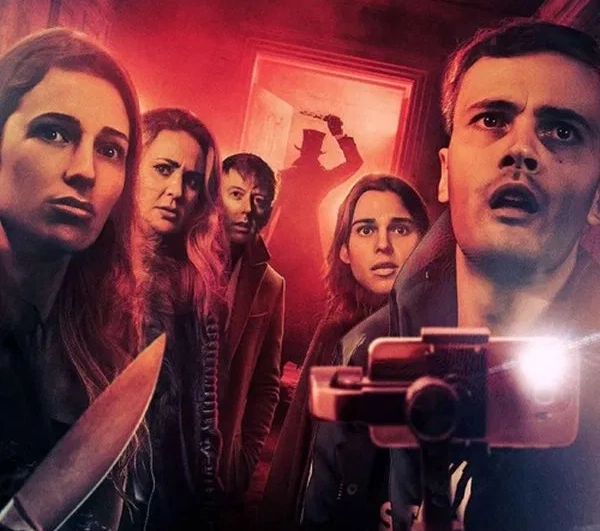
Even with a principal cast of only five some people get short-changed, their presence reduced to little more than another person to gasp ‘What the fuck?’, and although flashbacks pepper the film to provide more character motivation, better writing could have integrated these aspects into the central narrative. Conversations are captured at awkward angles as characters stand around and explain their thoughts out loud to each other, sometimes involving threats and recriminations. Aside from their clunky relationships, the characters themselves are largely obnoxious, irritating, and lack reasons to engage with them – something made more pronounced by the largely stilted performances produced by inert direction.
This lack of characterisation is indicative of a fundamental problem – the lack of a clear concept – which leaves The Haunting at Jack the Ripper’s House as a rather standard horror film, and not a very effective one at that. The opening scene features a couple easily sneaking into the titular house, which they clearly shouldn’t do, and wouldn’t you know it, bad things happen. When our haunt-hunting heroes arrive they encounter a harbinger who’s also a facilitator – which could have been an interesting feature (like The Haunting of Hill House, both the novel by Shirley Jackson and the limited series by Mike Flanagan), but once again, little is done with this feature.
The lack of development and focus means that The Haunting of Jack the Ripper’s House veers clumsily between haunted house, possession and slasher sub-genre tropes. There are jump scares accompanied by musical stings, white-eyed possession and bodily contortion, and shadowy spaces that are hardly menacing because the sequences are often too rushed to allow much tension to build up. The space is a wider issue (no pun intended), as the layout of the eponymous house is inconsistent with no clear sense of geography, and areas often being rather cramped when the property is referred to as a manor. Suspense and fear are generated by presenting equilibrium and then destabilising it, but in this case there’s no sense of balance from the start, and as a result, everything feels messy.
Speaking of which, why is this the house of Jack the Ripper? The Whitechapel murders of 1888 have passed into legend, partly because of their brutality, but also because the killer was never identified. The film includes brief news footage to explain that the mystery had been solved, which leads to the house now being known as the home of the killer, but once again, nothing is done with this idea.
This is a frustratingly missed opportunity, especially as the hunters could have been investigating the mystery of Jack the Ripper by seeking answers from beyond the grave – a concept that would sit well in the contemporary era of true crime obsessives. Without making anything of the central premise, the mention of Jack the Ripper is pointless as a fictional serial killer would have served the same purpose, which sadly makes The Haunting of Jack the Ripper’s House a case of all title, no trousers.
THE HAUNTING AT JACK THE RIPPER’S HOUSE HAD ITS WORLD PREMIERE AT FRIGHTFEST 2025