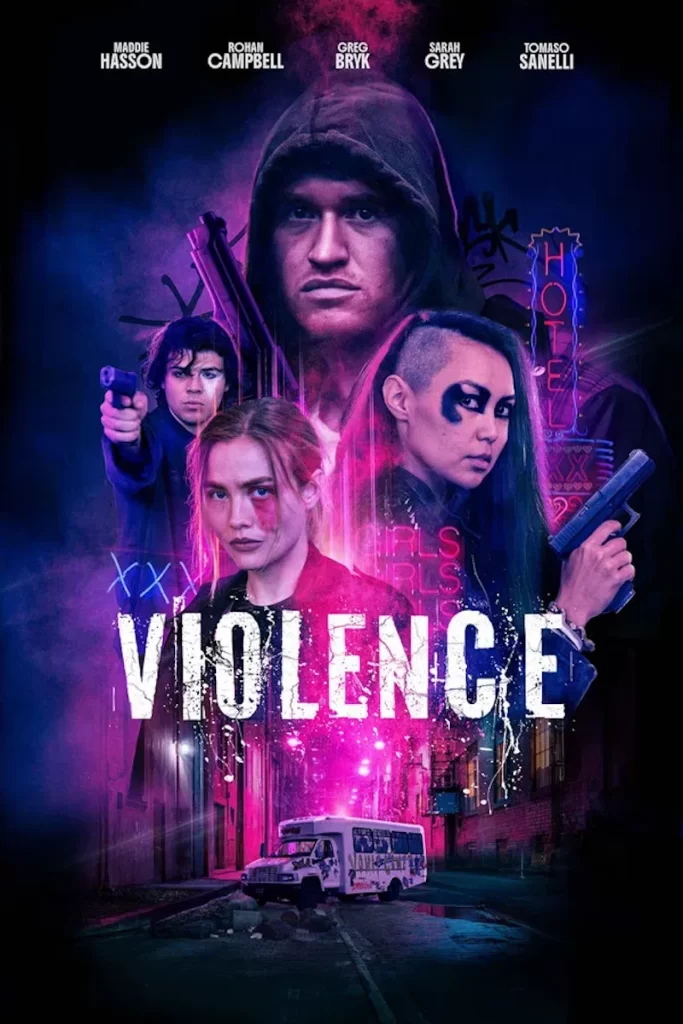
Movie titles have long fascinated me as beyond the first-impression factor, they’re the most immediate point of marketing, and a good title hints at what’s to come. One of the films playing at this year’s Glasgow FrightFest is Connor Marsden’s Violence, and at first glance the name suggests slasher one-upmanship or “torture porn”, but no. The “Violence” of Marsden’s debut is a red herring as it’s actually the surname of the lead character, Henry Violence, and an homage to a type of film that has long since passed.
Set in a hyper-stylised, fictionalised 1980s where punks (the American musical variety; Ian MacKaye of Fugazi & Minor Threat is name-dropped), and vicious gangs reign supreme, we meet Henry Violence (Rohan Campbell). He’s a former drug runner turned straight-edge punk who burned all his bridges trying to escape this dystopian hellhole with his drug-addict girlfriend, Charlie (Maddie Hasson). After failing and being caught by his former boss, the despotic Jimmy Jazz (Joris Jarsky), Henry negotiates his way out of a sure-death situation, freed only to tidy up the mess he made when he first tried to flee. Things don’t go to plan, nor does the promise of his surname deliver, and for a long time Henry is a victim of violence rather than the anti-hero you might expect with such a name as he bounces from one interaction to the next, battered by every group he happens upon.
If that synopsis doesn’t paint a picture then look to The Warriors (1979), Escape from New York (1981), and even Scorsese played in this field with After Hours (1985). An entire wave of carbon copies were born across North America off the back of those films, the main perpetrators being the Italian exploitation filmmakers of the 1980s, who never saw a movie they couldn’t replicate on the cheap. It was a wonderful time for fans of nightmarish visions of inner-city life, but with the rise of the real-life gangster films these stories died off – surviving on only in the minds of comic book writers and fans of gangsploitation cinema. Connor Marsden is clearly one such fan as the world-building and how the desperate groups play off each other is as close to a carbon copy of this cult cinema style as you’re likely to get. It’s rare – the only other recent example I can recall being Sion Sono’s Tokyo Tribe, so while it’s nice to see this brand of cult movie return, the question remains whether people outside of those who collect Arrow Video and 88 Films releases will remember them. Without that affinity there’s no nostalgic itch to scratch – a sentiment that also extends to the punxploitation Marsden also evokes.
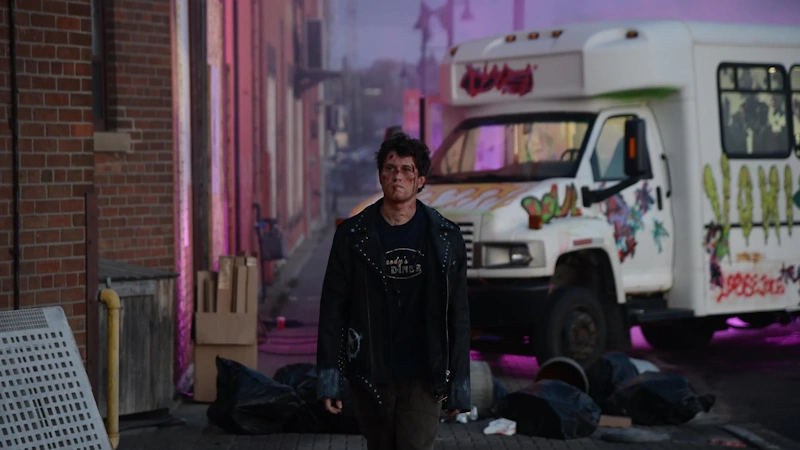
As a lifelong punk fan I enjoyed Violence‘s musical stylings even if the hero wears a shirt from a band that didn’t form until after the time period of the movie
FOR MORE ON VIOLENCE AND GLASGOW FRIGHTFEST CLICK THE POSTER AT THE BOTTOM OF THE ARTICLE
As a lifelong punk fan I enjoyed Violence‘s musical stylings even if the hero wears a shirt from a band that didn’t form until after the time period of the movie, but that’s me outing myself as a music nerd. For everyone else, it’s nice to see such a marginalised music style receive prominent placement – especially when the band scoring much of it apes the abrasive NYHC scene. Let’s be honest, the time is right for a punk revival in cinema because it raises as the voice of anger and dissatisfaction in times of societal trauma – themes that come to prominence in times of “dischord”, like the times we’re living through now. If we’re about to see a new era of punxploitation that lands with more authenticity than the playdoh punk of How to Talk to Girls at Parties, then I’m all in. At least Marsden understands what made the previous era stand out, and he replicates it with joyful abandon.
Outside this context Violence is a much harder sell, and although we get small nuggets of who Henry is in flashbacks with his girlfriend, they’re fleeting moments within a larger piece about people being awful to each other. The movie starts with one gang bundling Henry into a car and stabbing his hand, after which he’s released then kidnapped by another, his feet burned by a haphazard torture device, then freed and immediately caught by yet another gang and facing yet another life-or-death situation. The movie jumps to other parties, most notably the ambitious Charlotte Cola (Sasha Grey), and Bats (Tomaso Sanelli), but that’s it for the narrative form – capture, interrogation, rant, violence, escape, capture … and so on. At no point does the movie elicit enough sympathy in its characters to familiarise those unaware of the punk/gang cycle. Those classic examples didn’t either, but when modern filmmakers revisit old styles they tend to patch over shortcomings to help introduce the genre to new eyes. That, or they double down and go more extreme, but that’s not the case here as Violence doesn’t reach the depravity or misogyny that older titles did – Sasha Grey’s character wouldn’t have gotten close to having a look-in during the ’80s.
Within the confines of Glasgow FrightFest, or any festival it plays, Violence will find those who see what it’s going for it and appreciate Marsden’s authentic attempt to revive the genre for a new generation. He’s made a movie that feels like a lost relic from a bygone era – and sometimes that’s exactly what you want. Without that niche grounding knowledge though, it’s a test of how much circular, repetitive violence you can tolerate.
VIOLENCE HAD ITS INTERNATIONAL PREMIERE AT GLASGOW FRIGHTFEST 2026