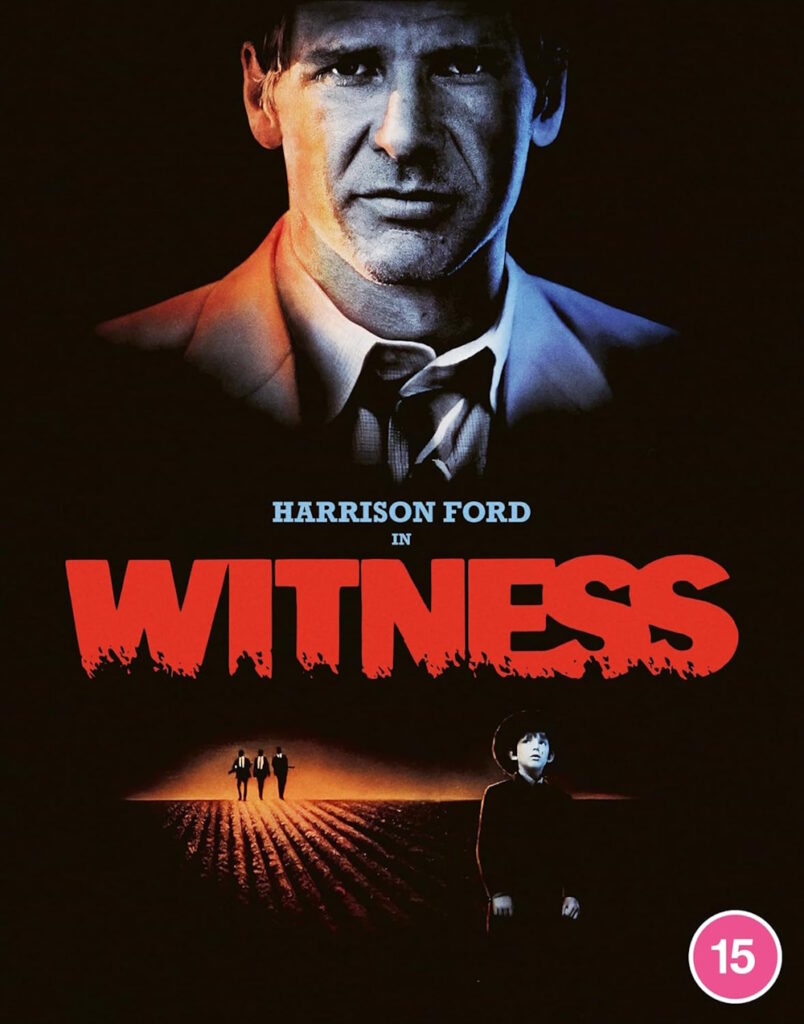
Upon first glance, Peter Weir’s Witness appears as a straightforward detective thriller with some romance and fish out of water comedy. An Amish mother and son, Rachel (Kelly McGillis) and Samuel (Lukas Haas) are involved in a murder investigation once Samuel witnesses a murder in Philadelphia. A homicide detective, John Book (Harrison Ford) unofficially takes the two into protective custody, but when police corruption leaves him wounded and isolated, he must hide out amongst the Amish, learning their ways and, to an extent, adopting them, until his world comes a-calling. The set-up and beats are familiar, the developments in keeping with their genre, and the payoff satisfying.
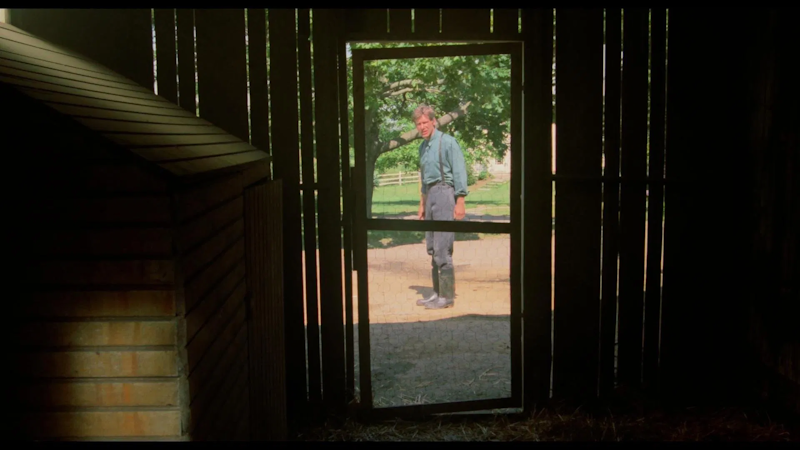
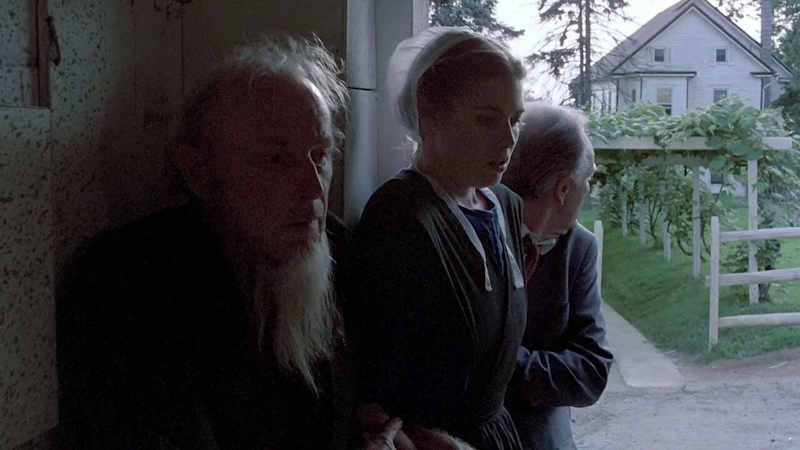
Look a little closer, however, and one encounters a delicate and intriguing exploration of identity, community and distinct philosophies. The early sequences, when Samuel is surrounded by the grand architecture of the train station as well as the confines of the police station, express his childlike wonder of these unfamiliar spaces. Weir directs with a delicate, nuanced touch, especially when Samuel explores the police station, as the camera rests at a child’s eye-level to draw the viewer into the boy’s bewildered but fascinated perspective. Later, when John is in the Amish community, a similar unfamiliarity occurs, much of it played for laughs such as when Eli (Jan Rubes) instructs the detective on how to milk a cow, but also John’s wonder and delight when he joins the Amish to raise and assemble a barn. The location shooting, easy camaraderie between the characters and genuine carpentry on display here (creating an intertextual link for those who know Ford’s pre-acting profession) expresses warmth and beauty, John becoming a part of the community even as suspicious eyes turn towards his blossoming romance with Rachel.
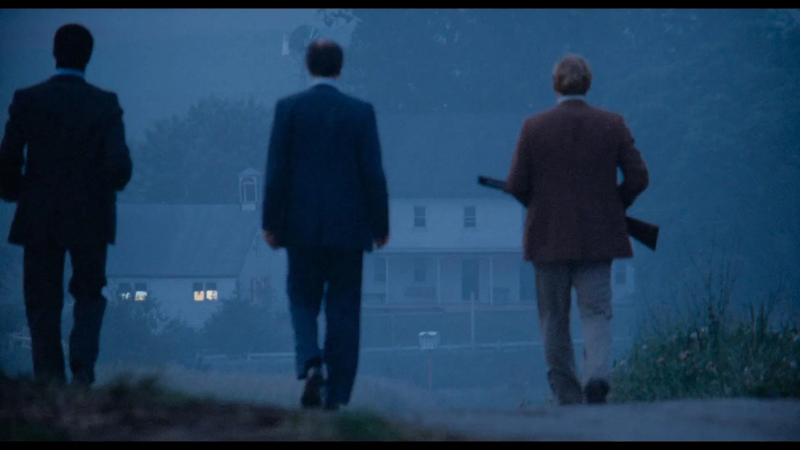
This romance is also handled effectively, restricted to moments of intimacy between John and Rachel and many meaningful looks. These looks, however, express more than a forbidden longing, as they form a connection between two people from very different worlds, who are simultaneously pulled together and pushed apart. These competing forces become apparent in the film’s striking moments of violence, including the initial murder, a subsequent shooting, a confrontation between the Amish and their unfriendly neighbours, and the climactic shootout that draws from the Western genre. The blood that we see is bright and stark, shocking because these scenes are brief. The climax also includes one of cinema’s most memorable death scenes, which takes place in a grain silo where Weir plunges the viewer into the peril with debris falling on and around the camera.
Despite these moments, the film also offers a curious treatise on non-violence. John is referred to as a man who ‘whacks’ people, and his scenes in Philadelphia are often associated with violence, grabbing a suspect in a manner that Popeye Doyle would be proud of and going for his gun without hesitation. Yet John’s gun becomes a significant point of contention amongst the pacifist Amish, its hiding place in the kitchen highlighting it and John being out of place. A confrontation between John and an adversary features a remarkable monologue that confronts violence, arguing against its necessity in a way that champions passive resistance.
The drama is beautifully captured by cinematographer John Seale, who lenses the expansive fields and Amish farm buildings of Lancaster County, Pennsylvania as survivors of an agrarian past. The production and costume design add to this, the environment and characters configured in a way that feels lived in and genuine. Speaking of characters, it is worth noting that Witness is Harrison Ford’s only Academy Award nomination for Best Actor, and it is easy to see why. For all the dependability and engaging qualities of Han Solo, Indiana Jones, Rick Deckard, Norman Spencer, James Marshall and more, John Book might be the most varied and nuanced character Ford ever played.
John is dependable and honourable, a decent cop who faces up against corruption and prizes loyalty and compassion. But he is also impulsive and at times desperate to the point of foolishness, stoic yet humble, optimistic yet realistic. And Ford gets the chance to be a bit silly in an endearing fashion, especially when John sings and invites Rachel to dance with him. For all the indelible performances Ford has given over a more than 50-year career, Witness remains a particular gem, thanks to the detailed and Oscar-winning screenplay of William Kelley, Pamela Wallace and Earl W. Wallace and Weir’s intricate direction.
The climax also includes one of cinema’s most memorable death scenes, which takes place in a grain silo where Weir plunges the viewer into the peril with debris falling on and around the camera.
Arrow go all out in equipping this Limited Edition release with a plethora of extras. The film comes in an excellent 4K Ultra HD transfer in Dolby Vision, with original lossless 2.0 stereo audio and optional DTS-HD MA 5.1 surround audio, plus optional English subtitles for the deaf and hard of hearing.
Extra material includes an audio commentary by film historian Jarret Gahan. Gahan interweaves infectious enthusiasm with intricate detail about the film. These details include the genesis of the script in the early 1970s, the history of depicting the Amish on film and the critical and commercial reception of the film. Gahan’s exhaustive research and extensive knowledge provide further depths to the film, valuable for any enthusiast in terms of production, representation and how film careers develop.
There is a video interview with cinematographer John Seale, entitled The Eye of the Witness. Seale confirms respecting the Amish’s request to not be photographed, but confirms that, despite this, the Amish were still helpful. He describes the look of the Amish as ‘ethereal’ in contrast to the contemporary look for the Philadelphia sequences. Seale’s acknowledgement of Vermeer as a visual reference point is a fascinating contextualisation of cinematography within the wider field and history of visual art.
Film journalist Staci Layne Wilson provides a visual essay on the film’s performances in Show… Don’t Tell: The Quiet Power of Peter Weir’s Witness. Wilson’s analysis is neatly delivered over images from the film, such as a close-up on McGillis’ face when Wilson refers to trust. Footage of Ford’s face resonates with Wilson’s description of the actor’s desire to play a tough yet vulnerable character, and she draws effective attention to the smile of Alexander Gudonov as well as the often-wordless performance of Lukas Haas. The discussion is interesting, but mostly based on production histories and interviews with the cast and crew rather than critical analysis, which is a missed opportunity.
Arrow have also gathered archive material for this release, including a 1985 interview by critic Bobbie Wygant discussing Witness with Harrison Ford. Ford highlights that the script appealed to him as something different to what he had done before, the importance of communication and taking pleasure in his work. His answers are sometimes guarded, especially in relation to Blade Runner and his feelings about fame, but at other times open, such as the difference between John Book and other cop characters. The date of the interview is amusing with hindsight, especially Ford’s comments on Star Wars. In A Conversation with Peter Weir, the director charts his involvement with the project and his approach to working with seven year-old Lukas Haas. Some of his anecdotes are replicated in Wilson’s video essay, which might be frustrating for the viewer.
There is a comprehensive five-part archival documentary on the making of the film, Between Two Worlds: The Making of Witness, that features interviews with Ford and fellow actors Kelly McGillis, Lukas Haas, Patti LuPone and Viggo Mortensen as well as Weir, Seale and producer Edward S. Feldman. Produced in 2005, this documentary features some interesting reflections such as Feldman’s reworking of the script and Weir’s status as a Hollywood outsider. There is something quite touching about these recollections, twenty years after the film’s production, now viewed a further twenty years later. There are two vintage documentaries from EPK, that feature interviews with Ford, Weir, McGillis, although these also overlap with other extras in terms of the content discussed.
Other materials include a deleted scene from the network TV version of the film featuring Donkey Kong (seriously), a theatrical trailer and image gallery. The package includes six double-sided collector’s postcards and extensive work by artist Tommy Pocket, his illustrations featuring on the reversible sleeve of this limited edition’s packaging, as well as on a double-sided fold-out poster featuring original and newly commissioned artwork and in a 60-page booklet that features writing on the film by Dennis Capicik, Martyn Conterio, John Harrison and Amanda Reyes. All in all, this special release of a 40-year-old classic offers plenty to witness and much to give thanks for.
WITNESS IS OUT NOW ON ARROW BLU-RAY