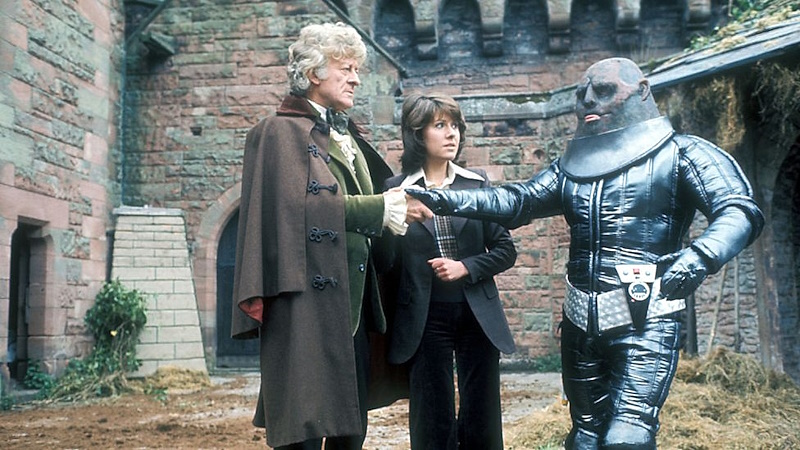
It’s not always easy to judge which Doctor Who stories are important – not at the time, and not even in retrospect. A retrospective view, for instance, will probably pick Dennis Spooner’s The Time Meddler as being the story which set the template for all modern-day stories set in Earth’s past. While it was the first story to figure out the formula of pitting the Doctor against an alien interfering in human history, it’s also not the one that made this storyline one of the show’s reliable standbys. It’s rarely noted that, following The Time Meddler, the rest of the William Hartnell historicals played out as if that story had never happened, and the Troughton years would surely have followed suit if it wasn’t for David Whitaker casting around for something different to do with the Daleks. The era where “pseudohistoricals”, as fans call these stories, were a regular part of the show’s repertoire starts here, with Robert Holmes’s The Time Warrior.
Spooner was probably the funniest writer the show had during the 1960s, so it’s appropriate that his baton is passed on to Robert Holmes, who’s established himself as the Pertwee years’s resident wit. One year after The Time Warrior, he’ll be installed as the show’s script editor, a tenure which will leave him with a very different reputation: the only Doctor Who writer who made the show so scary, he was forced to leave by a reactionary backlash. The temptation is to read The Time Warrior as a test run for Holmes’s stewardship of the series. It certainly ticks off a lot of the characteristics of the stories Holmes would produce as script editor, with its Gothic setting (albeit OG, 13th century, Gothic rather than the 18th/19th century Gothic revival), sadistic villain and colourful guest characters. But this would be a mistake.
For a start, the tone of The Time Warrior isn’t particularly horrific. As noted above, Holmes’s niche under Terrance Dicks’s script editorship is “the funny one” rather than “the controversial one”; it’s hard to make the case for Carnival of Monsters, his most recent story at this point, being terrifying, but it is very funny and inventive. The Time Warrior is in this vein. There is a lot of mortal threat, more even than there is in a normal Doctor Who story, but it’s played in an adventure-serial register, the tone set by Jeremy Bulloch’s Robin Hood-ish archer Hal. You’re never far away from another arrow lodging with a loud “boing” into another door.
There were a lot of medieval films around in the late 1960s and early 1970s, and despite being contemporaneous with the first wave of folk horror they weren’t interested in the era for its scare-story potential. You may liken The Time Warrior to Jacques Demy’s cheerfully campy The Pied Piper, or Walerian Borowczyk’s whimsically romantic Blanche, or – naturally – Monty Python and the Holy Grail. What Doctor Who has that these films don’t – despite Demy and the Pythons’s love of anachronism – is time travel. This proves to be another way for Holmes to focus on the comic potential of the story. There have been many scenes in this show’s history where a companion gets to step out into Earth’s past for the first time, but there haven’t been many like the one Sarah Jane Smith gets here, where she’s firmly convinced Irongron and his men are in some sort of medieval faire. It’s the closest Doctor Who has ever got to the version of time travel Mark Twain produced in A Connecticut Yankee in King Arthur’s Court.
If you wanted a crash course in why Elizabeth Sladen became a series icon, you couldn’t do much better than her first appearance here. Following her own agenda, easily slipping past UNIT’s hilariously crap security and refusing to accept the Doctor’s attempts to brush her off, she’s a delight, and she looks incredible in her brown trouser suit. Again, you can’t take the UNIT scenes too seriously. By this point, the relationship between the Brigadier and the Doctor is that of a hapless sitcom boss struggling to keep his unruly employee in line, a characterisation that some fans find irksome. But he’s a lot of fun, as is Professor Rubeish, a more warmly affectionate comic stereotype than Holmes would produce later. Interesting to see how UNIT fit into a pseudohistorical, too, with most of the first episode cutting between the medieval scenes and the Doctor’s investigation into an apparent time-slip. It’s worth putting yourself in the shoes of the serial’s first viewers, who will likely have had no idea how these two plot-lines were going to dovetail.
A show of firsts, then; if it isn’t the first pseudohistorical, it’s definitely the one that established how the format would work once it became a show staple. Sladen’s debut is, as noted above, a triumph, and the Sontarans would never be this capable or cunning again. Perhaps the biggest surprise is how it rejuvenates Jon Pertwee, who had already made his decision to leave the series and would look frankly checked-out for some of the rest of this season. He starts out even grumpier than usual, but the comedic slant of the story makes this an enjoyable character flaw rather than a drag on narrative momentum. By the end, leaping around Irongron’s castle subduing Linx with his absurd kung fu, he looks like a man regenerated.
Next: Invasion of the Dinosaurs (1974)