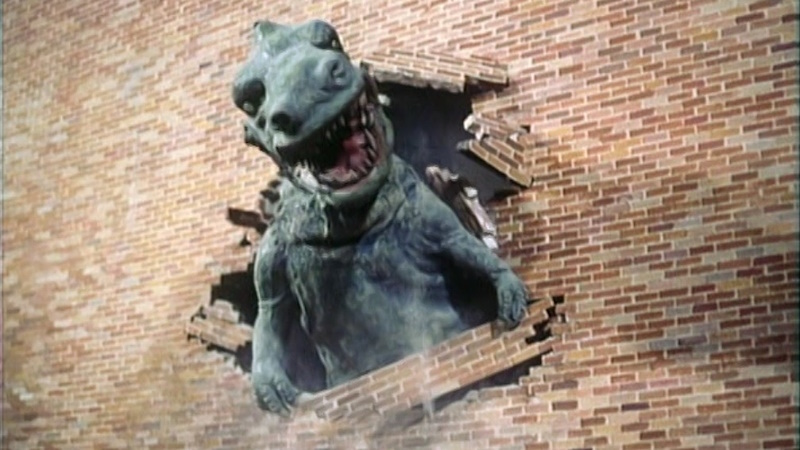
Invasion of the Dinosaurs was the final Doctor Who story to be released on VHS, implying that even late-in-the-range releases like a box set of Underworld and The Time Monster were considered a more desirable consumer item than this. This is a strange anti-accolade, and not just because of the story’s pedigree. It’s got a popular Doctor, arguably the iconic companion and a well-regarded writer, but the strangest thing about Invasion of the Dinosaurs‘s unpopularity is the reason why fans don’t like it. It’s very simple: the effects are terrible.
This is normally the kind of blockbuster mentality that Doctor Who fans are normally keen to trumpet their superiority to; you may be impressed by motion capture and gigantic explosions, but we’re impressed by quality writing and acting. The dinosaurs in this serial are plasticky and barely able to move, yes, but so is the Magma Beast in The Caves of Androzani, and for a lot of fans that’s the best Doctor Who story ever. There are two reasons for this apparent double standard. The first is that the Magma Beast barely figures in Caves, while Invasion of the Dinosaurs builds nearly all of its action scenes around the titular prehistoric animals. Their first appearance, involving the Doctor and Sarah being menaced by a pterodactyl that is very clearly dangling on a string, is enough to explain why fans have a bit more trouble looking past the effects and focusing on the writing here.
The second reason is that the production team should have known better by this point. The Pertwee era notched up its first unconvincing big kaiju-style monster in its second story, and reliably returned to screw up the exact same idea every year since. But then there’s a lot going wrong in Pertwee’s last season, as we’ll see over the next couple of articles, and not all of it is considered embarrassing. Perhaps the problem with Invasion of the Dinosaurs is, ironically, that the non-saurian elements of the production are actually very good. If a giant plasticky dinosaur rolled up halfway through The Time Monster, you’d shrug and say, yep, that figures. This, on the other hand, begins with a genuinely chilling montage of an evacuated London, full of ominous details like abandoned children’s strollers lingered on by director Paddy Russell. Russell’s previous Doctor Who credit was The Massacre of St. Bartholomew’s Eve, and comparing that story to this one demonstrates how much the show’s priorities had changed in her eight-year absence. But she directs it with just as much sincerity, and no wonder – underneath it all, both of her first two stories are political thrillers.
This is no surprise, considering Invasion of the Dinosaurs is the last script from Malcolm Hulke, famous as the only card-carrying Communist to write for Doctor Who. The story has been seen as his valediction not just to this show but to Leftist politics in general, featuring as it does a sinister cabal of environmentalists looking to erase humanity from history. It’s not hard to see why Invasion of the Dinosaurs is read this way – the “Reminder Room”, a sinister-sounding brainwashing facility which turns out to be a dull plastic chamber with a tedious documentary about pollution playing on a loop, is a great parody of Communist states’ notorious re-education programmes.
But Invasion of the Dinosaurs is also an attempt to write a conspiracy thriller, a mode introduced to Doctor Who at the end of the last season with The Green Death. Hulke was clearly impressed with The Green Death – it’s the only story by another writer that he produced a Target novelisation for – but his own stab at the conspiracy thriller draws more from the wider genre than it does Doctor Who‘s efforts at it. The focus on brainwashing suggests the influence of The Manchurian Candidate, even if the realisation more closely resembles The Parallax View, released in the same year. Like those films, it turns out the conspiracy has tentacles everywhere, although Hulke has a better explanation than most for this: the plan actually hinges on everyone being evacuated from London except them, meaning everyone the Doctor and Sarah meet will be considered a conspirator. Also like those films, Invasion of the Dinosaurs‘s political ideology is informed by paranoia, not doctrine; any apparently clear-cut political grouping will turn out to be a front organisation for its antithesis, which will in turn be a front for their enemies, and so on.
The script marks a clear difference between the leaders of Operation Golden Age, who are planning an absolutely unconscionable genocide, and the people duped by it, whose essential good intentions are attested to by Sarah and the Doctor. And who is in charge of Operation Golden Age? Why, the establishment, of course – the same government functionaries, out-of-control military generals and power-hungry politicians who Hulke held responsible for the carnage in The Silurians and The Ambassadors of Death. In the real world, these people spent the mid-’70s plotting to bring down the Prime Minister. Hulke said the best part about writing Operation Golden Age was characterising “all these people behind it who just didn’t fit in. There were lots of rather sad people always living in the past, and who wanted to turn back the clock” – which doesn’t sound much like Greenpeace to me, but captures a certain kind of golf-club conservatism to a tee. Suddenly, you see a wonderful satirical intent in those otherwise unimpressive monsters: dinosaurs bringing forth dinosaurs.
Hulke’s problem with the rank-and-file Golden Agers, those well-drawn minor celebrities and officials convinced they’re on their way to a glorious new world, isn’t that they’re Leftists. It’s that they’re insufficiently Leftist to realise that they’re being hoodwinked by a reactionary plan in revolutionary drag. This critique extends towards the show itself, whose politics have become more vexed in the years since Hulke had the Brigadier blow up the Silurians. UNIT, at the start of this story, are well into their comedy phase, with Benton talking with dopey pride about the colour-coding they’re using to chart dinosaur sightings. Yet they’re also dealing with looters in a version of London that’s under a brutal military lockdown, which is both more pathetic and more sinister than the UNIT we were introduced to in The Invasion. Hulke seems to be intent on dealing a blow to this element of the show on his way out, and the plot will go on to reveal a deep nastiness underneath the cosy sitcom UNIT have become.
Despite each appearance of that goofy T-Rex being enough to give you a fit of the giggles, there really isn’t much that’s cosy in Invasion of the Dinosaurs. John Bennett’s General Finch is perhaps the nastiest of the show’s many petty-authoritarian military men, and through Russell’s lens even Pertwee’s kung fu looks like it might hurt someone. The Doctor and Sarah’s relationship is still prickly, with an even-more-patronising-than-usual Third Doctor missing no opportunity to remind her he didn’t choose her as a travelling companion. Yet by the end the polarity, to coin a phrase, has been reversed. It’s Sarah who wants to stay home, while the Doctor tries to tempt her away with a charm offensive that’s actually more charming than offensive for once. She’s won over, and is landed in the middle of Death to the Daleks for her trouble. Fans who can similarly soften their own disdain for Invasion of the Dinosaurs will be rewarded with something far better.
Next: Death to the Daleks (1974)