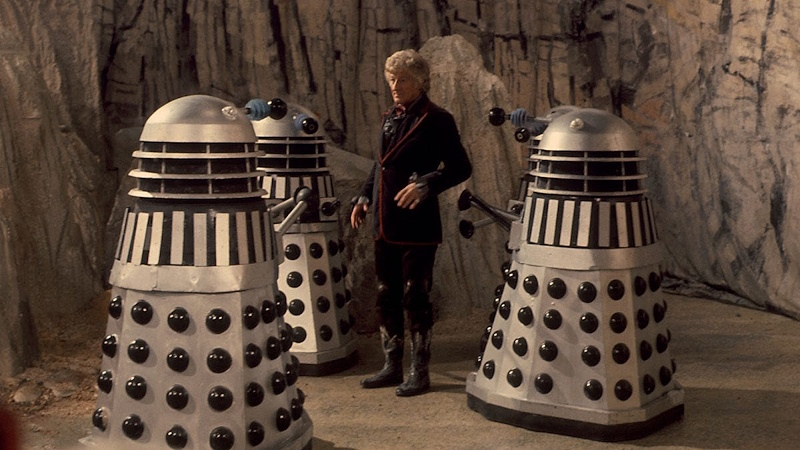
There’s a shift in Doctor Who towards the end of Jon Pertwee’s run which doesn’t actually affect much of what you’re watching, but it had a seismic impact on how people watched it. From 1963 to 1972, Doctor Who existed in an eternal present: the only recurring monsters were ones the average person in the street might be able to name, and once a companion or a Doctor left they were never mentioned after their successor’s first episode. Then the show celebrated its tenth anniversary. If you were a Radio Times reader at this time – and a big chunk of the TV audience was – you’ll have got a special anniversary supplement which made the show’s history more accessible than it had ever been. Suddenly the current Doctor wasn’t just the Doctor, he was the latest Doctor, and your dad’s vague memories of old Hartnell episodes could finally be linked to a story title.
It wasn’t until the 1980s that Doctor Who began regularly telling stories which required a knowledge of that history, but the tenth anniversary season had a couple. The Three Doctors is the most obvious example, but audiences newly genned-up on Who history might have interpreted Planet of the Daleks in the same way: an old-fashioned yarn about Daleks and Thals, written by the man who created them both. In truth, Nation’s attitude towards the Daleks was now so proprietary that he would probably have returned to the show even if there wasn’t a pressing reason to celebrate the show’s past. Either way, he was re-installed as the show’s Dalek Guy, and in Pertwee’s final season he came back to write Death to the Daleks.
The history of writers returning to Doctor Who after a long break is not a glorious one. The show changes so quickly that it cruelly exposes writers who can’t keep up, and even the good ones come with caveats. I love Robert Holmes’s 1980s stories, for instance, but they are basically antagonistic towards the show as it existed then. Rona Munro, meanwhile, went from being one of the most cutting-edge writers of Sylvester McCoy-era Who to writing an endearingly trad story for Peter Capaldi’s final season. Again, these are the good ones. The bad ones include countless examples of notable writers from the show’s past submitting a script to a new production team and having it rejected on the grounds of being impossibly antique. Death to the Daleks suggests that if Nation hadn’t held an unbeatable trump card in the shape of the rights to the Daleks, he’d have been on the reject pile as well.
The defence of Nation – and it’s a defence I’ve got some time for – is that he keeps the faith for a particular vision of Doctor Who as a breathless, vaguely Jules Verne-style family adventure serial. The fullest expression of his worldview comes in the 1960s Dalek comics and annuals, which deliver an unceasing flow of weird alien animals and plants across a series of Dan Dare planets, unhampered by the constraints of a TV budget. By contrast, many fans claim the worst excesses of his style can be found in TV stories like The Chase or The Keys of Marinus. I’m not so sure about that. Those stories do, at least, have a structure that works for Nation: they show you a wonder and then they move on. Death to the Daleks applies the exact same sightseer mode of storytelling – no build-up, no consequences, just a long chain of “look at that!” – to a four-part story set entirely on one planet. The result is one of the dullest Doctor Who stories ever made.
I realise I’ve got four paragraphs into this review without summarising the story. This is a fairly easy job: there isn’t one. The first episode is extremely dialogue-light, which was refreshing when The Wheel in Space did it, but there’s a difference between watching the Doctor explore a mysterious David Whitaker story and watching him fail to figure out an extremely superficial Terry Nation script. You will be surprised to hear, for instance, that the alien Exxilons are exiles. They look and sound so much like stock ‘primitive’ characters, you almost expect a twist where they turn out to be incredibly sophisticated, but no – they’re just savages, whose only civilisational accomplishment was a sentient city they forgot how to use centuries ago. The Doctor claims the ancient Exxilons were somehow involved in the construction of Machu Picchu, which is the kind of von Daniken twaddle that later stories like City of Death would use for amazing twists. Here, it has no effect on the story at all, other than making us want to slap the Doctor as he rambles on about how the ancient Peruvians couldn’t have possibly made buildings on their own.
The image of the ancient Exxilons as a technologically advanced civilisation takes a serious knock when the Doctor gets into their city and finds access is restricted to those who can work out a series of simple puzzles – hopscotch, mazes, that sort of thing. Some of these ideas were reused by Terrance Dicks in The Five Doctors, but Dicks at least remembered to establish the deadly penalties for getting the games wrong before the Doctor started playing. Nation forgets, meaning that the thrilling cliffhanger to episode three comes across as little more than the Doctor noticing a patterned floor. It’s the kind of childish whimsy the show seemed to have gotten out of its system in the Hartnell years, as is the portrayal of plucky, feminist journo Sarah Jane Smith as being essentially scared of everything.
To put it bluntly, there’s no reason for this to exist in 1974. Even the worst parts of the rest of Pertwee’s final season – and it’s a mixed bag for sure – were at least playing with ideas that had been introduced to the show during the 1970s. The only thing that codes this episode as a Pertwee story is Pertwee himself, and even he looks like he’s ready to leave: tired, visibly older, requiring an obvious stunt double for scenes where he falls over in a sandpit. The only Doctor Who stars who look more tattered than him are the Daleks, who are hilariously easy to best in this episode. The revelation that the Exxilon-wide power cut has disabled their guns is presumably meant to give the Doctor and his allies a fighting chance, but these Daleks blow up as soon as somebody sneezes near them, so the lack of extermination just makes them even more pathetic. Apart from Elizabeth Sladen, who tries her best, everyone here is halfway out the door. Both Nation and the Daleks would need a miracle to restore their reputation after this.
Next: The Monster of Peladon.