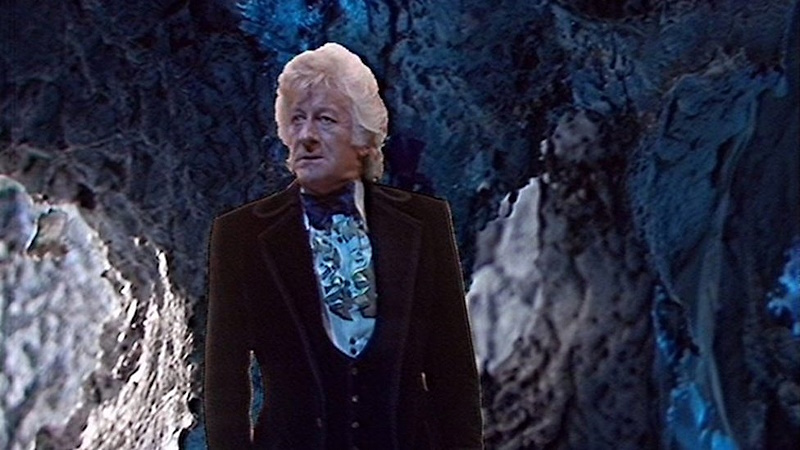
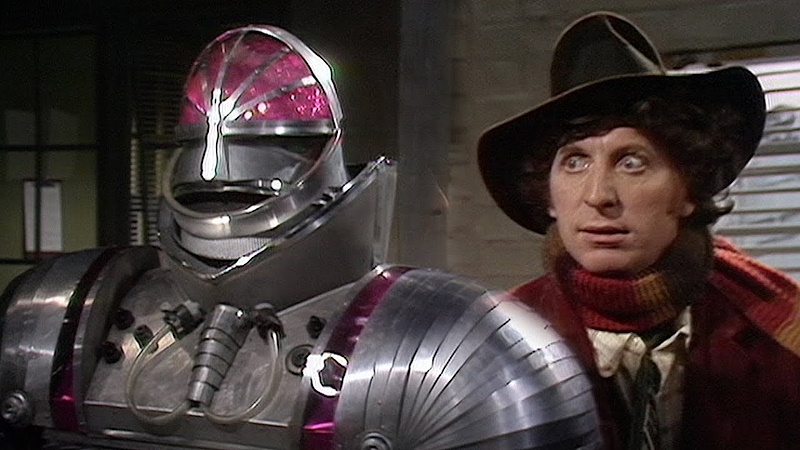
I don’t know what I expected when I started this project – I don’t know if I was doing anything as vulgar as expecting something – but probably the last thing I was expecting was having my childhood love for the Third Doctor comprehensively reignited. And yet, despite a rocky final season, this is exactly what’s happened. I came to Doctor Who shortly after the BBC cancelled it, and so I eagerly latched onto the UNIT format as an example of how the show could be brought back for the X-Files generation. Yet I now see that, even back then, I had internalised the fan consensus that Season Seven was good but Jon Pertwee’s tenure became more childish and tacky with each passing year. His transformation into Tom Baker, which occurs at the end of Planet of the Spiders, was judged to be less a regeneration and more a mercy killing.
Which is strange, because if you had to pick one regeneration story from the old series that clearly points the way to the all-star tear-jerkers outgoing Doctors get today, you’d have to say Planet of the Spiders is more of a template than canonical classics like The War Games or The Caves of Androzani. For the first time, the Doctor’s regeneration is pitched as the cumulative moment, not of a serial, but of the actor’s whole tenure. Here, we see the tying up of plot strands left dangling in The Time Monster, The Green Death, Invasion of the Dinosaurs and more. And what is the “UNIT family” if not a dry run for the inclusion of the companion’s family in new-series arcs? The connections it makes are de rigueur now, but they still have the authentic thrill of seeing things properly pay off.
First up, we get a display of the kind of proactive curiosity that is maybe the best thing about the Third Doctor. Even Patrick Troughton’s Doctor was still shaking off a little of the character’s original conception as a wanderer; he’ll eagerly investigate a situation once he’s stuck in the middle of it, but he doesn’t go out actively looking for mysteries in the way the Third Doctor does in stories like The Mind of Evil. Here, the Doctor seeks out a psychic in order to research the human capacity for telekinesis. The Doctor and the Brigadier meet Professor Clegg, played by the inimitable Cyril Shaps, at a tacky working-men’s club. In a nice reversal of expectations, he actually has a genuine psychic gift, but he pretends to be a showbiz huckster to evade the agony his wild talent causes him. (This is essentially the same set-up as Hilary Mantel’s brilliant novel Beyond Black; far be it from me to suggest Britain’s greatest modern author got her inspiration from a mid-70s Doctor Who serial, but wouldn’t it be a better world if she did?)
But the Doctor isn’t the only person out doing detective work. Refreshingly, Sarah Jane Smith is introduced working on her own agenda – again, this harks ahead to how the revived series would often treat Clara – by investigating a group of Tibetan emigres who have started a meditation centre in darkest Mummerset. The depiction of Buddhism could be seen as negative; their leader Cho-je is played by Kevin Lindsay in yellowface (although, in its mild defence, he turns out to be something other than Tibetan) and their meditation is instrumental in bringing the giant spiders of the title to Earth. What salvages it is producer – and, for this story, director – Barry Letts’s sincere interest in the faith. Cho-je’s group might be a corruptible lot, but the story’s internal logic is consciously designed to support Buddhist philosophy, rewarding acceptance, love and humility, punishing greed and arrogance, and even interpreting the Doctor’s regeneration cycle into another spin on the wheel of time.
This is what makes Planet of the Spiders such a treat. It has some dated attitudes and production values – although Letts is laudably restrained with the blue-screen here, allowing Sarah and Mike Yates to drive through actual countryside in gorgeous orange winter sun – but it also has heart. It rewards tireless show stalwarts like the usually monster-costumed Lindsay and stunt performers Stuart Fell and Pat Gorman with unmasked appearances, and brings back every supporting character who’s still in play at this point. At one point this was supposed to be a farewell to Roger Delgado’s Master as well as Pertwee’s Doctor, and this is acknowledged by getting Delgado’s widow Kismet to voice the Queen Spider. She gives a terrifically enjoyable performance, not least because her crowning moment of megalomania is not just a villainous rant but also a parallel to the Doctor’s growing acceptance that he, too, has behaved with a hubristic need for knowledge and power.
The open-minded, open-hearted path the Doctor should have followed is illustrated by Tommy, a disabled man whose purpose in the story isn’t clear until exposure to an alien artefact supercharges his intelligence. In many ways Tommy is the kind of “magic disabled man” stereotype who would shame Stephen King, yet he’s written and played with a compassion that transcends that. His alliance with the Doctor and Sarah comes partly through his own growing understanding of the new world he’s been forced into, but also because Sarah has the presence of mind to show him kindness when no-one else will. Any series which has ran for nearly sixty years will inevitably fall foul of changing times, yet there is clear blue water between the problematic aspects of Planet of the Spiders and the problematic aspects of The Ark and The Dominators. Put simply, Planet of the Spiders is decent-spirited even at its most flawed.
As with the serial, so with the Doctor. It’s surprising that the familiar criticisms of Pertwee’s Doctor – too snobby, too arrogant, too Establishment – are so rarely viewed in the light of the monumental humbling he receives here. It might be that Planet of the Spiders is too full-bodied an example of the Pertwee era to work as a repudiation of it – but if that’s the case, it suits me fine. Even episode two’s lengthy vehicle chase delighted me substantially more than the escapes from captivity and laser battles that pad out many a lesser six-parter. It’s certainly an unusual mode for Doctor Who, but as we’ve seen a lot of the unusual aspects of Planet of the Spiders are just areas where it was massively ahead of its time.
Next: Robot (1974-5).