

Interviewed ahead of Peter Capaldi’s debut in Deep Breath, Steven Moffat said he’d already written his Spearhead from Space in The Eleventh Hour, so why not do Robot for the next Doctor? The comparison has to do with familiarity: Pertwee’s debut, like Smith’s, was a sudden, startling break with the show’s status quo, but Tom Baker and Peter Capaldi were both introduced with familiar characters and settings surrounding them.
It’s a valid choice, but in both cases there is a production reason for this happening. The difference between The Eleventh Hour and Deep Breath is, after all, the difference between a show changing its showrunner and a show retaining it; even if Moffat had wanted to introduce the Eleventh Doctor with Donna Noble at his side, Russell T Davies had closed her story off before he left (we thought!). Robot, meanwhile, might be the first story of a new Doctor but it’s the last story of an outgoing producer. It was regular practice during the Pertwee years to “bank” one of next year’s stories by making it during the previous production block. Robert Holmes, the incoming script editor, knew this better than most, as for the last two years his stories had been the ones banked. This meant that, when the time came for producer Barry Letts to move on, he was still under contract to produce a story for the next season. So he did, with the outgoing script editor Terrance Dicks signed up to write, and Elizabeth Sladen, Nicholas Courtney and John Levene staying on to play supporting characters.
This all sounds very unadventurous for a supposed fresh start, but on paper very little about Season Twelve looks like a fresh start. The planned arc involves the Doctor being forced into performing missions for the Time Lords, which seems to reset the show back to where it was two seasons ago. After Robot, the next story was supposed to be written by a Hartnell-era writer, followed by a story with recurring monsters, followed by two stories by Hartnell-era writers featuring recurring monsters. There is a pragmatism to this: Jon Pertwee was, at the time, the longest-serving and most successful Doctor, and there was no point alienating viewers with too much change. But on paper this is the most conservative introductory season a new Doctor has ever had, and yet in practice it really doesn’t feel like it.
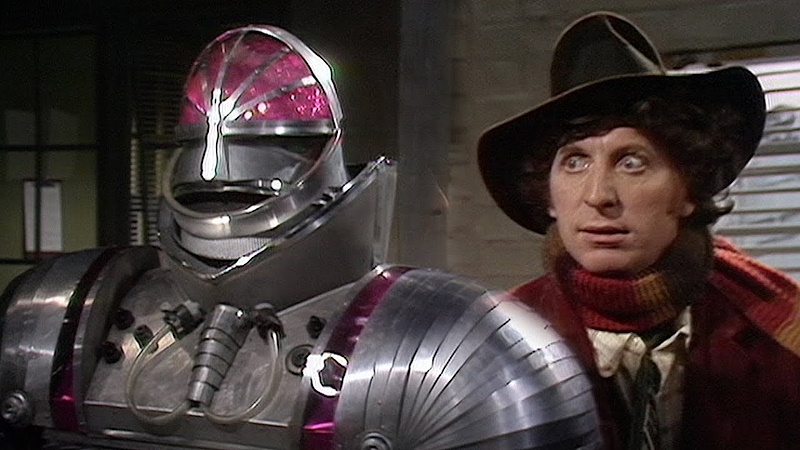
Part of the reason is because producer Philip Hinchcliffe and Robert Holmes had so many new ideas for the show, ideas that would transform even worn-out propositions like another bloody Terry Nation Dalek story into a radical rethink of what Doctor Who could be. But they haven’t really arrived yet, so let’s go to the other reason why Season Twelve feels so fresh: Tom Baker. This wasn’t Baker’s first story: Hinchcliffe felt, in another of his good new ideas, that the lower-stakes adventure of The Sontaran Experiment could be moved forward in the schedule to allow him to feel his way into the part. But it’s hard to remember this when you watch Baker in Robot. Not only does this not feel like the work of a man who’s played this role before, it doesn’t feel like the work of a man who’s visited this planet before. In ninety-eight minutes of bravura scene-hogging, Baker establishes the characterisation that will go on to make him the Doctor people think of when you say Doctor Who.
The common line on Robot is that Baker’s performance is a lot broader than the one he’ll settle into, using post-regenerative delirium as a way of concealing the actor’s own uncertainty about how to play the role. This is tellingly almost right. It’s Dicks’s script that has the Doctor acting scatterbrained and goofy, but Baker plays most of this with an unnerving severity and weight that’s recognisable from his later stories. With the exception of his costume changes, nothing is a straightforward gag here; even his skipping rope, which initially seems to be a piece of manic silliness, turns out to be part of a scheme to get away from Harry and UNIT. There is an awful lot of method beneath the Fourth Doctor’s madness, a character trait that will remain central to his characterisation right through to the end of the 1970s.
The show can’t quite keep up with what Baker is doing here. Dudley Simpson’s score is uncharacteristically off-form, scoring all of the Doctor’s deadpan eccentricities with too-jaunty ‘comedy’ music. There are also some bits which frustratingly don’t quite grasp where the show will be going from here, such as the portrayal of Miss Winters. Her techno-fascism is surprisingly predictive of the weirdest current in contemporary politics, which is presumably why her organisation Think Tank earned a namecheck in Lucky Day, the new series episode that deals most directly with this. Miss Winters does clearly resemble a first draft of the very human villains – Harrison Chase, Magnus Greel, Hieronymous – that Hinchcliffe’s era would excel at. But having set up a brilliant adversary for the Doctor, she and her followers are essentially forgotten about in the last half of the serial in favour of Dicks speed-running the plot of King Kong.
The K1 robot, an artificial intelligence defeated by its developing emotions, isn’t an original idea but it’s a memorable, well-characterised threat. I suspect Professor Kettlewell was always aware it would become all too human, not just because of his otherwise inexplicable decision to also make a metal-eating virus, but because he’s clearly designed its hands and wrists to stop it from masturbating. The more K1 features, the sillier the story becomes, and it’s here where Baker’s decision to play his Doctor as a driven, obsessive genius pretending to be a manic weirdo pays off. By the end of the serial, he’s gone from being the story’s wildest element to its most grounded: somehow this man who was dressing up as a Viking three episodes ago convinces utterly as someone who can casually reprogram Winters’s missile launch program. Next week he’ll be giving sombre speeches on the indomitability of the human race, and part of the success of Robot is that you’re not surprised by that. It’s a serial that’ll always be admired as something that prepared the ground for future triumphs, rather than on its own merits, but it is far sharper and less frivolous than its reputation suggests.
Next: The Ark in Space (1975)

Robot was actually filmed first as it was filmed in parallel with Planet of the Spiders from the previous season.