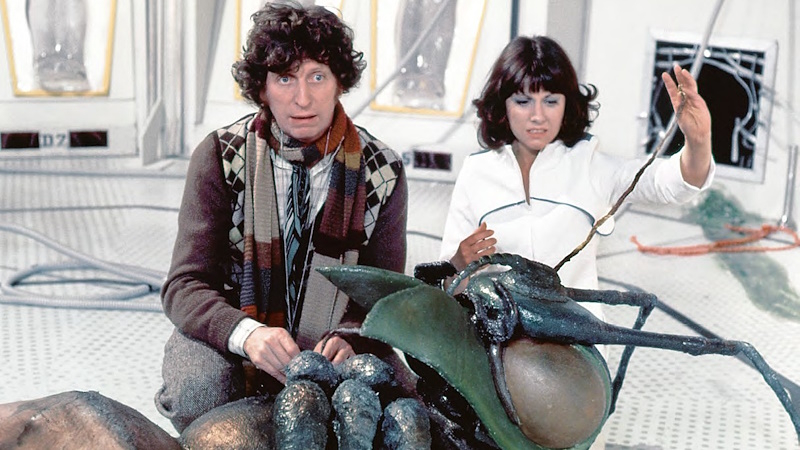
With Tom Baker’s debut story, Robot, handled by Barry Letts and Terrance Dicks, this is the first story to be produced and script edited by the iconic team of Philip Hinchcliffe and Robert Holmes. The break feels sudden and immediate. Even the Troughton era was never this single-mindedly concerned with being scary. The Ark in Space touches on a number of issues – the idea of humans as part of a natural ecosystem, life existing in space, predator-prey relationships, even eugenics – none of which are explored in anywhere near as much depth as the slow process of Kenton Moore’s Noah slowly mutating into a giant larvae. Famously, the effect was achieved using a then-obscure packaging material painted green. The fact that this “bubble-wrap” went on to become quite popular has done nothing to affect the deeply disturbing, limb-twisting nature of Moore’s performance.
As he did last episode, Baker also helps The Ark in Space feel like a fresh start. He is astonishingly assured right from the start, delivering a much-quoted speech about humanity in episode one. This Doctor’s attitude towards us is notably more detached than his predecessor’s, though. The Third Doctor was involved enough with the minutiae of human life to get actively angered by Earth politics (“‘England for the English’? Good heavens, man!” – The Claws of Axos). The Fourth Doctor seems to admire humanity as a grand, galaxy-sweeping saga while also finding individual humans mostly annoying, particularly poor Harry, who is continually traduced.
Sarah Jane Smith fares little better, spending much of the first two episodes needing to get rescued. If the “homo sapiens” speech is the Doctor’s most relatable, heartfelt moment in this story, his most alienating comes when he lambasts Sarah for being too cowardly and feminine to get herself out of danger. It is, naturally, not how he really feels – he’s trying to motivate her by giving her something to kick against, and it works. Even so, it’s the sort of scene that Pertwee would have softened, perhaps looking abashed afterwards at having to stoop to such low means. As in Pyramids of Mars, the Fourth Doctor’s priority will always be the safety of thousands rather than the feelings of a friend, and he’s not wrong, exactly – but it does make him a substantially more prickly, less human character than his immediate predecessor.
None of this means Baker’s performance or characterisation are bad, though. Indeed, it’s even more impressive that he became the popular favourite of the classic series Doctors despite being substantially less concerned with likeability than any of his peers. And it doesn’t mean the story doesn’t work either. In fact, it’s exactly what makes this Doctor click with the series’ new horror-oriented direction; if the monsters can scare this guy, they must be frightening. And sure enough, it’s the conviction of the cast that makes the Wirrn a serious threat despite their fitful realisation. Credit should also go to director Rodney Bennett for simple but effective tricks like cutting away from the larva in episode one before the audience can work out what it is, and to John Lucarotti for his script.
No, The Ark in Space isn’t written by John Lucarotti – it’s just that he turned in a script so unworkable that Robert Holmes had to do a page-one rewrite. Opinions are divided on whether Lucarotti’s Puffball was good or not; the oft-quoted final image of the Doctor whacking alien fungi into space with a golf club is not promising, but Barry Letts thought the script’s main problem was that it was too complex and spectacular, rather than too bad. One thing everyone agrees on is that it was clearly the work of someone who hadn’t watched the show since the Hartnell years, with Lucarotti even giving the individual episodes titles, a practice the show phased out ten whole years prior to this. Holmes gives the script a thorough reinvention, and yet there are still Hartnell-era traces.
The first episode has a very First Doctor focus on the Doctor, Sarah and Harry simply exploring their surroundings and trying to work out where they’ve been hidden, the sort of thing that seemed a little like a throwback when the Second Doctor and Jamie did it in The Wheel in Space. Here, it feels gleamingly new, and so does everything else. Sometimes too gleaming and too new – the shiny white Nerva Beacon is not the most atmospheric set for a horror story. Later serials like The Robots of Death would do a better job merging the space-age and the spooky. This nevertheless feels like a mission statement for Holmes and Hinchcliffe’s vision of Doctor Who, both in its artistic qualities and its production. The next two years would see a remarkable number of scripts rewritten by Holmes, with the result that his voice would dominate the show in a way no other writer managed until the showrunners of the revival series. Ordinarily, it’s something I’d chafe against: Doctor Who should feel kaleidoscopic, limitless, not beholden to one writer’s vision. But Holmes made it feel like a blessing, and if you want to know why you could do worse than watch this.
Next: The Sontaran Experiment (1975)