In retrospect, it’s hard to believe anyone was ever nervous about Tom Baker taking over as the Doctor. At the time, though, Jon Pertwee was both the longest-running and most popular Doctor, so producer Philip Hinchcliffe and script editor Robert Holmes came up with a number of strategies to ease the new guy in. Almost all of them failed, but the most important thing is this: you’d never know from watching the episodes. If your only familiarity with Season Twelve was reading a production history, you’d assume it was one of Doctor Who‘s all-time train-wrecks. Instead, it established the definitive incarnation of the Doctor and delivered some of the show’s most celebrated stories.
The Sontaran Experiment isn’t one of them, but that’s largely because it’s sandwiched in between The Ark in Space and Genesis of the Daleks. Most stories would struggle to shine in that company, especially if they’re only two episodes long. It’s also written by Bob Baker and Dave Martin, two writers who often felt hemmed in at the show’s standard four-episode length. It’s not as if they’re bad writers – inconsistent, maybe, but they’ve got too many great stories to be written off easily. The problem is, they seem to start from the assumption that Doctor Who is made with an unlimited budget and an unlimited run-time. Close analysis has proved that it is not.
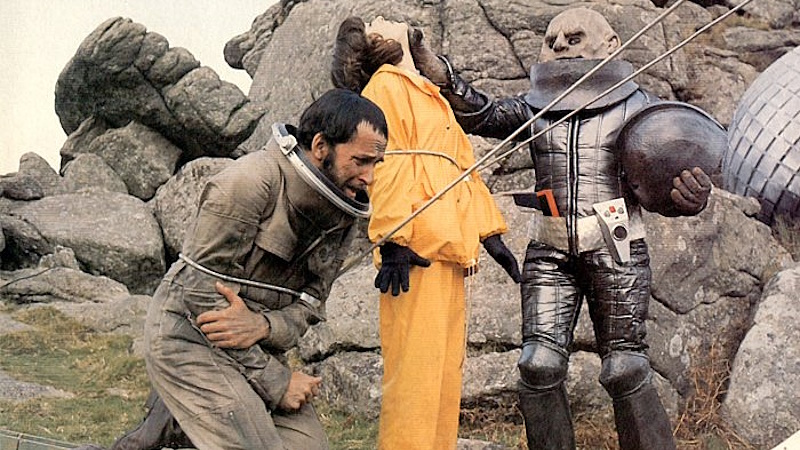
The Sontaran Experiment has a ton of limitations, but – and this seems to have made all the difference – they’ve been imposed from the start rather than added afterwards in a vain attempt to discipline their imagination. Aside from the unusually truncated length, it’s filmed entirely on location on Dartmoor. The well-trimmed heather is hardly wild enough to convince as an uninhabited future Earth, but that’s easy to ignore. For all The Sontaran Experiment is a fairly generic invasion story – it doesn’t have room to be anything else – it does persuasively make the case that any generic Doctor Who story will be massively improved if the running around corridors is replaced with scrambling between boulders. The Sontarans’ scout robot, a standard-issue sci-fi design that wouldn’t have stood out in a studio-bound story, looks fascinatingly, creepily out of place when it’s gliding across the moors.
But The Sontaran Experiment is more than just a location. Baker and Martin are very good at writing for the Sontarans, an apparently straightforward villain who are, in practice, very hard to get right. Since Doctor Who is an anti-militaristic show, it can fall into the trap of portraying military figures as idiots. A good military man like the Brigadier still ends up being written as an amiable buffoon half the time; the Sontarans, as warmongering baddies, are too often dismissed as thugs. But The Time Warrior established them as having some cunning and technical expertise, and their single-minded aggression and lack of individuality reveals them to be yet another Doctor Who villain inspired by memories of the Nazis.
The Sontaran Experiment gets this. The titular experiment, on a crew of South African astronauts, is hardly a major scientific endeavour, but that’s not the point. By the mid-70s, pulp adventure stories had spent decades trying to process the horror of the Holocaust through gamey stories of sadistic, perverted Nazis experimenting on human subjects. The Sontarans here, with their eagerness to identify “human females”, are in that alarming lineage. They have no ideology other than sadism and warmongering, and they lick their lips as they dish out the punishment. The rather Freudian hallucinations they subject Sarah Jane to, including a fat snake wrapping itself around her hand and a thoroughly repulsive porridge-like goo slithering over her feet, hark ahead nicely to the Doctor’s ordeal in The Deadly Assassin.
In among all this, the regulars – Tom Baker, Elizabeth Sladen and Ian Marter – are solid, which is all the more impressive considering this was the first story they recorded together. Hinchcliffe thought this straight-ahead adventure would be a good one for Baker to find his feet in, but he ended up breaking his collarbone doing a stunt. (I told you everything went wrong this year) He spends a fair bit of the final episode being doubled by Terry Walsh, and he’s clearly wearing a neck brace bulky enough to make him look like Quasimodo in the close-ups. The ending in general is a weak link, with the death of Styre and the thwarting of the Sontaran invasion coming across as barely set up.
That’s obviously a risk of the two-episode format, but elsewhere Baker and Martin use their time very wisely. The decision to have this story carry on directly from The Ark in Space means they can rely on that serial’s world-building rather than spend time establishing a new setting, and they add some nice touches of their own. The revelation that the astronauts on Earth regard Nerva Beacon as a Roanoke-esque lost colony speaks volumes about how bad things have got back on Earth, compared with the shiny white cryo-future of The Ark in Space. And compared to the next story, it’s a nice holiday on Dartmoor.
Next: Genesis of the Daleks (1975).