Pyramids of Mars is one of those stories so enshrined in fan mythology as one of the series’ maximum highs that it can be hard to think clearly about it. When asked about it, we know exactly what to say: this is a great serial because it has a darker portrayal of the Doctor, and cements the show’s new Gothic horror direction. Which it is, and it does, but it’s worth remembering why these are both good things for the show.
The last time the show moved so decisively towards horror territory was the mid-point of Patrick Troughton’s tenure, which by 1975 hadn’t quite been canonised as a classic era. Even today, it has its detractors, who lament that a show with such a wide-open format got stuck in a formula. The early Tom Baker serials don’t attract such criticism, which is partly because they execute their formula well enough to silence all dissent. But it’s also because of what they were following up. The Hartnell era, to my eyes, has more outright clangers than the Troughton era, but there is something laudable in how it insists that Doctor Who can be about anything. The Troughton stories mostly restrict themselves to being about monsters. The Tom Baker era, by contrast, is following on from the Jon Pertwee years, when Doctor Who was frequently a show about monsters in Surrey. The fact that the next era widened this out to feature monsters on other planets, even other English counties, therefore does not register as a lack of ambition.
The wider issue, though, is whether it diminishes Doctor Who to reduce it to a show about monsters. Clearly it does inasmuch as the show is sometimes about other things, but if the public demand monsters – and by this point it’s been clear for roughly a decade that they do – this isn’t a restrictive demand for the series to shoulder. Exploring monstrosity, exploring what is repellent or aberrant, has always been a fertile field for storytelling.
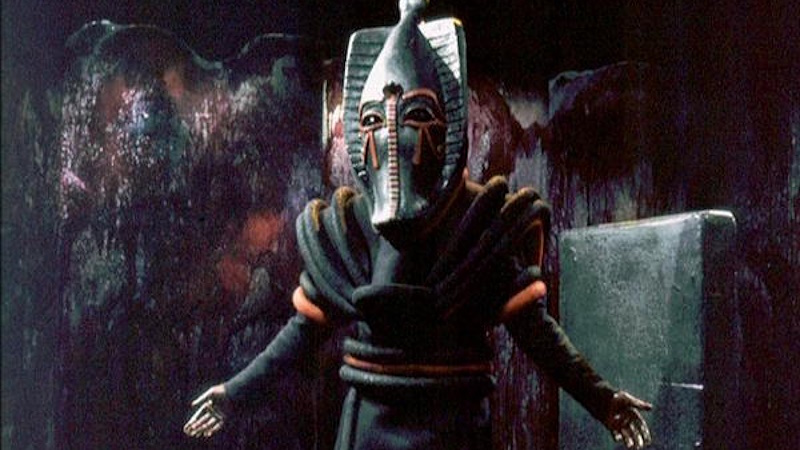
Script editor Robert Holmes didn’t want the show to be solely about monsters, which is why most of the scripts produced under his tenure pair a grotesque creature – the Wirrn, say, or the Krynoid – with a human or humanoid villain they were possessing or collaborating with – Noah, or Harrison Chase. As a result, the early Tom Baker seasons are the show’s most sustained engagement with the nature of evil, augmenting the simpler thrill of big, scary, roaring beasts with more mature, thought-provoking attempts to define individual wickedness. By the middle of his first full season, Holmes is already crediting the audience with enough intelligence to notice this pattern, which is why you have that magnificent end-of-part-one fake-out where Namin, the gun-toting fanatic who we fully expect to fill this role, is casually burned to death by the late English archaeologist Laurence Scarman, his corpse reanimated and equipped with deadly powers by Sutekh, the Egyptian God of Death.
That’s quite a sentence, isn’t it? The show had drawn from mummy’s-curse stories before in The Tomb of the Cybermen, but this time it’s very different. The Tomb of the Cybermen is a mummy’s-curse story in the same way that Forbidden Planet is an adaptation of The Tempest: the adults in the audience will be able to pick up on the shared story beats, but the children will enjoy it on the level of pure science fiction adventure. Opening the Cybermen’s titular tomb isn’t dangerous because it bears an ancient curse, it’s dangerous because it’s full of Cybermen. Pyramids of Mars, though, is an Egyptological horror story that uses the same props as its Hammer and Universal inspirations. It dutifully comes up with cod-scientific explanations as to why this week’s episode of a science fiction serial features killer mummies rising from their sarcophagus, but make no mistake, the thrill of it, the spectacle, is about people being stalked and killed by Egyptian mummies and artefacts.
So this adds another subgenre to the list of story types Doctor Who has bent to its own purposes over the years. What makes it a classic, though? The quickest answer is that Robert Holmes, heavily reworking Lewis Griefer’s script under the pseudonym Stephen Harris, is the first person to work out that this is one of the essential thrills Doctor Who can deliver. The uncanny effect of seeing science-fiction gadgets in a faithfully recreated period of Earth’s history is something other SF franchises achieve using holograms or medieval planets or somesuch. Doctor Who can just go and do it, and it’s incredible to think it didn’t do this from the get-go. Barring a few throwaway gags about Daleks on the Marie Celeste, only The Time Meddler and Holmes’s own The Time Warrior had dedicated themselves to exploring this idea prior to Pyramids of Mars. The much-commented-upon scene where the Doctor shows Sarah a ruined 1980s Earth, explaining that if they don’t stop Sutekh this will be the future, would be a brilliant scene if it was a belated explanation for a long-running plot contrivance, in the same way that The Masque of Mandragora will soon explain why everyone in the Doctor Who universe appears to speak English. But it’s actually Holmes establishing the ground rules for this new kind of story, a story type that will soon be so ubiquitous fans will have to coin a name for it (“pseudohistorical”).
Pyramids of Mars has an extraordinary chain of such iconic set-pieces, none greater in my eyes than the scene where Sarah is enraged by the Doctor passing lightly over the murdered body of Bernard Scarman in order to examine a robot mummy. The core of the Doctor’s personality should always be his alien nature, but it’s never been as uncomfortably front-and-centre as it is here. The great thing about this scene is that both of our protagonists are in the right; Sarah has seen a lot of deaths but it’s easy to understand why she feels this one – a man murdered by the possessed corpse of his brother – is upsetting enough to demand some kind of pause, some commemoration. But the Doctor also has a point when he says billions of people will die if they don’t hurry up and stop Sutekh.
Even though we love Sarah – and Elizabeth Sladen’s stressed-out line readings bring as much humour to this incredibly grim story as it can bear – we know the Doctor is right. We know because Holmes does such an extraordinary job selling Sutekh as a threat unlike any other. He begins by psychically breaching the TARDIS, a major assault on the show’s one safe haven, purely as a show of strength. His emissary is Bernard Archard in corpse-like make-up, which would intimidate anyone. When Sutekh himself finally takes centre stage in the story, he lives up to the hype. Gabriel Woolf’s voice performance is justly celebrated, but it’s worth noting that he’s not playing Sutekh as a booming, dominating villain – he would give that performance much later, as The Beast in The Satan Pit. The voice of Sutekh is subtle, cultivated, capable of finding amusement in his single-minded obsession with death and torture.
Sutekh, then, is a monster in every sense. My friend Alexander Lane likes to say the test of a well-written villain is whether or not you can imagine them doing something non-villainous; going to the greengrocers, for instance. For Sutekh, this is a non-issue. He’d kill the greengrocer. The unremitting quality of his hatred and sadism would be comical if it wasn’t for Holmes’s eloquent, menacing dialogue, Woolf’s carefully shaded performance – and Tom Baker’s performance, too, because even the Doctor is clearly terrified of him. Everything Holmes and director Paddy Russell have at their disposal – these performances, the Hammer horror trappings, the incongruously pretty countryside location that reminds us what will be lost if Sutekh wins – has combined to create a picture of ultimate evil that the show has often tried to replicate, but rarely matched.
Baker famously said the Doctor wasn’t an acting role, not in the sense that you don’t have to act in it – although Baker is one of those rare performers who can essay the role of a mad immortal alien just by being himself – but in the sense that he doesn’t experience any change. Pyramids of Mars might be an exception. The Doctor begins by brooding about his advancing years, reminding Sarah Jane that these rank in the hundreds. “I’m a Time Lord”, he says, and Sarah’s eye-rolling response – “Oh, I knooooooww you’re a Time Lord” – indicates he’s frequently claimed this identity. Later on in the show, though, the Doctor is taunted by Sutekh, who considers the Time Lords to be weak. The Doctor then says something extraordinary – he does not consider himself a Time Lord any more. We knew he was an exile, but now he seems to have renounced the identity altogether.
Maybe if Pyramids of Mars had aired after The Deadly Assassin revealed how rotten Time Lord society was, this might have attracted more comment. Even if you missed that, though, you’d have to acknowledge a major change in the Doctor’s demeanour by the end of the serial. Facing the ultimate monstrosity of Sutekh energises him, brings him out of his self-pity, makes him dive head-first into danger and relish the destruction of his enemy’s apparatus once again. It’s a fitting end for a story which revitalises everything it touches, from the shopworn Hammer formula (this aired one year before the last of the original Hammer cycle, To the Devil a Daughter) to Doctor Who itself.
Next: The Android Invasion (1975)