The Masque of Mandragora is an interesting story, because everyone always forgets about it. I realise that implies it’s not very interesting at all, but consider the context. This is a story with the Fourth Doctor and Sarah Jane Smith, the consensus favourite Doctor-companion pairing. It’s produced and script-edited by Philip Hinchcliffe and Robert Holmes, the consensus favourite production team. It’s the first story in Season Fourteen, which that insistent old consensus claims is the best season of the show. Why, with all this going for it, is it so invisible?
It doesn’t seem to be down to any egregious mis-steps. There are a few stories from this era that aren’t well-loved – Revenge of the Cybermen and The Android Invasion spring to mind – but people can, at least, generally point to something in those stories that they actively dislike. Hell, it’s easier to point to glaring flaws in acknowledged masterpieces from this era. The Masque of Mandragora has no giant rat or killer clam to briefly mar it – its only sin seems to be that it doesn’t stand out. Unlike the stories we’ll be seeing later on this series, it doesn’t reinvent Time Lord history, or have a unique, imaginative design aesthetic, or feature a heartbreaking companion farewell. In a normal season that wouldn’t be a problem, but this is Season Fourteen, and every subsequent story will have at least one element that counts as the show’s all-time greatest example of whatever it’s attempting.
But this is actually why I like it. Without some grand experiment like The Face of Evil‘s uncharacteristic choices of companion or villain, or The Deadly Assassin‘s companion-free format and head-trip third episode, we can check out what this era looks like when it’s just coasting along and making a fun adventure story. And the answer is pretty startlingly good. You’d be surprised to see it in anyone’s all-time top ten, but there are whole seasons of Doctor Who whose stand-out episodes aren’t as great as this. The plot barrels along, the dialogue crackles, there’s some stunning location work in Portmerion, famous for its starring role in The Prisoner. It must be said that the Doctor and Sarah spend even more time than usual being captured and escaping, but the combination of excellent stunt-work, witty one-liners and the sheer amount of fun Tom Baker is having make this entirely forgivable. It might still be running on the spot, plot-wise, but it’s a more entertaining run on a better class of spot.
On one level, this is aiming for Shakespeare, but thankfully writer Louis Marks and his Jacobean-minded script editor understand that Shakespeare is – however hard it may be to appreciate at this remove – aiming to entertain. He wasn’t afraid of larger-than-life characters, violent action, crude humour and elaborate insults, and neither are they. Federico’s description of the Doge of San Martino as a “box-faced old blowhard” might be the finest insult in Doctor Who history; less high-minded children will have surely enjoyed one of his guards protesting against being sent to a catacomb full of “bat droppings twice the height of a man”. As a fan of Renaissance art, I got a particular kick out of the Doctor silencing the villain, the deranged astrologer Hieronymous, by telling him to “drop all that Bosch”.
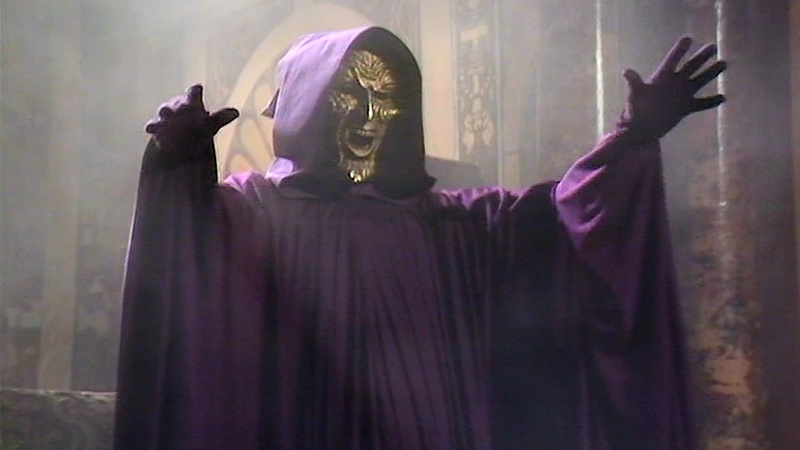
With supporting characters like Hieronymous and Federico, this story would be just as entertaining if the monster didn’t turn up – and in a way it doesn’t. The alien threat is a formless energy that hijacks the TARDIS and takes it to a specific point in Earth’s past, equidistant between the Dark Ages and the Renaissance, where it plans to manipulate Hieronymous into changing the course of history. Similarly incorporeal threats have featured in the show before, but they usually have the good grace to bring along some robot Yeti or giant ants to scare the kids with. There are scary moments in The Masque of Mandragora – the episode three cliffhanger, where Hieronymous is briefly changed into something akin to the mirror-faced creature from Maya Deren’s Surrealist short Meshes of the Afternoon, is deeply unnerving – but the Mandragora energy isn’t really filling the role of a monster here. Its story function is more akin to one of those cataclysmic events – the Great Fire of Rome, the gunfight at the OK Corral – that Hartnell-era historical stories frequently wind their way towards. Except this time it’s fictional, so the Doctor can avert it.
The emergence of the “pseudo-historical” – i.e., a story with SF elements in a historical setting – is often cited as one of the developments that killed off Doctor Who‘s pure historical stories. The Masque of Mandragora takes the pseudo-historical format as close to being a pure historical as it possibly can; it would be over forty years before episodes like Rosa and Demons of the Punjab would try something similar. Normally when the Fourth Doctor goes back in time, it’s because the genre we’re pastiching this week requires a historical setting, but this has an authentically Hartnell-era interest in history for its own sake. There are, certainly, genre elements; sinister cultists demanding human sacrifice, sword-fights and horseback chases, masked balls as a pretext for violence, prophecies about lunar eclipses. Yet none of these demand the story be set in fifteenth-century Italy. It doesn’t map easily onto any Hammer or Universal film. Nor, as noted above, does it link up with any Great Moment in History – the Mandragora Helix has landed in this era specifically because it predates those moments. Holmes and Louis Marks – one of the show’s few remaining writers from the Hartnell era, remember – seem to be exploring this era because they think it’s interesting.
The fun is infectious, particularly when it’s channelled through Tom Baker. It’s remarkable how Baker can go from the brooding, morbid characterisation that defined the previous season to this, where he sticks an apple on the end of someone’s sword then steals their horse, without giving any sense of breaking character. Part of the wonder of Baker’s performance is that he can do anything and still feel perfectly, inexpressibly Doctorish. As with Troughton’s Doctor, it’s a quality that’s hard to describe without using the word “trickster”, and that’s an especially useful concept to bring up in the context of this story. In last season’s The Brain of Morbius, an actual mystic shrine was saved by the Doctor’s schoolboy pranks. Placed in the middle of an even more overt clash between science and magic, it’s no wonder he’s in his element.
Next: The Hand of Fear (1976)