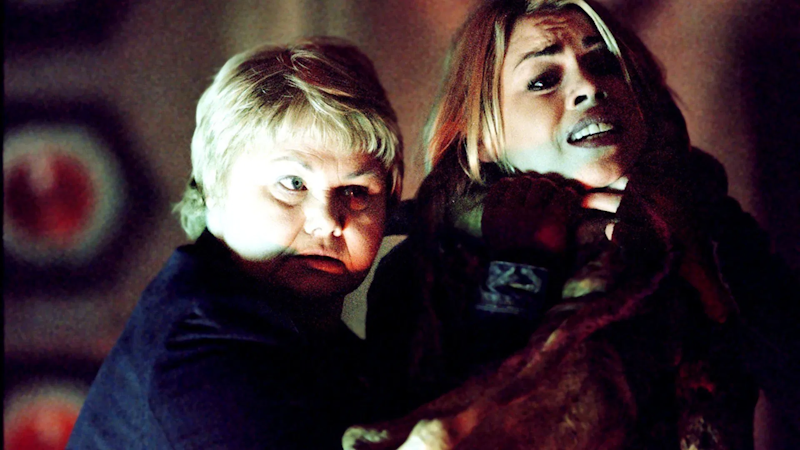
In a lot of ways, The Talons of Weng-Chiang is the culmination of Robert Holmes and Philip Hinchcliffe’s vision for Doctor Who. It had to be: the furore over The Deadly Assassin would see Hinchcliffe forcibly moved on after this, while Holmes stayed on for just half of the subsequent season in order to give his successor time to bed in. But it’s also the point where a lot of their running themes come to full maturity. The question of evil, which has been unusually prevalent in these early Tom Baker seasons, becomes such a preoccupation here that it’s hard to understand how it was broadcast during family viewing hours. This time, the Doctor and Leela are fighting a war criminal and human experimenter from the future, a Dr. Mengele with the limitless powers of a god, and a particularly unwholesome interest in performing experiments on underage girls who are walking the streets of Victorian London for reasons Holmes’s script wisely doesn’t spell out.
Hinchcliffe later said that, had he not been forced off the show, the next season would have recast the Doctor as a proto-Indiana Jones explorer-hero, the lead character following his new companion Leela out in the jungle. There seems to be an acknowledgement here that Holmes and Hinchcliffe’s early Hammer Gothic style couldn’t be pushed much further than this, that once the Doctor has fought an enemy who evokes the Phantom of the Opera, Fu Manchu and Jack the Ripper all at the same time you have to either change tack or fall into self-parody. Certainly, the producer was treating this as a last hurrah. Hinchcliffe instructed the production team to ignore budgets wherever possible, producing a serial whose lavish, location-shot look is as impressive as its script and acting for once. Even the giant rat, commonly cited as the serial’s one embarrassing element, isn’t anywhere near the bottom of the barrel when it comes to giant monsters in classic Who. The overall standard of Season Fourteen is so astonishingly high we have to pretend it’s worse than it is, just to give us something to pick at.
Which is surprising, because a lot of Doctor Who fans who started watching during the revival series find it very easy to pinpoint something wrong with The Talons of Weng-Chiang. Russell T Davies once used its first episode to defend genre writing as a whole, arguing that Holmes’s writing here is as good as Dennis Potter at his peak. He’s not wrong. The Doctor and Leela take a little while to enter the action, and for once you don’t care: every single character is fabulously drawn, from the grandiloquent theatre manager Henry Jago to the nameless “ghoul” who provides a Greek chorus as the peelers fish a corpse from the Thames. Later, Holmes pulls off the trick he and Robert Banks Stewart worked out for The Seeds of Doom, of treating a six-parter as a two-part story and a four-part story wherein one of those stories must end with the Doctor losing. Unlike The Seeds of Doom, it is here done so elegantly that most people miss it. The Talons of Weng-Chiang is set up as a story where the Doctor must stop Magnus Greel from retrieving a time machine at all costs. When episode four ends with Greel cackling maniacally as he drives off with his time machine, you intuitively know that the final two episodes are going to be even more urgent and dangerous than usual, and so it proves.
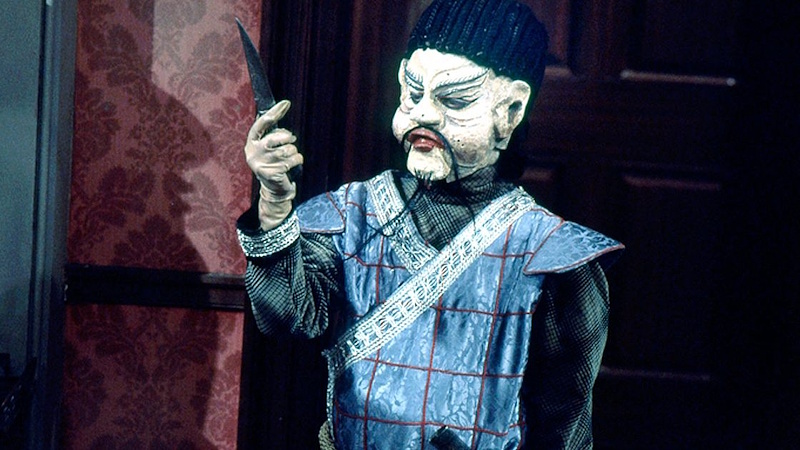
It seems unlikely, though, that Davies is encouraging many non-fans to watch The Talons of Weng-Chiang today. Its status as a beloved classic of the series has forced some older fans into a defensive position about its portrayal of Chinese characters, but there’s no need for that. There is simply no way to look at John Bennett’s performance as Li H’sen Chang, all yellow make-up, prosthetic slanty eyes and ah-so accent, and honestly say it is acceptable by today’s standards. It can be hard to accept something is a genuine, rightly adored masterpiece and pretty damn racist; for some people, the second fact means they can’t appreciate the first. That’s a shame, but I understand it – far more than I understand the people who think the first fact means the second can’t be true.
Like a lot of cultural clashes about race, the disagreement is compounded because the two different sides are using two definitions of racism: one see it as a force so culturally prevalent that even decent people can be tainted by it, whereas others see it as a straightforward evil practiced only by the worst people. And fair enough, if I thought anyone was accusing Hinchcliffe and Holmes of the latter I’d be affronted too. The Talons of Weng-Chiang is not Birth of a Nation, a film which, for all its technical innovations, was made to portray the real-life murderers of black men as heroes. It’s a playful, ironic riff on Victorian sensation fiction, and had it used any of its other many intertextual references – even Jack the Ripper! – as its central element, it wouldn’t be even remotely contentious.
Unfortunately it chose Fu Manchu, the Yellow Peril incarnate, though the show’s science-fictional substitute for Sax Rohmer’s criminal mastermind is an interesting one. Originally this was going to be a Master story, but The Deadly Assassin got that villain. What Weng-Chiang got is Magnus Greel. We’re told he’s Chinese, but his Teutonic name and his back-story – as with Holmes and Hinchcliffe’s previous portrayals of Davros and the Sontarans – is pure Gestapo, a nightmarish yarn of genocide, human experimentation and barely-subtextual paedophilia from World War Six. He is as close as the series has ever got to genuine, incomprehensible human evil, and the Doctor and Leela seem loosed from their responsibilities in dealing with it. For once, the Doctor barely raises his voice against Leela’s casual killing of Greel’s henchmen, and by the end even he’s started dishing out choice beat-downs to the villain and his cyborg henchman Mr. Sin.
I suppose this is why I find it so easy to square the circle with this story; its treatment of Chinese culture is the product of a careless, unrestrained production team, but so is everything that’s great about it. The Talons of Weng-Chiang would be easier to watch nowadays if its production team had been more tasteful and sensitive about race, but a tasteful and sensitive production team might also have vetoed the horrifying violence and gore, the sexual innuendos (check out the scene where genteel Victorian Mr. Litefoot is shocked by Leela’s, er, appetite!), the same killer doll motif that had got them into trouble with Terror of the Autons, the shamelessly indulgent Victoriana, the budget-busting stunts, sets and night shoots. The Talons of Weng-Chiang now feels like a kind of thought experiment: is it possible for something to be both problematic and perfect? Watching the Fourth Doctor charge into action with his deerstalker and rifle, you’d have to say it is.
Next: Horror of Fang Rock (1977)