

There are some eras of classic Doctor Who – notably the very first and the very last Doctors of the classic era – which lend themselves surprisingly well to being watched from a modern perspective, where main characters are expected to have multi-season arcs. Then there’s the Tom Baker years, by general consensus the high point of the classic run, which are nevertheless absolutely 100% impossible to watch in such a fashion. The standard hero’s journey is a movement from innocence through crisis to some sort of catharsis, but by his second story Baker’s Doctor is broody, distant and irritable with his companions. After this, he gradually becomes more light-hearted, increasingly refusing to take anything seriously until a final season where he suddenly jumps back into an even more extreme take on his early, mordant persona.
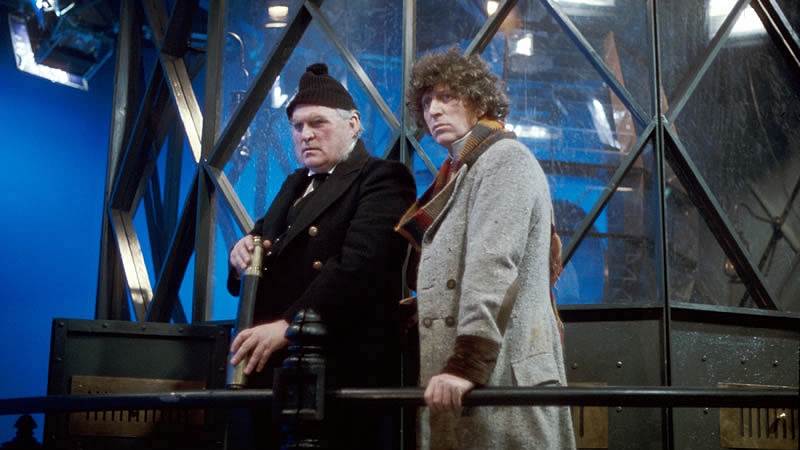
This isn’t the kind of structure they teach you in screenwriting classes, but there is a natural kind of ebb and flow to it. It’s never less than believable, largely because Baker is such a natural, relaxed performer. And Season Fifteen – which opens with Horror of Fang Rock – is right in the middle of it. What’s more, you could make a solid case that the pivot from Early Tom to Late Tom happens right here. Previously, Baker’s Doctor has tended to face off against tyrants and gods, or at least invasion fleets, but here it’s a small-scale threat in a small-time setting. The joy the Fourth Doctor takes in taunting and talking over his enemies, which has surfaced previously in stories like Revenge of the Cybermen, finds a much more natural outlet when he’s faced with a desperate, lone threat like the Rutan here. Soon it’ll be one of the defining characteristics of his Doctor.
Yet the story as a whole is so bleak – famously, the first Doctor Who serial where not a single guest character survives – that it doesn’t register as the carefree clowning of Season Seventeen. Rather, it reminds you that the Fourth Doctor’s ability to laugh at mortal danger is intimately related to his ability to shrug off other people’s deaths. It’s a rather unnerving characteristic for a children’s adventure hero, and even at his wittiest Baker is still too weird and too wired to be a reassuring presence. Normally the show grounds the Doctor’s peculiarities with a relatable companion figure, but here we’ve got Louise Jameson as Leela, threatening to cut people’s hearts out and demanding the Doctor kill her when she believes – wrongly – that she’s disabled. (Rumours that Leela went on to work at the Department of Work and Pensions under Iain Duncan Smith remain unconfirmed)
Except in a strange way Leela is a reassuring figure. She is quick to jump into action, and it’s hard for the audience not to appreciate that characteristic when they’re watching an adventure story. She is also very funny, particularly in a period setting. It’s a shame that the show moved away from historical settings during her tenure, because as in The Talons of Weng-Chiang there is something very endearing about her license to blunder unapologetically through the pieties, hypocrisies and bigotries of previous ages. It is also worth noting that Doctor Who is a show responsible for so many of our childhood crushes, and Leela was mine. It’s not just because, in this story, she beats Knives Out to the trick of making fisherman’s jumpers sexy. I was slightly too young to know what “sexy” meant to me when I first encountered Leela, but I knew there was some kind of unspoken promise in that above-mentioned indifference to social taboos, as well as her hot (in every sense) temper. In the scene where Leela slaps Adelaide, actress Annette Woollett apparently asked Jameson to hit her as hard as she could for real. I would have made the exact same request.
We have, then, two icons of the show operating at the peak of their powers. There’s also a third: Terrance Dicks. Dicks is such a giant of the show’s writing staff it can be easy to forget that most of his contribution lies in something other than writing scripts: editing scripts, most obviously, and the prodigious amount of novelisations he produced. For all he’ll forever be associated with the Jon Pertwee era, he never claimed a scriptwriter’s credit for any of those stories: the bulk of his screenwriting credits come from the Tom Baker years. Of those, only Robot resembles the kind of story Pertwee might have featured in, and even then only because it was designed to reassure audiences that this new guy with the scarf was still playing the character they loved. Dicks’s other Tom Baker scripts were notable for embracing the Philip Hinchcliffe style of gothic horror Who, keeping that version of the show alive long after Hinchcliffe had been forced out of the producer’s chair – and this is the first Doctor Who serial of the post-Hinchcliffe era, so he didn’t waste time.
To be a good script editor – and Dicks was a great script editor – requires a certain humility. You need to have the brilliance to restructure or rewrite a failing story, but also the modesty to stand around at BBC parties listening to the screenwriter claim it was all their own work. More than any of his other stories as scriptwriter, then, Horror of Fang Rock is a script editor’s script. Dicks didn’t write this because he had a burning passion for the story, he did it because there was a gap in the schedules and no-one else could knock out a script fast enough. It’s got a small cast, an even smaller amount of sets and a blob for a baddie, yet anyone who’s seen it will know how deftly Dicks transforms these limitations into ways to make the story more intense and claustrophobic.
Horror of Fang Rock is properly old-fashioned, theatrical television, the sort of thing that only Reece Shearsmith and Steve Pemberton are allowed to produce these days. It has one of the great directors of such material in the form of Paddy Russell, and a cast who know exactly how to play it. It’s the Doctor Who equivalent of a campfire ghost story, a link made explicit at the end – and it works terrifically. It’s not a showy kind of brilliance, but Terrance Dicks wasn’t a showy kind of genius.
Next: The Invisible Enemy (1977)

Great episodes! The restricted setting works really well and it’s got such great atmosphere, but still with moments of dark humour. It’s the first one I’ve seen with Leela as a companion and I agree she’s a really entertaining counterpoint to the other characters.