It does go slightly against the principle of this series, but sometimes it’s worth taking a Doctor Who story out of the context of its season or era and looking at it in isolation. Image of the Fendahl is a case in point. The most consistently overlooked of Chris Boucher’s three excellent Doctor Who scripts, the main charge against it is that it represents a worn-out formula, the last gasp of the Gothic style that made the early Tom Baker seasons so acclaimed. When the charges against a story looks like this, there’s a value in taking it out of that context and asking if it works on its own merits. And in the case of Image of the Fendahl the answer is yes, tremendously well in fact.
Indeed, a large part of the problem seems to be that the new production team hasn’t established itself firmly enough for this to feel like an enjoyable throwback. There’ll be two more identifiably Gothic horror serials before Tom Baker leaves the show, and both of them are regarded more highly, perhaps because they represent a refreshing change in the middle of seasons that have a strong identity of their own. Does that make them better artistically, though? Even the partisans of The Stones of Blood acknowledge that the last episode is an awkward tonal leap, while State of Decay has to do a bit of work making Season Eighteen’s intellectual, video-effects-driven house style accommodate a story about literal blood-drinking vampires. Image of the Fendahl, meanwhile, is pure uncut Holmesian Gothic. It’s the last serial Robert Holmes commissioned before being removed as script editor, and boy does it feel it.
Actually, this is slightly unfair. Image of the Fendahl has the vibe of pure Gothic horror, helped by the same atmospheric direction George Spenton-Foster would later deploy on Ribos. But the feel of a story can be deceptive. There are actually a number of different horror subgenres mingling in Fetch Priory, including one of the series’ closest engagements with folk horror. Doctor Who was an early adopter of the folk horror style, producing The Daemons in the same year that Anthony Ainley and Wendy Padbury starred in The Blood on Satan’s Claw. But The Daemons is essentially a Dennis Wheatley reskin; Wheatley’s brand of genteelly English Satanic mumbo-jumbo was a key step on the road to The Wicker Man, but it’s still a separate thing. When Image of the Fendahl deploys a pentagram, by contrast, it does so in a staunchly pagan context. Time-slips are mistaken for ghosts, rock salt is a defence against ancient evil, and the local Wise Woman – played unforgettably by Daphne Heard – becomes the Doctor and Leela’s closest ally.
We’ve had cause to note before that this collapsing of the distance between Doctor Who and its horror-movie inspirations is one of the key innovations of Holmes’s time as script editor. Tomb of the Cybermen is a science fiction story that uses tropes from mummy’s-curse tales, whereas Pyramids of Mars is a story where Egyptian mummies walk around killing people. If this was all Image of the Fendahl was doing – remaking The Daemons with a production team who wouldn’t flinch at Roger Delgado reciting the Lord’s Prayer backwards – it would still be a thoroughly entertaining ride. But there’s another horror subgenre at work here, one similarly alluded to in the Troughton years but which is allowed free rein here. This is a Lovecraftian story.
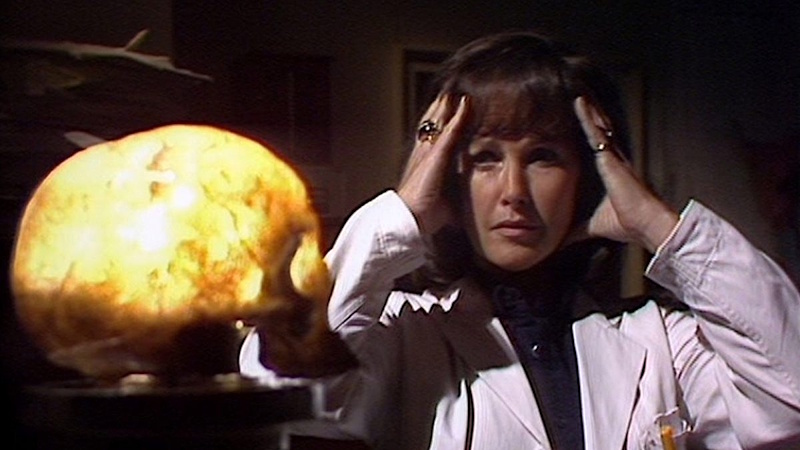
When Denis Lill’s Dr. Fendleman has his terrible realisation that “mankind has been used”, he’s giving vent to the central fear of the Cthulhu mythos; that humanity is fundamentally unimportant, a speck of dirt on the hands of the gods that could be brushed off at any time. It’s the kind of awful knowledge that sends the caver in The Silurians insane, and it prefigures Max Stael killing himself here in one of the bleakest scenes in Doctor Who history. The fossilised human skull that houses the Fendahl is clearly inspired by Doctor Who‘s usual crib sheet of Quatermass and the Pit, but the Fendahl itself is clearly an Elder God. Rather than a hostile alien race, as they were in Nigel Kneale and “Guy Leopold”‘s stabs at this story, the Doctor and Leela are facing a gestalt entity which possesses humans and feeds off life energy, the result of evolution being thrown so fully into reverse that it produced an animal that can only thrive on destruction. The science doesn’t even bear squinting at, but that’s OK, because this isn’t a science fiction story. This is the closest the show ever got to a pure kind of occult horror, one where even the vaguer areas of the Fendahl mythology – and there are a few of those – work well as insinuations of Things Mankind Was Not Meant To Know.
The depiction of science is worth pausing over. Prior to Douglas Adams arriving, Doctor Who was written by people steeped in C.P. Snow’s Two Cultures, to the extent where even Kit Pedler, the man brought on as the show’s scientific advisor, mostly produced stories about how artificial heart valves would turn us all into robo-zombies. When scientists were brought on as characters, they tended to be either cackling lunatics or bland voices of authority. For all the big, broad performances by Denis Lill and Edward Arthur have attracted some criticism, they deserve praise for not falling into this trap. All four of the scientists are distinct characters, particularly Arthur’s cocky, sneering Colby. Maybe he’s just like this to distract the audience’s suspicion from Stael, but he lands closer to early Christian Slater than any of the lab-coated conformists the show normally depicts.
The show’s other scientific authority, the Time Lords, are still in their post-Deadly Assassin funk, with the show regularly invoking them without the dramatic weight they would later regain. The revelation that the Time Lords have suppressed all knowledge of the Fendahl could be cut out of the serial without anyone noticing, though it does, at least, explain why the Doctor’s vague knowledge of the Fendahl offers him no advantage. It hardly matters; Baker is, once again, so good at selling the Doctor’s fearful reverence for his enemy that it would make a teddy bear scary. Alongside him, Louise Jameson overcomes a bad hair day and an even skimpier costume than usual to deliver a very strong performance as Leela. She’s clearly enjoying working with Boucher’s characterisation of her one last time – even Robert Holmes tended to write Leela simply as being extremely violent, which was often fun enough, but Boucher has him beat when it comes to little pieces of Leela-logic like her completely understandable misinterpretation of the word “council”. If you’re not a fan of Image of the Fendahl, it’s well worth pulling out of context and giving it another try.
Next: The Sun Makers (1977)