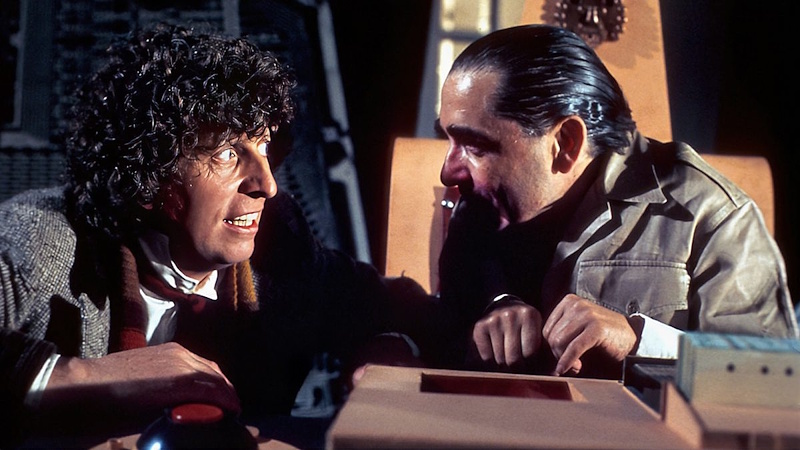
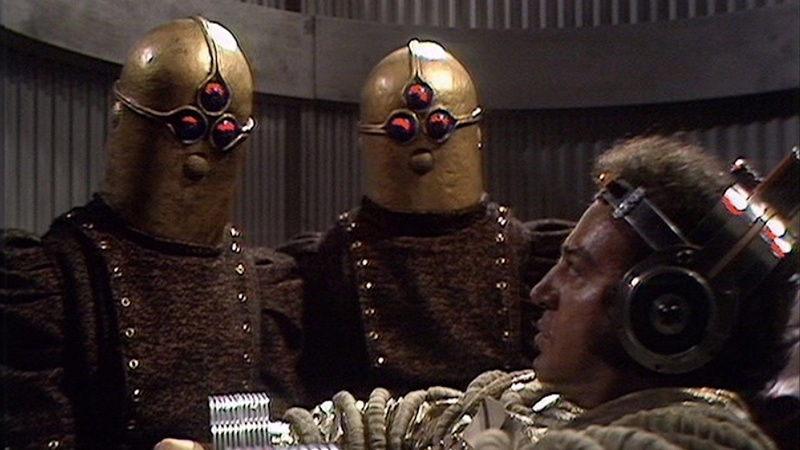
I dunno, they’re making it too political these days, aren’t they? Making all the villains capitalists, and all the companions have to be “woke” and empowered. I prefer the good old days, when the Doctor and his cheerfully murderous friends landed on a planet owned by a mining corporation so rapacious they taxed their workers for dying. In this week’s exciting adventure, the Doctor misquotes Marx and encourages an oppressed proletariat to throw the head tax collector off the top of a skyscraper. Terrance Dicks, in the Target novelisation, walks this back a bit and has the rebels worrying that they’ve gone too far. If that was in the script, it doesn’t come across on film.
The oft-cited fact that Robert Holmes turned in his final draft of this script after receiving a particularly punishing letter from Inland Revenue has overshadowed a lot of what it’s about. Yes, it’s about unfair taxation, but not in the Grover Norquist sulky boot-stomping way (oh, isn’t it awful that we force billionaires to pay for roads?). While this kind of sociopathic selfishness wasn’t yet Conservative dogma in the late ’70s, it did exist – if Holmes had wanted to create a right-wing anti-government screed he could have made the oppressed classes resemble, say, Rod Stewart, then talking to every press outlet he could find about how Chancellor Denis Healey had forced him into exile. (In fairness to this reading, the main villain, Henry Woolf’s nameless Collector, does have very Healey-esque eyebrows) Instead they’re miners, and the society they live in is drawn to resemble the ‘company towns’ that proliferated in the nineteenth and early twentieth centuries. The company towns enjoyed an unethical level of control over their workers because they were closed systems, issuing wages in currency that could be spent nowhere outside the town. The Sun Makers‘s Plutonian colony goes one step further by becoming a closed thermodynamic system, with a series of artificial suns ensuring the Company’s slaves always have daylight to work in.
It’s a wonderful, nasty idea, and it gets worked into the story in a variety of gratifyingly subtle ways. The Company cement their tackiness by appropriating Aztec sun motifs for their joyless, culture-deficient offices and clothes, and the constant daylight eventually gets just as uncanny as the moody night shoots on Holmes’s last serial, The Talons of Weng-Chiang. As in Weng-Chiang, Holmes can’t be bothered to have the Doctor disapprove of Leela’s tendency towards violence, and once again it kind of works: the Company’s planet is such a scabrously drawn cartoon universe that we don’t feel the instinctive frisson of wrongness when one of our heroes picks up a gun. Weng-Chiang‘s less forgivable flaw, racial stereotyping, also rears its unfortunate head at the end, where after successfully walking the tightrope for four episodes the depiction of the Collector tips carelessly into antisemitic tropes, a shift heralded by the revelation that he is from the planet – oh dear – Usurius.
That aside, this is an engaging mix of unexpectedly blatant political satire and solid Doctor Who basics. Normally, scripts by an outgoing script editor feel like cosy valedictions – Terrance Dicks’s Robot, most obviously – but the protean Holmes proves unsurprisingly capable of adapting himself to Graham Williams and Anthony Read’s new concept of a witty, literate show with a revolutionary hero. Indeed, it might be that Holmes has worked it out before Williams and Read have. Over the next two years, the show would struggle to crack the nut of making this week’s band of rebels as dramatically interesting as the Doctor, his companion and the colourful villains. Unlike Douglas Adams in The Pirate Planet, Holmes doesn’t mock his rebel group, exactly, but he does have Leela establish her authority by wiping the floor with them. It’s the kind of lovingly choreographed fight scene normally associated with Jon Pertwee, making it abundantly clear why this is Louise Jameson’s favourite story.
As with a lot of the stories in this season – including the two either side of it – there is a rather throwaway mention of the Time Lords that is very far away from the mythic weight Gallifrey usually carries. The Company recognise the Doctor is a Time Lord, but they’re more concerned about his history of subversive activity than his species’ powers and capabilities. Holmes had, of course, demythologised the Time Lords last season, albeit in a way that creates its own counter-myth. Rather than Olympian gods, they were now viciously unscrupulous politicians, which amusingly didn’t change their role in the show all that much. The show hadn’t grasped their potential here yet, and arguably it wouldn’t until the revival series’s Time War mythology.
Next: Underworld (1978)