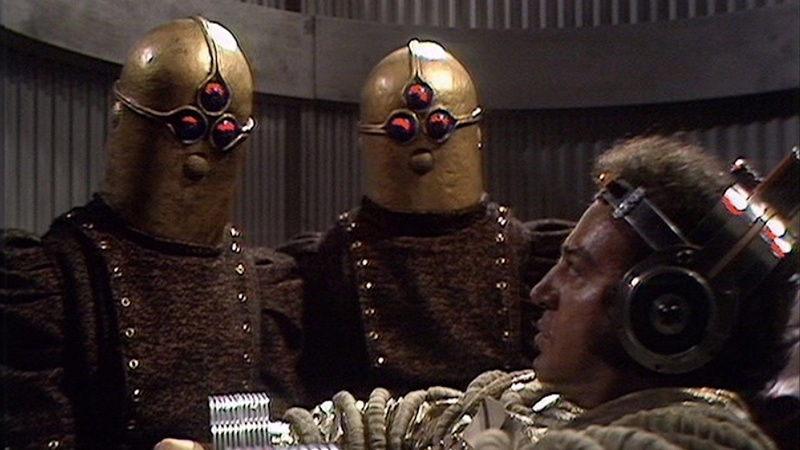
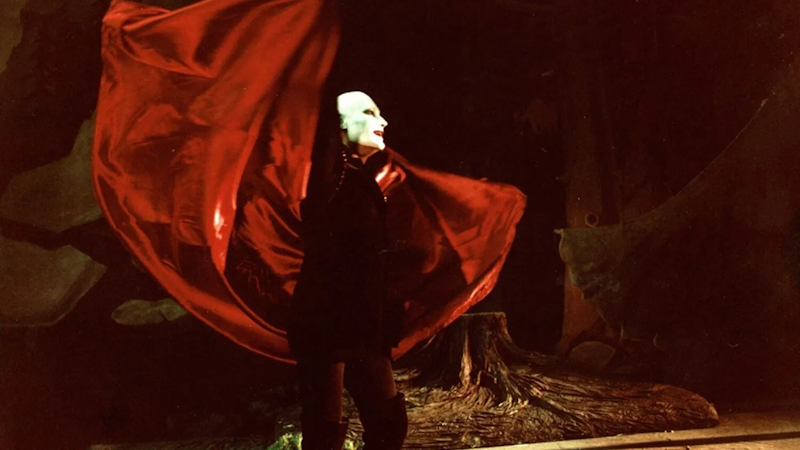
We Doctor Who fans like to pretend we’re a special breed, unswayed by the fancy special effects that buy the affections of other SF and fantasy fans. To some extent this is true. Nobody has ever argued that The Caves of Androzani is not a classic story just because it briefly features a ropey plastic dragon. But what happens when the bad effects aren’t a fleeting ingredient in an otherwise first-rate story, but are front and centre for three of the serial’s four episodes? That’s where you get Underworld.
Underworld was written by Bob Baker and Dave Martin, who’d already earned a reputation for handing in scripts full of unworkably grand concepts. Under an experienced script editor like Terrance Dicks or Robert Holmes, they would get pruned down into something like The Claws of Axos or The Hand of Fear: still extravagant, but just within the boundaries of what the BBC could achieve. Unfortunately, Underworld was the first script that hit the desk of incoming script editor Anthony Read. Realising that a Baker and Martin script was the steepest learning curve imaginable, producer Graham Williams suggested splitting the locations into two groups – spaceships and caves, essentially – and building two large sets that could be redressed in order to save money.
Williams then went on a few days leave and returned to find the spaceship set was already taking the programme over budget. In desperation, he suggested using green-screen for the caves. It’s not unusual for a Doctor Who serial to fail to live up to the promise of its opening episode, but Underworld is the only one where you can pinpoint the exact shot where things go wrong. Early in episode two, a spaceship crashes into a planet, terrifying its subterranean inhabitants. This is realised as a bunch of extras in rags running from one side of the studio to the other in front of a photograph of a model of a cave. This is the first look we’ve got at the story’s second location after an entirely spaceship-bound Part One, and it’s disastrous. There may yet come a day when people look at it and don’t immediately think of the peasants in Monty Python and the Holy Grail, but that day is not today.
If Underworld had built its sets the other way round – if we’d got one episode of bad green-screened spaceship and three episodes of amazing-looking caves – would it be remembered more fondly? Perhaps, although it would still be frustratingly flawed. As soon as the Doctor recognises that he’s on board the Minyan ship, he notes that the race has a fraught history with the Time Lords. The Minyans are essentially dystheists – they regard the Time Lords as gods, but also enemies – and they have a rejuvenation process that doesn’t seem a million miles away from regeneration. All of this seems set up to deliver some major revelations, but it’s quickly forgotten. One of the few constants of Doctor Who is that, whenever Gallifrey is brought into play, it has to be for something that matters, or is at least trying to matter. Doing it to add ballast to a standard run-around feels like cheating. There’s been a fair bit of this happening this season, but mostly it’s been confined to throwaway mentions. This is the one where it most damages the story.
Underworld is a story about myths, but not the series’ own mythos – as noted above, it has very little interest in that. It’s a take on the myth of Jason and the Argonauts, which the Doctor unwisely lampshades at the end. Doctor Who – particularly Tom Baker-era Doctor Who – has never been averse to magpieing other people’s stories, but it normally uses them as a springboard to something else. Underworld seems to think the allusions to classical mythology are interesting in and of themselves. We recognise that Jackson is Jason and the Minyan Race Banks are the Golden Fleece, but Jackson is dull and the Race Banks are a barely-sketched-out MacGuffin, so what’s there to hold our interest once we’ve ticked off the references?
Not much, really. The Minyans are standard military-SF explorers, the subterraneans are Pythonesque peasants and the baddies are just men in black hoods. There is one attention-grabbing performance from Alan Lake, Diana Dors’s tragic third husband, who starred in Sixties cult items like Charlie Bubbles and Catch Us If You Can before his alcoholism and prison sentences derailed his career. (His other role of 1978 was opposite Mary Millington in The Playbirds) Even here, I’m not sure whether it’s notable because of Lake’s brusque hamming or because his Heracles-derived character is called Herrick, which means that whenever someone calls his name – which is often – it sounds like they’re shouting “ERIC!”
There is a fair bit of unintentional humour in Underworld but if you’re looking for things that actually work you’re limited to Tom Baker and Louise Jameson, one of the show’s all-time great pairings, doing their best to elevate the material. Baker’s Doctor makes his entrance in a painter’s smock for no adequate reason, and responds to the question “Who are you to question me?” with “Why, who should I be?” He shouldn’t have to work this hard to make the story entertaining, but in the absence of much to divert in the script it’s welcome.
As for Jameson, we’re at this late stage of Leela’s tenure on Doctor Who where she had more of a grasp on her character than any of the writers did. There’s a charming scene where she gently explains to a cave dweller that other worlds exist, and her uncharacteristic sensitivity surely comes from the fact that she can remember having the Doctor explain this to her. She’s come a long way from the intelligent but uncultured character she was initially, which still shines through in a few moments. It’s not unusual for a companion to have a crush on someone they meet, but it is quite unique for them to scare him off by immediately grabbing and stroking his face.
Next: The Invasion of Time (1978)