The awards success of Gints Zilbalodis’s Flow over the last year has really put the Latvian film industry on the map in a big way, animated entirely through Blender, it’s been called one of the best films of the decade so far and is the highest-grossing Latvian film of all time. It’s no surprise that other Latvian filmmakers are riding the wave of Flow’s success by showing off their talents and ideas, and more power to them. Lauris & Raitis Abele’s Dog of God is completely unique to Flow, however, for a multitude of reasons. The animation was achieved through rotoscoping, it actually has dialogue and a plethora of characters, and, to put it mildly, it’s bloody nuts (literally). Flow was a serene 80 minutes and a really calming watch – Dog of God immediately starts off on a visceral, violent note and does not stop there.
The synopsis is one of those brilliant mad sentences that normally only comes to human beings in dreams – a 17th century village has fallen into disorder and debauchery when a strange man arrives claiming to be a werewolf carrying the Devil’s Balls. Yeah, ten points if you correctly guess what part of this got me sold. And for the first scene at least, the film does not keep you waiting. The tone is set pretty perfectly here in what is probably my favourite moment of the film, if only because it proves that Dog of God is unafraid to be audacious and shocking straight from the get-go.
It’s after this that we cut to the village of Zaube, where the rest of the film takes place, and it’s certainly an interesting location. It’s always a good thing in fantasy and horror when the setting contributes just as much to the atmosphere as the material does, and as day turns to night the mood shifts. A moody but meaningful sermon by a priest lets us know that this village is experiencing hard times, but subsequent scenes reveal the sinful world of sex, gluttony and debauchery that the villagers have immersed themselves in. And let’s just say, unless you’re a fan of Ralph Bakshi (who is still frustratingly on my watchlist) or you’re into particular subsections of anime, chances are this is the most psychedelic, aggressive and sexually-charged imagery you’ve seen in animation.
I’ll just tease you with this: both this and Flow contain black cats, only Flow’s use is considerably more child-friendly.
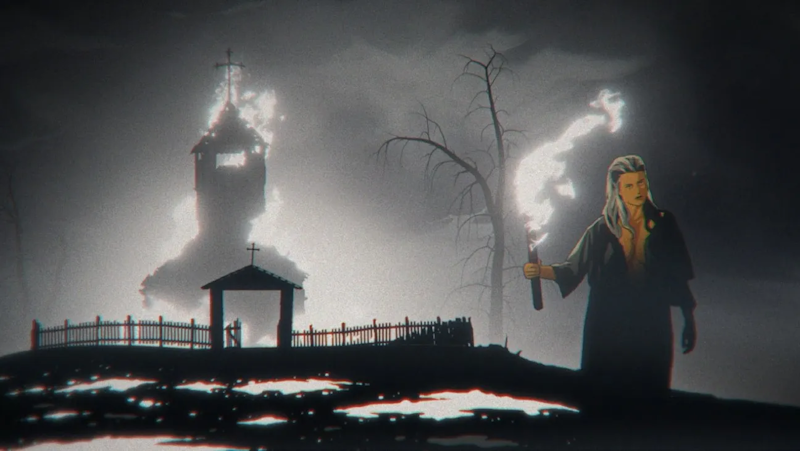

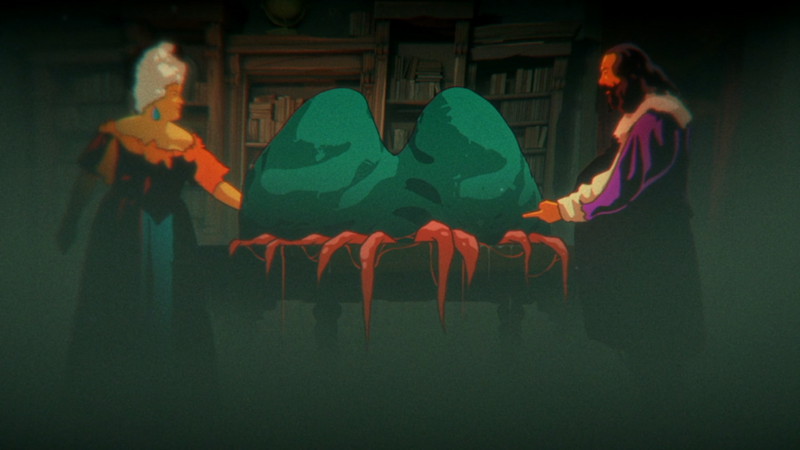
The use of rotoscoping is unique here, as it’s not a particularly popular style of animation, certainly not in Western releases. With the exception of Richard Linklater’s animated works (Waking Life, A Scanner Darkly, etc), the only other example I can think of is the animated Lord Of The Rings by the aforementioned animation legend Ralph Bakshi. While it certainly has its strengths and uses, I don’t think it was the right style of animation for the story here. I get its use in A Scanner Darkly, given that film’s more gritty and realistic look, but the heavily stylised rotoscoping clashes with the fantasy elements and the more extreme acts committed on screen.
Speaking of these extreme acts, while it certainly is interesting to present the moral decline of Zaube in this way, the first act does wear these moments out to the point of tedium. There’s only so many unholy acts of sex and torture I can watch before I go “OK yeah, what’s the actual story here?” The titular Dog of God is a really interesting character – incorporating a different spin on the werewolf, inspired by Latvian folklore – and yet the film misuses its greatest asset by not having the villagers meet him until halfway through.
The design of the Dog of God is really cool, and I love the meanings the name can conjure up. When someone professes themselves to be the Dog of God and they have literally brought you the Devil’s Balls, you can only think of them as a devoted servant. But of course, he is a werewolf, typically seen as an unholy supernatural creature, and claiming to be something of God is of course severely blasphemous. Frustratingly the film does not delve into the moral complications of its titular character as much as I would’ve liked.
Despite the intriguing points of difference that Dog Of God has compared to other works, it also sadly falls into generic tropes every now and then too. In amongst all the grotesque and shocking imagery is a fairly played-out and paint-by-numbers witchcraft accusation story, which wouldn’t feel as cliched as it does if it wasn’t surrounded by an animated film trying its damnedest not to be normal. Again, this would provide the film with a really interesting moral debate: how can this bartender possibly be tried and found guilty of witchcraft, when we know for a fact that the villagers are engaging in far more debauched acts? Quite honestly, witchcraft is the least of this village’s worries. And yet there’s not enough confrontation about these issues for the narrative to feel like it’s achieving anything substantial.
Dog of God is certainly not a film that disappointed me, at least not in a major way. I at least enjoyed the mad avenues it went down and the no-holds-barred attitude to the barking mad actions it was depicting. However, the potential for it to go down even more interesting avenues was right there, and it didn’t, leaving Dog of God to be a maximum-level assault on good taste that annoyingly did the bare minimum.
DOG OF GOD HAD ITS CANADIAN PREMIERE AT THE 2025 EDITION OF FANTASIA INTERNATIONAL FILM FESTIVAL