Horror works when it taps into something primal that you can feel in your bones.
As dramatic as that sounds, it doesn’t need to something hard, deep or physical, it can invoke something mundane, twist it and there we have it – the uncanny. The uncanny is not only where the best modern horror finds itself, Japanese horror operated within that register for its greatest ever era. Kim Soo-jin’s contribution to the corruption of the mundane sees him tap into Hideo Nakata’s Dark Water (2002) via Yoshihiro Nakamura’s under-the-radar The Inerasable (2015), adding a multi-storey block of flats with many people living within close quarters with one another. Effectively living in each other’s pockets, you are exposed to more of your fellow residents than you would perhaps like, and in the case of Lee Je-hui & Kim Yong-hwan’s script – you hear everything. Noise concerns itself with the terror of the inconsiderately noisy neighbour; and living under a flat that bangs all day every day, this one felt personal.
Even if the building has seen better days, Sister’s Joo-young (Lee Sun-bin) & Joo-hee (Han Su-a) have achieved a dream together, home ownership. Unfortunately for the pair, they live underneath the noisiest neighbour imaginable, noises that go deeper and scarier than mere bangs in the night. In the brilliantly malevolent cold open, it’s just Joo-hee who is staying at the flat and she is deep in the middle of a manic, paranoid episode – she has sound recording devices at the go, and has installed specialist sound proofing used in recording studio on their ceiling. We don’t see anything happen to her, we just share in this moment of terrifying menace – after which, she goes missing and Noise cuts to her hard of hearing sister at work, swapping protagonists.
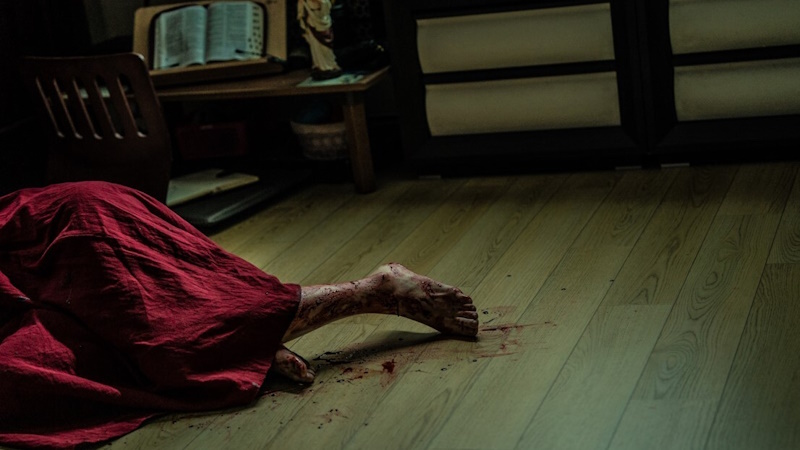
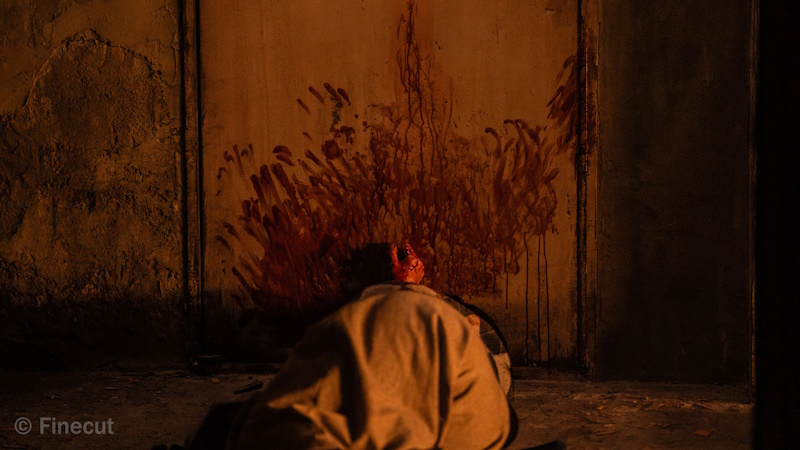
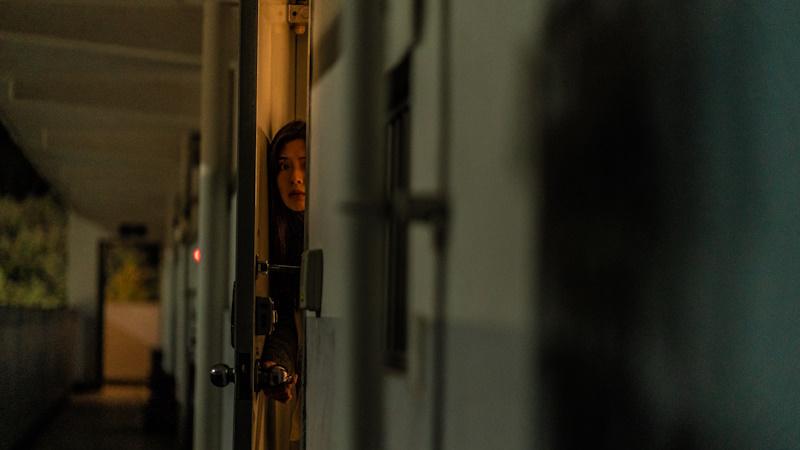
From this point on, Director Kim sinks his teeth into the sort of investigative-horror that was bread and butter for the “J-Horror Boom”. The remaining sister moves into the flat and canvases her neighbours in search for her absent sibling, an avenue that the script takes into the cliques, committees and general low level bureaucratic busybodies that would drive anyone to madness, and that’s before the incessant noise and ghosts.
I referenced The Inerasable earlier as that digs into the curses that cling to land and buildings from generation to generation, and while Noise doesn’t quite travel as far with that concept as the Japanese journeyman director Nakamura did, there is certainly common ground between the two. The building is old, it has seen better days as evidenced by the frankly terrifying amount of waste and detritus that has been dumped in the basement by the staff and building committee, and its in that legacy of generations living in the same places that ghosts are introduced into this story. Ghosts that aren’t necessarily evil, however, as they relive their previous routines, it allows Director Kim to set the stall for some skin-crawling set-pieces. There are two moments that stand out, both of which revolve around Joo-young’s front door: the first involves a neighbour furious with the noise he incorrectly assumes she is making (a situation that escalates to be scary as a real life possibility); the second has a voice coming from beyond her locked front door. Together, alongside the aforementioned, strong, cold open, these instances show that director Kim has a real gift for staging, blocking and putting together memorable sequences. The vast basement full of waste, memories and errant noise is further proof of that ability from the debuting director.
Here comes that fatal but…
When Noise is engaging in the mania of its put upon players and playing up the idea that this mammoth structure is impossibly haunted, it’s a banner item for Korean horror movies in 2025. But when it goes into the explanation of why there are so many ghosts, peering behind the velvet rope by offering some exposition and backstory, it loses its lustre. And this at its most problematic for the production with the ending as it takes the darkness holding sway, hiding in this high-rises countless homes and pivots to something more corporeal and stabby – it ends on a not particularly convincing twist. Sure, it’s not the most egregious of endings – even within Korean Horror – but that’s of little consolation. As many people have remarked, it’s how you leave the audience that matters most. So no matter how good Noise is up until that point, the final 10 minutes deflate the insidiousness at play, downgrading it from a potential modern classic into something very good, but far less vital.
NOISE HAD ITS NORTH AMERICAN PREMIERE AT FANTASIA INTERNATIONAL FILM FESTIVAL 2025