When asked about the possibility of a multi-Doctor story, Jodie Whittaker has always expressed a desire to see her Thirteenth Doctor team up with the Ninth, as played by Christopher Eccleston. For his part, Eccleston has said that “The father of us all is William Hartnell, but the greatest Doctor is Jodie Whittaker.” This love-in has naturally excited many fans, specifically as both actors are now breathing new life into their Doctors with Big Finish. It’s sparked hopes that they will get the chance to team up in the future. However, you don’t need to wait to see these two true northern powerhouses share the stage, you just need to check out the National Theatre’s adaptation of Antigone by Sophocles from 2012.
It is my view that good theatre should reflect the world outside, the issues happening right now. Whilst there will always be a universal truth to Sophocles’s play, a tragedy which dares to explore our freedoms and asks whether the personal obligation an individual feels trumps the expectation of society and its law for individuals to conform, it was nonetheless written in 441BC – it needs an update of sorts to remain relevant to whatever audience is witnessing it.
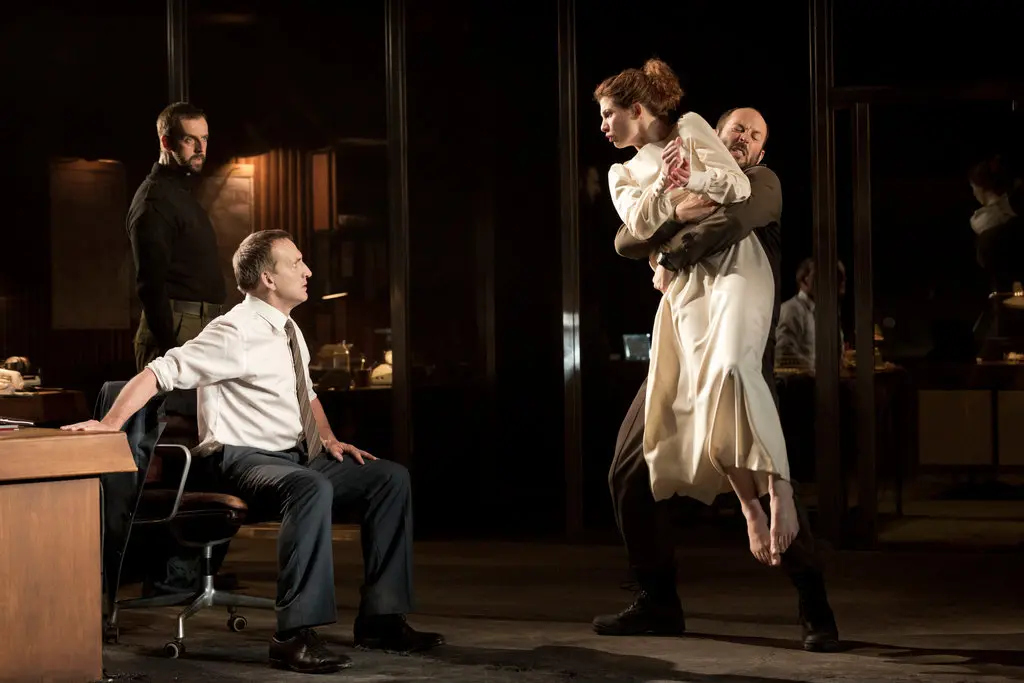
Using Don Taylor’s 1986 translation of the play first used by the BBC, Polly Findlay’s 2012 production definitely does this and audiences are left in no doubt that what they are witnessing, from the opening moments, is a reflection of contemporary events in a post 9/11, ‘War on Terror’ world. Right from the off, audiences are greeted with a tableau with unmistakable parallels to the death of Osama Bin Laden, as witnessed in the White House’s situation room, just a year earlier. Christopher Eccleston’s Creon is surrounded by his fellow cast members, huddled around a TV screen, their features traversing conflicting emotions of shock and repulsion, victory and relief, as an enemy of the state is assassinated in a military raid. Here, Polynices, one of Antigone’s two fallen brothers, is promptly condemned as a terrorist threat whose body, Creon decrees in his inauguration speech, must lie unburied upon the battlefield, unsanctified and refused holy rites. Determined to do right by her dead brother, Antigone, played with an astonishing single-minded purposefulness by Jodie Whittaker, defies the will of her head of state, thus becoming in his eyes, a dangerous subversive who must be punished.
Taylor’s adaptation is brief (at just 90 minutes) and not without humour, which certainly comes as a relief to audiences, as these are weighty themes indeed.

ANTIGONE CAN BE WATCHED ON NATIONAL THEATRE LIVE
An issue with updating such a play for modern audiences is that the natural sympathy regarding the narrative’s complexities as first performed is perhaps now lost. It’s easier perhaps to sympathise with Antigone than Creon today, because notions of the state do not possess the unflinching loyalty they once did – and rightly so. Not for modern audiences a belief that country must come before one’s own family. As a result, Antigone becomes less of the defiant martyr that Sophocles perhaps originally intended and the characterisation of Creon must receive greater nuance. Taylor’s adaptation, combined with Eccleston’s impressive performance, delivers a leader out of step with the modern world around him. Like our own political leaders, he has been raised with the notion that he is born to rule and his belief in the inalienability of his position and what he represents is unwavering – that is his tragedy.
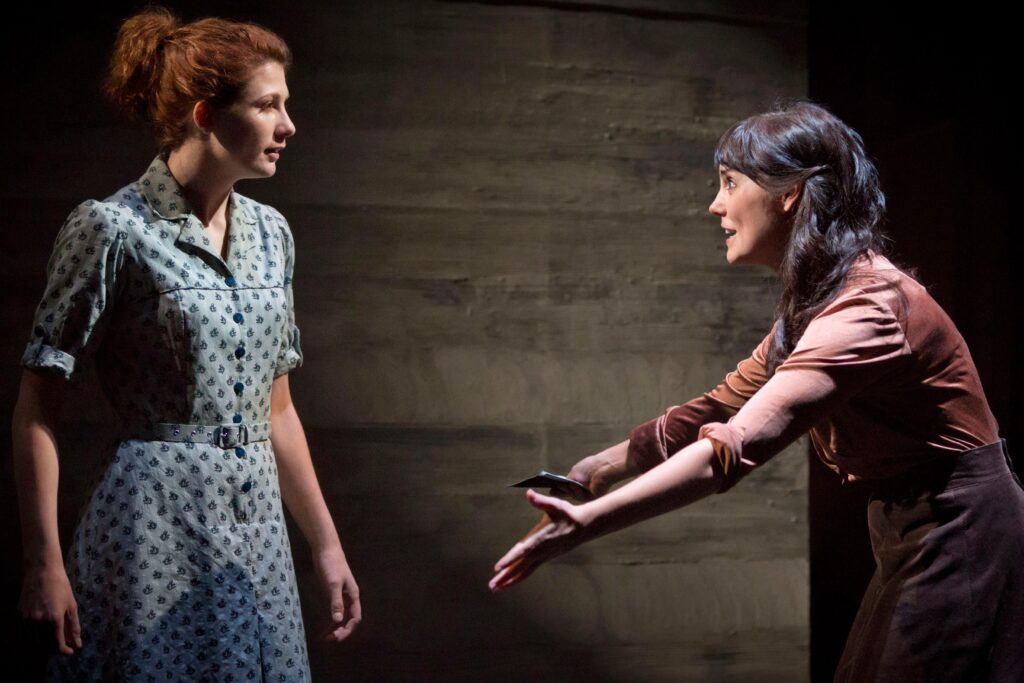
I really enjoyed the look of this production too. It perhaps rightly did not place us in some mock White House, with set designer Soutra Gilmour preferring instead to depict a government that owes more to a Banana Republic of the Cold War ’60s, with its decidedly analogue technology and trimphones, notebooks, blotters and pencils. Likewise the costume design suggests a bygone era with Creon’s perfunctory grey suits and Antigone’s modest, shabby floral dress. The sound design by Dan Jones is also impressive, even working well enough at half its power on screen. Taylor’s adaptation is brief (at just 90 minutes) and not without humour, which certainly comes as a relief to audiences, as these are weighty themes indeed. I just wish that something was made of the play’s inherent and perpetual problem: why did Antigone conduct a second burial of her brother? Theories including that her sister Ismene who performed the first and evaded capture (meaning her confession later is not false at all), that the gods did it, that Antigone is doomed from tragic obsession to go on repeating her actions, or that she’d simply mucked up the first burial, have all been brought forward over the years and Taylor refuses to commit to one theory, perhaps leaving it to audiences – and indeed, the cast – to make up their own minds instead.
Whittaker and Eccleston’s appearances here aren’t the only connection to Doctor Who either. Look at one of the young actors in the Chorus – it’s Alfred Enoch, son of William Russell, one of Doctor Who‘s original cast members. For my money, Enoch would make for a good Doctor one day too.