
Now here’s something I never had on my bingo card with the emergence of Arrow Video’s new specialist sub-brand Toy Robot Video. Back in the halcyon days of literal home video (VHS) and DVD, before you got to your chosen feature you’d be treated to a reel of trailers for other upcoming or available features. In these days of immediate gratification, this may seem wasteful, but personally this nostalgia feels like a warm embrace from simpler times. On Toy Robot’s release of Junya Satō’s Manhunt, we are treated to trailers for Roaring Fire (directed by Noribumi Suzuki and starring Hiroyuki Sanada) and Johnnie To’s Exiled, two future releases to get excited about. And for me, it recalls part of the puzzle of what made Hong Kong Legends and Tartan Asian Extreme so iconic.
Featuring one of the biggest actors of the time, Satō’s Manhunt stars Ken Takakura as Morioka, a legal prosecutor who has the tables turned on him when two people implicate him as a thief. It’s fair to say that the full weight of the Japanese legal system comes down on him. Insisting on his innocence despite the evidence piling up against him, Morioka has no choice but to go on the run. Not long after he does, it is revealed that the pair who implicated him are married, and the wife (Mitsuko Baisho) is found dead just days later, and her husband (Kunie Tanaka) disappears off the face of the earth. Events that conspire against Morioka and his pleas of innocence, so on the run across Japan he goes. Along the way he meets Mayumi (Ryoko Nakano), who he saves from a bear, and is pursued by the dogged, hard-boiled Detective Yamura (Yoshio Harada), all as part of a plot that grows far larger than a missing camera, a few thousand yen and a diamond ring.
I have to circle back around to that bear comment, because on the face of things, Manhunt is an adaptation of a novel about political corruption by Jukō Nishimura, but underneath it has odd flavourings. Lost and without any bearings in the endless Japanese countryside, Morioka happens upon Mayumi in the greenery of a tree, clinging on for dear life and screaming for help, as a bear (a guy in a suit) lingers feet below with a lust for blood. There are three interactions with the wandering ursid, and I have to describe them as hilarious. Obviously they can’t use a real bear, but the suit they are using makes each of these violent altercations so absurd that they become very funny to modern eyes, almost Hundreds of Beavers-esque. They aren’t meant as funny, as one of those instances nearly results in the death of Yamura, especially with the tone otherwise being that of a politically inclined man-on-the-run movie starring one of the biggest superstars of Japanese cinema at the time.

“As critical as this may be, these peaks and valleys do little to dull the fun I had with Manhunt (and not all of that can be counted up to that bear outfit)”.
CLICK THE POSTER AT THE BOTTOM OF THE REVIEW TO BUY MANHUNT DIRECT FROM TOY ROBOT VIDEO
Another fascinating wrinkle is the sexual politics. During the mid 1960s and 70s, Japanese cinema was rampant with attempts to court younger viewers, an effort that gave birth to all manner of sexualised styles and sub-genres. In the case of Manhunt, it evokes the Yakuza movies that made irredeemable scumbags into icons of lust, where the female cast became weak-kneed at the abusive gangster bad boys regardless of how they were treated. Manhunt feels like it has a little contrariness at the time at play, stacking against the likes of the Battles Without Honor and Humanity saga or the Outlaw VIP movies. The characters and actors are shared between movies, but here we have female characters with some degree of agency, to the extent that Mayumi saves both Yamura and Morioka. If you ignore the bear-scapades, there’s a deceptive modern streak to Manhunt. Of course, the opposite is true too, what with it giving a lot of time to Takakura and Harada to smoulder in their heroic manliness and a scene of questionable frontal nudity.
You can never accuse a politically inclined man-on-the-run movie of being fun, but Manhunt is. These movies are often more interested in the political intrigue to stop for long enough to have fun. Unfortunately, here comes the overriding bugbear that makes Satō’s movie a very hard one to recommend: it’s two and a half hours long, despite only really having the material for 100 minutes. There are great moments of drama and tension throughout, such as the original escape by Morioka, the episodes with Mayumi and the bear, the escape by plane (even though Morioka can’t fly), the moral arc of Mayumi’s dad and political campaigner Yoshinori (Hideji Ōtaki), and the whole section that starts with horses barrelling through the streets of Shinjuku and ends with the climactic plot in a hospital all up to an ending that does its best to unnecessarily muddy matters. Outside of that, Manhunt struggles to find footing especially with how long it takes to reveal its secrets. We are fundamentally talking about a movie that regularly fires on all cylinders only to run out of air moments later. For a director whose body of work includes The Bullet Train, Yamato and Golgo 13, this can come as no surprise as his style isn’t wholly suited to more deliberately paced pieces. Rather, he’s suited to manly spectacle, which is an incredibly hard thing to maintain in a two-and-a-half-hour man-on-the-run movie. Yet, as critical as this may be, these peaks and valleys do little to dull the fun to be had with Manhunt (and not all of that can be counted up to that bear outfit).
The extras impress. Typically, Asian movies that are 50 years old aren’t privy to the sort of lavish treatment that younger films are, but Toy Robot have done a stellar job at breathing life anew into Satō’s movie. The 2023 print on the Blu-ray sees the movie look fresh as a daisy without removing the imperfections that give it age and character. Elsewhere, we have a new audio commentary by Jasper Sharp and Amber T, a new introduction from Japanese film specialist Mark Schilling (Man on the Run), and a new discussion of the movie and its production by Junya Satō biographers Masaaki Nomura and Tatsuya Masuto. There are also two new on-disc text essays from James Marsh and Earl Jackson, which is new (or, to return to those nostalgia trailers as the disc loads, very nostalgic). All in all, ups and downs aside, this is a great addition to the collection of Japanese film fans that shows a generational icon like Ken Takakura in a more exposed and refreshing light.
MANHUNT IS OUT NOW ON TOY ROBOT VIDEO
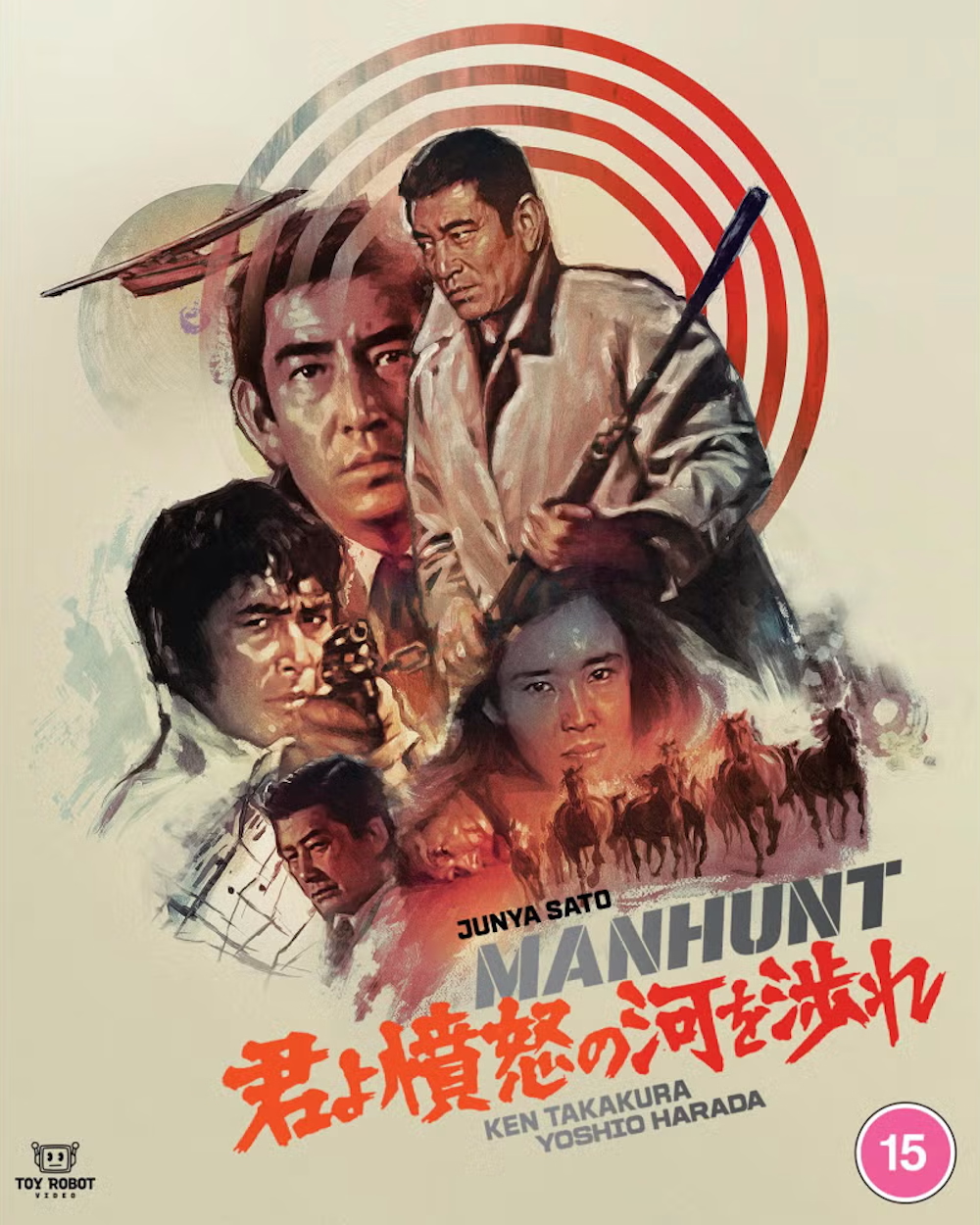
ROB’S ARCHIVE – MANHUNT
Discover more from The Geek Show
Subscribe to get the latest posts sent to your email.


